

sharon sanders
Editor-in-Chief & President
Nature: Limited Airborne Transmission Of H7N9 Between Ferrets
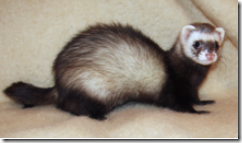
Photo Credit Wikipedia
# 7556
Yesterday?s report on Omani camels carrying antibodies to the MERS Coronavirus (see Lancet: Camels Found With Antibodies To MERS-CoV-Like Virus) pretty much dominated the headlines in the flu world, but another study deserving our attention appeared in the Journal Nature as well.
Researchers from the Erasmus Medical Center in the Netherlands University of Cambridge in the United Kingdom infected four ferrets with the Anhui/1/2013 strain of H7N9, and then placed uninfected ferrets in cages next to them.
Three of the four unexposed ferrets became infected, demonstrating limited airborne transmission (efficiency estimated somewhere between that of seasonal flu and avian flu). Genetic sequencing showed the virus they carried to be identical to the original test virus.
The link to the Nature Abstract follows:
While laboratory experiments have consistently shown the H7N9 virus can transmit reasonably well from ferret-to-ferret via direct contact or respiratory droplet, thus far the Chinese have reported no signs of sustained human-to-human transmission in the field.
The reasons behind this disparity, and whether this apparent lack of transmissibility in humans will continue, are among the many questions on the list of researchers studying the virus.
Posted by Michael Coston at <a class="timestamp-link" href="http://afludiary.blogspot.com/2013/08/nature-limited-airborne-transmission-of.html" rel="bookmark" title="permanent link"><abbr class="published" title="2013-08-09T08:23:00-04:00">8:23 AM</abbr>
Photo Credit Wikipedia
# 7556
Yesterday?s report on Omani camels carrying antibodies to the MERS Coronavirus (see Lancet: Camels Found With Antibodies To MERS-CoV-Like Virus) pretty much dominated the headlines in the flu world, but another study deserving our attention appeared in the Journal Nature as well.
Researchers from the Erasmus Medical Center in the Netherlands University of Cambridge in the United Kingdom infected four ferrets with the Anhui/1/2013 strain of H7N9, and then placed uninfected ferrets in cages next to them.
Three of the four unexposed ferrets became infected, demonstrating limited airborne transmission (efficiency estimated somewhere between that of seasonal flu and avian flu). Genetic sequencing showed the virus they carried to be identical to the original test virus.
These researchers did find that after ferret passage, variants with preferential binding to avian (a2,3) receptor cells, higher pH of fusion, and lower thermostability were selected, which potentially could reduce ongoing transmissibility of the virus in mammals.
Overall, these findings are similar to other ferret transmissibility studies we?ve seen published over the summer (see Science: H7N9 Transmissibility Study In Ferrets).
The link to the Nature Abstract follows:
Limited airborne transmission of H7N9 influenza A virus between ferrets
Mathilde Richard, Eefje J. A. Schrauwen, Miranda de Graaf, Theo M. Bestebroer, Monique I. J. Spronken, Sander van Boheemen, Dennis de Meulder, Pascal Lexmond, Martin Linster, Sander Herfst, Derek J. Smith, Judith M. van den Brand, David F. Burke, Thijs Kuiken, Guus F. Rimmelzwaan, Albert D. M. E. Osterhaus & Ron A. M. Fouchier
ABSTRACT (Excerpt)
Here we show that although the A/Anhui/1/2013 A(H7N9) virus harbours determinants associated with human adaptation and transmissibility between mammals, its airborne transmissibility in ferrets is limited, and it is intermediate between that of typical human and avian influenza viruses. Multiple A(H7N9) virus genetic variants were transmitted.
Upon ferret passage, variants with higher avian receptor binding, higher pH of fusion, and lower thermostability were selected, potentially resulting in reduced transmissibility. This A(H7N9) virus outbreak highlights the need for increased understanding of the determinants of efficient airborne transmission of avian influenza viruses between mammals.
Mathilde Richard, Eefje J. A. Schrauwen, Miranda de Graaf, Theo M. Bestebroer, Monique I. J. Spronken, Sander van Boheemen, Dennis de Meulder, Pascal Lexmond, Martin Linster, Sander Herfst, Derek J. Smith, Judith M. van den Brand, David F. Burke, Thijs Kuiken, Guus F. Rimmelzwaan, Albert D. M. E. Osterhaus & Ron A. M. Fouchier
ABSTRACT (Excerpt)
Here we show that although the A/Anhui/1/2013 A(H7N9) virus harbours determinants associated with human adaptation and transmissibility between mammals, its airborne transmissibility in ferrets is limited, and it is intermediate between that of typical human and avian influenza viruses. Multiple A(H7N9) virus genetic variants were transmitted.
Upon ferret passage, variants with higher avian receptor binding, higher pH of fusion, and lower thermostability were selected, potentially resulting in reduced transmissibility. This A(H7N9) virus outbreak highlights the need for increased understanding of the determinants of efficient airborne transmission of avian influenza viruses between mammals.
While laboratory experiments have consistently shown the H7N9 virus can transmit reasonably well from ferret-to-ferret via direct contact or respiratory droplet, thus far the Chinese have reported no signs of sustained human-to-human transmission in the field.
The reasons behind this disparity, and whether this apparent lack of transmissibility in humans will continue, are among the many questions on the list of researchers studying the virus.
Posted by Michael Coston at <a class="timestamp-link" href="http://afludiary.blogspot.com/2013/08/nature-limited-airborne-transmission-of.html" rel="bookmark" title="permanent link"><abbr class="published" title="2013-08-09T08:23:00-04:00">8:23 AM</abbr>