sharon sanders
Editor-in-Chief & President
FEMA: National Hurricane Preparedness Week
# 3246
New readers may wonder why an infectious disease blog would take time out to discuss other threats, like tornadoes, earthquakes . . . or in this case, Hurricanes.
There are several reasons.
First, I began writing about hurricanes long before I started this blog on infectious diseases. In fact, my first writing about avian flu (back in early 2005) appeared on some of the Hurricane boards.
Second, as my banner proclaims (`with an emphasis on personal and community preparedness?) this is a preparedness website, that happens to focus most of the time on infectious disease threats.
Hurricanes, like pandemics, are a force to be reckoned with.
If you don?t live in a Hurricane zone (and being inland 100 miles is no guarantee you won?t be affected), you undoubtedly do live someplace that is vulnerable to other threats.
Here is some sage advice from FEMA (Federal Emergency Management Agency) on some of those threats.
<embed src="http://www.youtube.com/v/bozos_hz5pg&hl=en" type="application/x-shockwave-flash" height="288" width="385"></object>
Here is FEMA?s 2009 Hurricane preparedness advice. Follow the link to access the entire page.
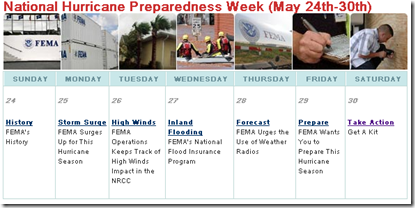
(Calendar of Events ? Click to access)
FEMA: Better Prepared for 2009 and Continuing To Move Forward
# 3246
New readers may wonder why an infectious disease blog would take time out to discuss other threats, like tornadoes, earthquakes . . . or in this case, Hurricanes.
There are several reasons.
First, I began writing about hurricanes long before I started this blog on infectious diseases. In fact, my first writing about avian flu (back in early 2005) appeared on some of the Hurricane boards.
Second, as my banner proclaims (`with an emphasis on personal and community preparedness?) this is a preparedness website, that happens to focus most of the time on infectious disease threats.
If you are well prepared for a pandemic, you are also well prepared for a hurricane, earthquake, or any other disaster.
And third, as native Floridian, I?ve been through my share of hurricanes (although never in the heart of a CAT 4 or 5 monster), and I?ve seen first hand the destructive power of these storms.
Hurricanes, like pandemics, are a force to be reckoned with.
If you don?t live in a Hurricane zone (and being inland 100 miles is no guarantee you won?t be affected), you undoubtedly do live someplace that is vulnerable to other threats.
Here is some sage advice from FEMA (Federal Emergency Management Agency) on some of those threats.
General preparedness should be a goal, and a mindset, for every family.
<object height="288" width="385">
<embed src="http://www.youtube.com/v/bozos_hz5pg&hl=en" type="application/x-shockwave-flash" height="288" width="385"></object>
Here is FEMA?s 2009 Hurricane preparedness advice. Follow the link to access the entire page.
Hurricane Season 09

With hurricane season starting on June 1st, FEMA is urging residents to be prepared for their personal safety and survival in case a hurricane threatens their community. To assist in these efforts, FEMA, along with the National Oceanic and Atmospheric Administration, is helping to raise awareness of steps that can be taken to help protect citizens, their communities and property.
With hurricane season starting on June 1st, FEMA is urging residents to be prepared for their personal safety and survival in case a hurricane threatens their community. To assist in these efforts, FEMA, along with the National Oceanic and Atmospheric Administration, is helping to raise awareness of steps that can be taken to help protect citizens, their communities and property.
(Calendar of Events ? Click to access)
FEMA: Better Prepared for 2009 and Continuing To Move Forward
- FEMA Preparedness Overview (PDF 102KB, TXT 19KB)
- The Declaration Process (PDF 28KB, TXT 6KB)
- Urban Search & Rescue (PDF 27KB, TXT 3KB)
- Disaster Emergency Communications (PDF 21KB, TXT 3KB)
- Mobile Emergency Response Support (PDF 25KB, TXT 3KB)
- Incident Management Assistance Teams (PDF 21KB, TXT 3KB)
- Disaster Operations Directorate (PDF 24KB, TXT 6KB)
- Logistics Management Directorate (PDF 36KB, TXT 9KB)
- National Flood Insurance Program (PDF 24KB, TXT 6KB)
- Use of Social Media Tools (PDF 35KB, TXT 12KB)