

sharon sanders
Editor-in-Chief & President
Japan: Govt. Call To Close The Hamaoka Nuclear Facility
# 5541
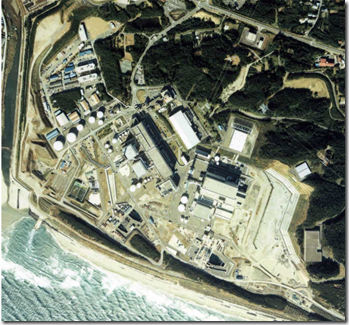
Aerial Photograph of Hamaoka Nuclear power plant at Shizuoka(JAPAN) in 1988. ? Wikipedia
Today Prime Minister Kan of Japan is calling upon Chubu Electric to shut down its No. 4 and No. 5 reactors at the Hamaoka nuclear plant located roughly 200 km south-west of Tokyo.
This from Reuters this morning.
Although reportedly engineered to withstand an 8.5 magnitude earthquake, the Hamaoka facility is located in an area that is susceptible to quakes of that size or greater, and that is considered `overdue? for another.
I wrote briefly about the concerns over the Hamaoka facility on April 9th in a blog called Divining Japan?s Seismic Future. An excerpt follows:
Although there are five reactors at the Hamaoka facility, #1 & #2 were decommissioned in January of 2009 due to their age and the costs of upgrading.
Of the three remaining reactors, #3 has been shut down for maintenance since last November, and #4 & #5 are currently operating.
Reactor #3 was scheduled to be restarted later this summer, but after the Fukushima earthquake/tsunami crisis there have been renewed calls to shut down the facility.
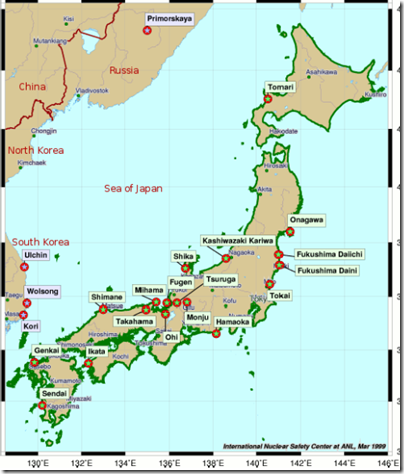
Source ? Wikipedia
There are currently more than 50 nuclear power reactors in Japan either in operation or under construction.
# 5541
Aerial Photograph of Hamaoka Nuclear power plant at Shizuoka(JAPAN) in 1988. ? Wikipedia
Today Prime Minister Kan of Japan is calling upon Chubu Electric to shut down its No. 4 and No. 5 reactors at the Hamaoka nuclear plant located roughly 200 km south-west of Tokyo.
This from Reuters this morning.
Japan PM to ask Chubu to halt all ops at Hamaoka nuclear plant
06 May 2011 10:19
Source: reuters // Reuters
TOKYO, May 6 (Reuters) - Japanese Prime Minister Naoto Kan said on Friday he will ask Chubu Electric Power Co to halt all operations at its Hamaoka nuclear plant in central Japan.
(Continue . . . )
This move comes as Japan makes changes to their nuclear safety regulations in the wake of the ongoing Fukushima nuclear disaster. 06 May 2011 10:19
Source: reuters // Reuters
TOKYO, May 6 (Reuters) - Japanese Prime Minister Naoto Kan said on Friday he will ask Chubu Electric Power Co to halt all operations at its Hamaoka nuclear plant in central Japan.
(Continue . . . )
Although reportedly engineered to withstand an 8.5 magnitude earthquake, the Hamaoka facility is located in an area that is susceptible to quakes of that size or greater, and that is considered `overdue? for another.
I wrote briefly about the concerns over the Hamaoka facility on April 9th in a blog called Divining Japan?s Seismic Future. An excerpt follows:
The most widely anticipated seismic event is the Tokai Earthquake ? expected to be an 8+ magnitude, and forecast to occur between the Bay of Suruga and Cape Omasezaki in Shizuoka Prefecture sometime in the near future.
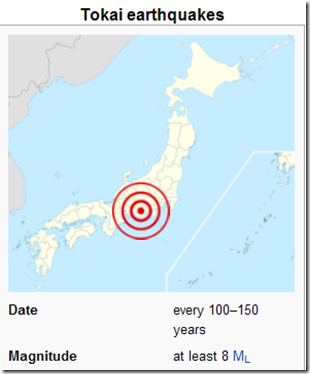
Major earthquakes have occurred in this region every 100-150 years, with the most recent recorded in 1498, 1605, 1707 and 1854.
That puts the Tokai region 157 years since their last major quake, and in the estimation of Dr Kiyoo Mogi ? Japan?s leading seismologist ? well overdue for another. In 1969, Dr Mogi began warning that the Tokai area was particularly vulnerable, and today the area is monitored continually by the JMA.
<Snip>
Somewhat presciently Dr. Mogi raises the issue of nuclear power plants located near the focal regions of shallow earthquakes in Japan, although he expresses greatest concern over the Hamaoka nuclear power plants that are located in the Tokai region.
Major earthquakes have occurred in this region every 100-150 years, with the most recent recorded in 1498, 1605, 1707 and 1854.
That puts the Tokai region 157 years since their last major quake, and in the estimation of Dr Kiyoo Mogi ? Japan?s leading seismologist ? well overdue for another. In 1969, Dr Mogi began warning that the Tokai area was particularly vulnerable, and today the area is monitored continually by the JMA.
<Snip>
Somewhat presciently Dr. Mogi raises the issue of nuclear power plants located near the focal regions of shallow earthquakes in Japan, although he expresses greatest concern over the Hamaoka nuclear power plants that are located in the Tokai region.
Although there are five reactors at the Hamaoka facility, #1 & #2 were decommissioned in January of 2009 due to their age and the costs of upgrading.
Of the three remaining reactors, #3 has been shut down for maintenance since last November, and #4 & #5 are currently operating.
Reactor #3 was scheduled to be restarted later this summer, but after the Fukushima earthquake/tsunami crisis there have been renewed calls to shut down the facility.
Source ? Wikipedia
There are currently more than 50 nuclear power reactors in Japan either in operation or under construction.
Since Japan is located in a seismically active region of the world, many of these reactors are built in areas at risk of earthquakes and/or tsunamis.
While all of these reactors are built to withstand `reasonably worst case? earthquake and tsunami scenarios, the events of last March 11th show that sometimes those parameters can be exceeded by a wide margin.
Which means that Japan - which depends on nuclear energy to provide nearly 30% of their power needs ? may face additional tough choices regarding the future of their nuclear power program in the months ahead.While all of these reactors are built to withstand `reasonably worst case? earthquake and tsunami scenarios, the events of last March 11th show that sometimes those parameters can be exceeded by a wide margin.
