• FluTrackers.com Inc. does not provide medical advice. Information on this web site is collected from various internet resources, and the FluTrackers board of directors makes no warranty to the safety, efficacy, correctness or completeness of the information posted on this site by any author or poster. The information collated here is for instructional and/or discussion purposes only and is NOT intended to diagnose or treat any disease, illness, or other medical condition. Every individual reader or poster should seek advice from their personal physician/healthcare practitioner before considering or using any interventions that are discussed on this website. By continuing to access this website you agree to consult your personal physican before using any interventions posted on this website, and you agree to hold harmless FluTrackers.com Inc., the board of directors, the members, and all authors and posters for any effects from use of any medication, supplement, vitamin or other substance, device, intervention, etc. mentioned in posts on this website, or other internet venues referenced in posts on this website.
  • We are not asking for any donations. Do not donate to any entity who says they are raising funds for us.

AFD - Health Care Workers Issues

sharon sanders

Editor-in-Chief & President
EID: Virus Transfer During PPE Removal


# 2102


http://afludiary.blogspot.com/


Health care workers are no doubt aware that they must follow a strict procedure when removing PPE's ( Personal Protective Equipment; gloves, gowns, mask, goggles) after having contact with an infectious patient.


There is, after all, the possibility of contaminating oneself taking off this gear.


That's why there are specific protocols established for PPE removal, as is shown in the CDC poster below.


Researchers at the University of North Carolina Chapel Hill, North Carolina and the Wake County Human Services, Raleigh, North Carolina have recently published a study in the CDC's Journal of Emerging Infectious Diseases that seriously calls into question the effectiveness of these protocols.


The link to the study is:


Casanova L, Alfano-Sobsey E, Rutala WA, Weber DJ, Sobsey M. Virus transfer from personal protective equipment to healthcare employees? skin and clothing. Emerg Infect Dis. 2008 Aug; [Epub ahead of print]


The rationale for this study (slightly reformatted for readability) is given below, followed by some discussion.


We evaluated a personal protective equipment removal protocol designed to minimize wearer contamination with pathogens. Following this protocol often resulted in virus transfer to hands and clothing. An altered protocol or other measures are needed to prevent healthcare worker contamination.


Caring for patients with communicable diseases places healthcare workers (HCWs) at risk. Infected HCWs may not only incur serious illness or death themselves but may spread infection to others. Methods to prevent HCW infections include vaccination (1), hand hygiene (2), and isolation of patients with communicable diseases (3).


A key aspect of patient isolation is proper use of personal protective equipment (PPE) to protect HCWs from pathogen exposure during patient care. PPE includes use of barriers (gowns, gloves, eye shields) and respiratory protection (masks, respirators) to protect mucous membranes, airways, skin, and clothing from contact with infectious agents (3).


The importance of PPE was underscored in the recent outbreak of severe acute respiratory syndrome (SARS). HCWs accounted for ≈20% of cases (4); failure to properly use PPE was a risk factor for HCW infection (5).


This outbreak raised concern that HCWs could contaminate their skin or clothes with pathogens during PPE removal, resulting in accidental self-inoculation and virus spread to patients, other HCWs, or fomites.


What follows in this study is a detailed explanation of how 10 volunteers properly donned PPE's, and then selected surfaces of these barriers were inoculated with a non-pathogenic virus.


Sites of contamination were as follows: front shoulder of gown, back shoulder of gown, right side of N95 respirator, upper right front of goggles, and palm of dominant hand.


Participants then performed a routine medical task (taking blood pressure) on a mannequin, then removed their PPE's using the CDC protocol.


The study participants were then tested to see if they had transferred this virus onto their hands, face, or scrubs.


The results are surprising.


(click to enlarge)


Ninety Percent of the volunteers ended up with detectable levels of the virus on their right hand, and seventy percent contaminated their left hand.


A full 100% contaminated their scrub shirts, and roughly 75% contaminated their scrub pants.


While contamination does not necessarily equate to infection, and there are always questions about viral load and how long a pathogen can remain viable on different surfaces, these findings clearly show that the current protocols need improvement.


The authors of this study conclude that the current protocol for PPE removal is inadequate to protect the wearer, and that new guidelines need to be developed (again reformatted for readability):


Developing and validating an algorithm for removing PPE that prevents contamination of the skin and clothes of HCWs are key to interrupting nosocomial transmission of infectious agents.


These experiments demonstrate that the current CDC algorithm is insufficient to protect HCWs from contamination during PPE removal.


However, options that might prevent such contamination do exist, including double gloving, use of surgical protocols for PPE removal, and PPE impregnated with an antimicrobial agent.


I confess that the levels of contamination found in this study truly surprised me. The PPE removal was done with the CDC chart in plain view, and without the stress, fear, and fatigue that would likely accompany an infectious disease outbreak.


So this study was conducted under the best conditions.


Above all, this study highlights the need for handwashing (or the use of alcohol sanitizer) immediately after removing one's gloves.


Double gloving, as suggested by the authors, would allow the wearer to remove the outer glove layer (contaminated in this study) before removing gowns, goggles, and masks.


Surgical PPE protocols call for tucking the gown sleeves underneath one's gloves. In this protocol for removal, goggles and mask are removed and then the gown and gloves are peeled off together, thus avoiding touching the outside of PPE's with ungloved hands.


During a pandemic, or any other infectious disease outbreak, PPE's will be vital equipment to protect caregivers. They aren't perfect, and neither are those who will don and remove them. But they can afford a high level of protection when used properly.


This study highlights the need for better protocols so that health care workers can be better protected while doing their jobs.


My personal kudos to the authors of this study, I suspect they may well end up saving some lives with this important work.​


A Hat tip to Ironorehopper on Flutrackers for posting this study.
posted by FLA_MEDIC @ 8:20 AM
 
Re: AFD - Health Care Workers Issues

Catching Up With The Nurses Poll


# 2110


It has been nearly 6 weeks since I last reported on the nurse's poll - ongoing on the Allnurses.com forum - asking if nurses would work without full protective PPE's (Personal Protective Equipment - masks, gowns, gloves, etc.) during a pandemic.


There are now more than 320 comments, and almost 1100 respondents to the poll. That is an increase of 300 votes since we last looked in.


Previous reports can be found here, here, and here.


While the polling question asked is whether nurses would work `during a severe pandemic with a shortage of PPE's', it is quite obvious from the responses that many nurses would be reluctant to work even with protective gear.


Many nurses have families, often including small children at home, and they believe their first duty is to their loved ones. Some fear being `locked down' inside a hospital, and unable to leave for weeks. Others fear taking the virus home if they are allowed to leave.


The comments are well worth reading in their entirety, particularly if you are a hospital administrator, charge nurse, or pandemic planner.


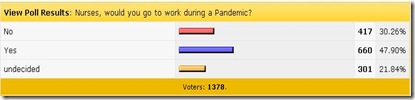
Although the numbers remain roughly the same as in late April, there has been a slow but steady downward drift in the percentage of nurses willing to work during a pandemic (ostensibly without PPE's). In April the number was 50.46% and now, with the addition of more than 500 votes, that number has eroded to 47.08%.
(click to enlarge)


With 30% of respondents saying `NO, I won't work', and another 23% undecided, the healthcare system could see substantial absenteeism before any nurses or techs are physically affected by the flu.


The assumption is 40% absenteeism due to illness or caring for an ill loved one. If this is subtracted from a pool of HCW's (Health Care Workers) already reduced by nearly 50%, then the number available to work could drop to 30% - that at a time when patient loads would be at their absolute highest.


If staff levels drop too far, it is possible that many of those who initially decided to remain would decide leave once they saw the impossibility of the situation.​


If hospitals want to stay open, and not turn into modern day Bedlam's, they need to find ways to protect, and reassure, their staffs. Too few appear to be openly preparing for a pandemic, despite the ample warnings provided by the government.


The newly proposed pandemic guideline Proposed Considerations for Antiviral Drug Stockpiling by Employers In Preparation for an Influenza Pandemic , strongly recommends that very high, and high risk healthcare workers be provided 12 weeks of Outbreak Prophylaxis (Tamiflu) during a pandemic wave.


How many facilities will follow this recommendation is unknown.


Many facilities haven't stockpiled enough PPE's (masks, gowns, gloves, goggles) to last more than a week or two into a pandemic wave. It is hard to envision them rushing out to stockpile expensive antivirals.


Sadly, I've heard from several nurses that their places of employment `actively discourage' talking about pandemic preparations - that "it isn't good for their career".


This sort of attitude only engenders more mistrust among the staff, and will likely increase absenteeism during a pandemic. We need more openness, not less.


It is a big job preparing for a pandemic, particularly for hospitals, nursing facilities, and emergency response agencies. PPE's in large quantities are expensive. Even at today's wholesale price, 12 weeks prophylaxis of Tamiflu would run about $500 per employee.


And then there is the problem of storage and security. Roche's RAPP plan helps with some of these difficulties, but the price remains steep. The minimum order under that plan is 2500 courses, or at today's price - about $165,000 ($6 reserve + $60/course x 2500)


That's a heavy hit for any employer.


There will, of course, be some nurses who will work even without outbreak prophylaxis or adequate PPE's. But their ability to provide decent care will quickly erode as their patient loads go up and the number of staff goes down.


And hospitals do not run just with doctors, nurses, and techs.


Without adequate support staff; housekeeping, laundry, cafeteria/ kitchen, maintenance, clerical, lab, and security - many of whom may be reluctant to work during a pandemic - the ability of any facility to function is in question.


Hospitals and other health care facilities need to begin to talk openly to their employees about their pandemic plans. Some of them apparently are, but many are not. And that includes their support staff, as well.

They have a stake in this too.​


Employee's deserve to know how their facility will protect them during a crisis, and they need to know how far along their preparedness is. Each department should be represented at the planning table, and they should be encouraged to solicit input from others in their department.

By being inclusive, sharing both the problems and decision making in their pandemic plan with their staff, health care facilities are far more likely to keep staff on hand during a crisis.


It isn't enough to say you have a pandemic plan, you need to share it as well.


Is the plan all on paper, with plans to purchase items at the last minute? Or are supplies currently being physically stored? Are there plans to buy or reserve antivirals? If so, who will get them? What about enhanced security during a crisis? What about extra patient supplies (IV's, disposables, meds)?


These, and many more questions, need to be answered publicly. And if the answers are not realistic ones that protect the staff, better solutions need to be found.


If hospital administrator's ignore the problems, or only discuss them behind closed doors out of earshot of their staff, they risk losing the confidence and support of their employees during a crisis.


And if that happens, they will have no one to blame but themselves.
posted by FLA_MEDIC @ 8:43 AM
 
Re: AFD - Health Care Workers Issues

Tuesday, July 15, 2008

<!-- Begin .post --> GAO Report On State's Progress Preparing For Medical Surge Event


# 2143


Via CIDRAP, with Lisa Schnirring's fine reporting, we get details on the recently released GAO (Government Accountability Office) assessment on how well states have prepared to handle a medical surge from an event such as a terrorist attack or an influenza pandemic.

This is only a snippet, follow the link to read the entire article.


GAO reports progress, pitfalls in state medical surge planning


Lisa Schnirring
purple-speck.gif
Staff Writer

Jul 14, 2008 (CIDRAP News) ? The Government Accountability Office (GAO) released a status report yesterday on progress states have made toward preparing for a flood of people needing medical care in the wake of an event such as a terrorist attack or an influenza pandemic.

The 59-page report, requested by various US Senate and House members, looked at four main components of medical "surge" readiness: increasing hospital capacity, pinpointing alternative care sites, enlisting medical volunteers, and planning for altered standards of care. The GAO also examined how federal departments have helped states make medical surge preparations, as well as what states have done for themselves. Lastly, investigators asked states what concerns they have about their medical surge planning.

From 2002 to 2007 the federal government awarded states about $2.2 billion in medical preparedness funds through the Department of Health and Human Services (HHS) Hospital Preparedness Program, the GAO said in the report. Federal agencies have also issued several preparedness guidance documents for states, such as a game plan for reopening shuttered hospitals.

Nongovernmental groups have also played an important role in issuing medical surge capacity guidance. In May, an expert task force issued a series of reports that took stock of current capabilities and recommended a framework for distributing care to as many patients as possible.
(Continue reading . . .)


The GAO report may be downloaded HERE.

posted by FLA_MEDIC @ 9:23 AM
 
Re: AFD - Health Care Workers Issues

No Such Thing As A `Planacea'


# 2168


plan?a?ce?a n.
A mythical plan, guideline, or rule book for all emergencies, pandemics, or other crises; `A Plan for All Reasons'.


The following is part of a press release regarding an article in JAMA (Journal of the American Medical Association). You need to be a subscriber to the journal in order to access the paper.


Pandemic flu: Most nursing homes don't have a plan

Less than a quarter of nursing homes in JAMA study have specific pandemic plan


ANN ARBOR, Mich. ? If an influenza pandemic hits the United States, acute care hospitals are likely to be overwhelmed. Nursing homes may then be expected to assist with the patient overflow, but a new study in the Journal of the American Medical Association suggests that many are not prepared for such a task.

Of the more than 400 nursing homes in the study, just 23 percent had a specific pandemic influenza plan. Another quarter of the nursing homes had a pandemic response incorporated into an overall disaster response plan. And more than half ? 52 percent ? did not have any pandemic plan.


"If nursing homes are called upon to serve as alternative care centers for patients who can't be treated in overcrowded hospitals, the impact on the nursing homes could be vast. Nursing homes serve a vulnerable population prone to dire consequences from an emergency," says lead author Philip W. Smith, M.D., professor and chief, Section of Infectious Diseases, University of Nebraska Medical Center. "While most facilities felt that nursing homes were being counted on to take hospital overflow patients in a pandemic, in reality few homes would be able to do so."

(Continue. . . )

Preparedness for Pandemic Influenza in Nursing Homes: A 2-State Survey
Philip W. Smith; Valerie Shostrom; Al Smith; Michael Kaufmann; Lona Mody
JAMA. 2008;300(4):392-394.
EXTRACT | FULL TEXT | PDF


While 48% of the nursing homes answering the survey claim either to have a specific pandemic plan, or to have incorporated a pandemic response into their overall disaster plan - there remains a huge unanswered question.


Are any of these `plans' worth the paper they are printed on?


Frankly, we don't know. No one does, really.


Unfortunately many `plans' are either dangerously optimistic about the impact of a pandemic, or assume the availability of resources or of outside help that simply may not be available during a crisis.


Saying you have a `plan' isn't enough. It needs to be a good plan. It must be realistic, comprehensive, and workable.


I know a lot of people my age who have a retirement plan. Unfortunately, in order to work, it requires they win the lottery.

It's a plan. It just isn't a very good one.

There are hospitals that plan to call on local or State police to beef up their security during a pandemic. To protect their staff, to turn away patients, to do crowd control, and to secure entrances.

It's in their plan.


Of course, if it isn't in their local or state's law enforcement agency's plan, they may run into a wee bit of difficulty.


And of course, many health care facilities plan on ordering supplies during a pandemic wave, just as they do during normal times. Very few are stockpiling PPE's and other supplies in sufficient quantities to last through a pandemic wave.

Given the increased demand for medical supplies during a pandemic, and the anticipated supply chain problems, that may not work out so well, either.


As far as I can tell, no one is cross checking plans.


Each hospital, nursing home, business, government agency, and municipality pretty much devises their own plan. There are templates, and assumptions, published on www.pandemicflu.gov , but no requirement that they be used.


Even among states, the assumptions about attack rates, fatality rates, and the percentage that will require hospitalization vary widely. Some states appear to be planning for a repeat of the mild Asian flu of 1957, while others are assuming a severe 1918 scenario.


Where would you rather live? In a state that overplanned for the next pandemic? Or a state that badly underplanned?


The JAMA press release also states :

Half of the nursing homes in the study had stockpiled some commonly used supplies such as gloves and hand hygiene products. Less than half had provided pandemic education to staff members. Just 6 percent had conducted pandemic influenza outbreak exercise.

Since we have no definitions of what constitutes `stockpiling' (a week's worth? a month? three months?), or what `pandemic education' or pandemic `outbreak exercises' entailed, it's pretty hard to take much comfort from those numbers.


Perhaps even more disturbing is the secrecy under which many of these plans are devised. Access is often restricted to an anointed few. Employees and citizens too often are told the specifics of the plan will be released `when a pandemic threatens'.


I try to take some comfort when I hear that a government, an agency, or a business has a `pandemic plan'. I take it as a sign that they have at least thought about the problem.


But a bad, or unrealistic plan will be of little use during a crisis. A plan that hasn't been rigorously tested, must remain highly suspect. And a plan that remains locked up in a drawer somewhere, out of the public eye, can't be trusted at all.


It is time that companies, health care facilities, and all local governments release their pandemic plans, and ask for input from the citizens and employees that they will affect. Those entities that have no plans should be `outed'.


That might prove to be enough of an incentive to spur them to action.


If the plans are any good, they will withstand the light of day.


If not, there is still time to fix them.


But to assume that simply `having a plan' will be sufficient during a crisis is just nuts.

posted by FLA_MEDIC @ 9:17 AM
 
Re: AFD - Health Care Workers Issues

The Other Prophylactic For Health Care Workers


# 2202


In over 2200 blogs I've never spoken personally about the toll that dealing with illness and death - and particularly the deaths of children - takes on health care workers.

There are some things you simply don't get used to, some things you just don't take in stride.

Dead kids are one of them.

We expect that children will grow to adulthood. That they will get their full four score of years to screw up their lives and the lives of their loved ones, and that nothing will cut that short.

Of course, that doesn't always happen.

Back in `the day' - when I was a paramedic - we didn't have counselors or psychiatrists on hand to talk to or debrief us after a particularly grisly or emotionally devastating call. There was a stigma attached to seeing a shrink in the 1970's that doesn't exist today.


We were expected to `suck it up', and keep on going. In fact, asking to talk to a `professional' was viewed by most of the guys as a good way to get yourself fired.


Or at least farmed out to the non-emergency unit.


That probably accounted for our high burn out rate. The average medic lasted less than 5 years on the job.


I can only remember one occasion when one of our medics was sent home in mid-shift after a bad call. He'd heard the dispatcher give his parent's address to another unit over the radio. He raced to their home in his own ambulance, only to find his father had committed suicide with a shotgun.


Even when my best friend, and ambulance partner, Bob Boller was killed in a motorcycle accident on his day off, I was expected to work my next shift, and expected to take over his job as Shift Commander as well.

It was a lousy way to get a promotion.


All of us who worked in the field carry ghosts with us. Not from every call, of course. But a few stand out, even years later. Invariably either the funny ones, or the tragic ones.


I mostly remember the funny ones. But there were three or four . . . well, they don't exactly haunt me. But they do still hurt when I think about them.


Please allow me to tell you about one of them. Her name was Trina. And she was barely 16 years old.


Trina and a girlfriend decided to take a ride in her friends VW bug one rainy evening. It wasn't raining hard, but the roads were slick. Her friend, at the wheel, apparently was driving too fast.

She lost control and hit a light pole.

My partner Ed Straight and I were on the scene within minutes. The driver, a girl I honestly don't remember much about, had a scratch on her shoulder and not much else wrong with her. She was very lucky.

Trina, however, had not been wearing a seatbelt, and she'd hit her forehead on the windshield - hard - then crumpled face-first below the dashboard.

After I determined that Trina was still alive (but just barely), Ed and I got a c-collar on her, and got her onto a backboard. She was very small for her age, which made getting her out easier. It was dark, and we were working by flashlight, but the only obvious trauma was a nasty looking laceration on her forehead.

One pupil, however, was blown and non-reactive to light.

A very bad sign.

As we were loading her into the back of our rig - Unit 23 - she coded. Her heart stopped and she quit breathing. Ed and I managed to restart her heart after a minute of CPR and a quick shock with our defibrillator.

Ed bagged her while I started an IV and took her vital signs. I could see a thin trail of blood and cerebral spinal fluid dripping from her ears. It was bad, and I knew it.

I took over ventilating her and Ed jumped into the driver's seat.

Time to scoot.

I radioed ahead to the emergency room. Informed them of the patient's condition, and suggested they ring the on-call neurologist.

As we were backing into the ambulance bay, Trina's heart stopped again. I applied the paddles, and sent another charge of electricity through her thin chest wall to restart her heart. She was back.

We wheeled her into the ER. The doctors and nurses took over. Moments later, she coded again. The doctor went for his defibrillator, and discovered that it wasn't working. He called for another one.

I ran to my unit, grabbed our lifepak 5, and brought it in.

Unfamiliar with my EKG/Defibrillator, the doctor asked me to do the honors. I did, and Trina was back again. A portable x-ray machine was brought in, and a skull series taken.

Thirty minutes later, the neurologist appeared with the X-rays in hand. When he learned I'd brought her back 3 times, he read me the riot act.

In front of everyone.


I was an idiot, he said. Trina was brain dead. A vegetable. I should have known better. Congratulations, you've just created a living nightmare for her family. One that could go on for months . . . even years.


I was mortified and devastated, all at the same time. I'd done my job, exactly as I was supposed to, but that didn't help.

I didn't have the latitude to decide in the field not to try to revive her. Not a 16-year-old kid. And the last time she coded, I'd acted under the ER doctors express orders.

That didn't help either.

The neurologist's stinging appraisal of my actions hung with me the rest of my shift, and for days to come.

The next morning, I went to the hospital to see how Trina was doing. The news wasn't good. She was on life support, and even though the doctors didn't express any hope for her, her mother refused to pull the plug.

I visited Trina in Intensive care every day. I sat with her for hours, watched her - with her pixie haircut and freckled cheeks - as she lay in limbo, hooked up a ventilator, IV's, and a catheter.

All the while I silently asked her to forgive me.

Five days later, mercifully, Trina died.

Sleep well, my little angel. Sleep well.


In two and a half years of blogging, I think this is the first `war story' I've told.


I hope you'll forgive me, but I do have a reason behind it.


Every day health care workers deal with tragedy and loss. Most of the time they can compartmentalize their feelings, and shield themselves from serious damage. We often use gallows humor as an adjustment mechanism.


Those who have never dealt with these types of situations may not understand, but finding irony, or humor, in a tragic situation may be the best defense you can mount.


Sometimes though, events can overpower even the most stable, rock solid, hardened professional. I've seen firefighters in tears, along with LEO's (Law Enforcement Officers), Medics, and of course doctors and nurses after a particularly tragic event.


And sometimes it isn't one single traumatic event that gets to you, it can be the result of a death-of-a-thousand-cuts. The daily grind of seeing nothing but tragedy and pain. That takes it's toll, too.

No one comes out of emergency services unscathed. No one.


Of course, it gets worse during a mass casualty event, such as a pandemic. As dedicated, experienced, and tempered that our health care workers may be, dealing with a pandemic will be something well beyond their experience.


They will have to not only deal with losing patients, who often will be young adults or children, they will have to accept the limitations of what they can do for them.


It is one thing to do your best, and lose a patient. You can tell yourself the damage was too great, that nothing could have saved them. It is a minor form of solace, but solace nonetheless.


It is quite another to not have the right medications, or a ventilator available, or even a bed to offer. The frustration of only being able to offer minimal, perhaps only palliative care, will be enormous.


With at least 40% of the health care system absent during a pandemic, those that are working will be working extended hours. A 40 hour week will likely become a dim memory. This too will have an adverse affect. The working conditions are likely to be brutal.


And of course there will be fear as well. Justified fear.


Health care workers will be at a high risk of contracting the disease. And those that are healthy and still working will be watching as their friends and colleagues are stricken.


And some of them they know may die.


Despite their dispassionate demeanor, their professionalism, and their dedication, these people are not robots. They are every bit as human, and fragile, as the rest of us.


If you prick them, they will bleed. If you abuse them long enough, mentally or physically, they will break down.


As traumatic as a pandemic would be for the entire world, it will be a private little slice of hell for most health care workers. They will deal with a mindnumbing onslaught of new pressures, fears, and traumas each and every day- for weeks, perhaps months on end.

If the CDC's estimate of 1.9 million deaths in the U.S. during a severe pandemic holds up, then we risk losing more than 500,000 kids in a matter of just a few months. The pain of dealing with this will be enormous.

And without support, many will break.


Hospitals need to make serious provisions for counseling and support for their workers if they expect them to survive a pandemic wave intact. They need to be thinking in terms of how they can relieve some of the inevitable stress a pandemic will bring.

And these interventions should come before, during, and after a pandemic. They need to be proactive, as well as reactive.


My guess is that few facilities are addressing the psychological needs of their staff in their pandemic plans. That most think `we'll deal with it' if it happens.


That compared to other preparedness issues, this is a low priority.


And that would be a tragic mistake of monumental proportions.


posted by FLA_MEDIC @ 10:36 AM
 
Re: AFD - Health Care Workers Issues

Monday, August 04, 2008

<!-- Begin .post -->

Australia: Will Doctors Work In A Pandemic?


# 2204


Thanks to Crof over at Crofsblog for picking up on this story out of Australia. A synopsis is carried by Adelaide Now : GPs not prepared for bird flu pandemic.


The study referenced in this story appears in the eMJA, the Medical Journal of Australia. Here is the abstract, slightly reformatted for better readability.


Registration is free, and a simple matter, if you wish the read the entire article.


How will Australian general practitioners respond to an influenza pandemic? A qualitative study of ethical values
Olga Anikeeva, Annette J Braunack-Mayer and Jackie M Street


Abstract

Objectives:
To explore general practitioners? perceptions of their preparedness for an influenza pandemic, the changes they would make to their practice, and the ethical justifications for their planned actions.


Design and setting:
A qualitative study was performed among South Australian GPs between March and October 2007. A semi-structured interview was carried out with each participant in his or her practice, and the interviews were audio-recorded, transcribed and analysed thematically.

Participants:
10 GPs were recruited: five from a metropolitan Division and five from a rural Division of General Practice.

Results:
Some participants felt they would not be able to cope with an influenza pandemic, while others felt it would simply mean an increase in their workloads.


Most respondents considered creating separate waiting rooms, moving the reception desk outside of the practice and delaying all non-urgent consultations in order to deal with a pandemic more effectively.


Respondents mentioned the conflict between their various roles and responsibilities as a primary source of tension when thinking about the way they would organise their work in the event of a pandemic.


A number of GPs said they would not practise in the event of a pandemic, as they felt their responsibility to their families outweighed that to their patients.


Conclusions:
Professional codes of ethics should include guidance about the scope of the duty to treat during infectious disease outbreaks. The community has to uphold the value of reciprocity, and ensure that GPs and their families are provided with support during a pandemic and are given the opportunity to be actively involved in pandemic preparedness planning.


The moral dilemma for health care workers during a pandemic remains largely unaddressed by most governments and health care facilities.


The assumption appears to be that, `of course doctors and nurses will work. It's their duty'.


This despite the fact that again and again we've seen polls and studies that indicate that a certain percentage of HCW's (health care workers) would be reluctant to work during a pandemic.


Quoting from this study, 30% of the doctors participating expressed reluctance to work during a pandemic.


However, three GPs gave quite different responses: they were hesitant to see influenza patients during a pandemic because they felt that their responsibility to themselves to stay healthy and to protect their families outweighed their responsibility to continue working:


I would try to see what I can do to work; it?s just that I don?t want to sacrifice my life. (P4)


I think that anybody that works in general practice has some sort of responsibility to their patients, but I would still say that my primary responsibility is towards my family. (P7)


Interestingly, 30% is roughly the percentage of nurses who have expressed a similar hesitancy in the allnurses.com pandemic poll that I've highlighted in past blogs including here, here, here, and here.


How many doctors and nurses, and their support staff, will continue to show up and work during a pandemic will depend on many factors.


The severity of the pandemic will be a major factor of course. The CAR (Case Attack Rate) and the CFR (Case Fatality Ratio).


But equally important will be the availability of PPE's (Personal Protective Equipment), the availability and effectiveness of antivirals (for HCW's and their families), and the security and safety of the workplace.


Governments and Health Care facilities have a duty to rigorously prepare for a pandemic, and protecting the health and well being of their staff (and their families) should be at the very top of their preparations list.


Most healthcare workers, I believe, want to work during a pandemic.


But few are going to be willing to sacrifice themselves needlessly on the altar of inadequate preparedness.


posted by FLA_MEDIC @ 2:09 PM
 
Re: AFD - Health Care Workers Issues

October 1, 2008

Will GP's Work In A Pandemic?


# 2346


It's a teaser article in today's Strait's Times, and we are promised more details tomorrow.

It sounds very similar to another story we heard earlier this summer out of Australia, where a limited survey of doctors showed 3 out of 10 reluctant to work during a pandemic.

So I'm not sure if this is a rehash of an earlier story, or a new poll. I suppose we'll learn tomorrow. In any event, here is the teaser:


Oct 1, 2008

Treat patients in pandemic? Some GPs may quit: Poll

They fear being infected, but in fact, doctors will be among the first to get any vaccines

NOT all doctors are willing to be in the line of fire in a flu pandemic.

A survey of general practitioners (GPs) and polyclinic doctors, who would be in the front lines of a massive infection here, found that almost three in 10 doctors felt they should not have to look after patients at the height of a pandemic.

One in eight would stop work to avoid the risk of catching a virus that could prove deadly, with some willing to quit their jobs rather than treat patients.
Read Salma Khalik's full story in Thursday's edition of The Straits Times.

No one should be shocked by this revelation.


Doctors, nurses, and other health care professionals are not required to risk their lives, and the lives of their families, in order to treat others. It is a quaint and noble idea, but it is not part of their oath.


Interestingly, 30% is roughly the same percentage of nurses who have expressed a similar hesitancy in the allnurses.com pandemic poll that I've highlighted in past blogs including here, here, here, and here.


There are now more than 330 comments, and almost 1400 respondents to the poll. Every pandemic planner, nursing director, and hospital administrator needs to spend a couple of hours and read these comments.

How many doctors and nurses, and their support staff, will continue to show up and work during a pandemic will depend on many factors.

The severity of the pandemic will be a major factor of course. The CAR (Case Attack Rate) and the CFR (Case Fatality Ratio).

But equally important will be the availability of PPE's (Personal Protective Equipment), the availability and effectiveness of antivirals (for HCW's and their families), and the security and safety of the workplace.

Facilities that do not plan, in advance, to deal with these issues are likely to find fewer of their employees willing to work during a crisis.
 
Re: AFD - Health Care Workers Issues

Study: 1 In 6 HCWs May Not Work In Any Pandemic


# 3540

Admittedly, this survey was conducted before the arrival of the novel H1N1 virus, and so it may not exactly represent HCW sentiment today.

But unlike other polls we?ve seen that assumed a severe pandemic, this one is based on `any severity level?.

First the study, and the press release, then some commentary.

Published 24 Jul 2009 PLoS One
Assessment of Local Public Health Workers' Willingness to Respond to Pandemic Influenza through Application of the Extended Parallel Process Model

Daniel J. Barnett, Ran D. Balicer, Carol B. Thompson, J. Douglas Storey, Saad B. Omer, Natalie L. Semon, Steve Bayer, Lorraine V. Cheek, Kerry W. Gateley, Kathryn M. Lanza, Jane A. Norbin, Catherine C. Slemp, Jonathan M. Links
Public release date: 24-Jul-2009

Johns Hopkins University Bloomberg School of Public Health
1 in 6 public health workers unlikely to respond in pandemic flu emergency

Approximately 1 in 6 public health workers said they would not report to work during a pandemic flu emergency regardless of its severity, according to a survey led by researchers at the Johns Hopkins Bloomberg School of Public Health. The findings are a significant improvement over a 2005 study conducted by the same research team, in which more than 40 percent of public health employees said they were unlikely to report to work during a pandemic emergency. The new study suggests ways for improving the response of the public health workforce. The results are published in the July 24 edition of the journal PLoS ONE.

"Employee response is a critical component of preparedness planning, yet it is often overlooked. Our study is an attempt to understand the underlying factors that determine an employee's willingness to respond in an emergency," said Daniel Barnett, MD, MPH, lead author of the study and assistant professor in the Department of Environmental Health Sciences at the Bloomberg School of Public Health. "Overall, 16 percent of the workers surveyed said they would not report regardless of the severity of the outbreak."
(Continue . . .)
According to this study, the respondents were mostly professionals, with considerable expertise and longevity at their current place of employment.

Most respondents were female (81%), over 40 years of age (72%), had at least a Bachelors' degree (73%), worked in their present organization for at least five years (64%), were in their profession for 10 or more years (58%), perceived having a role in responding to a public health emergency (84%), and had a family member dependent on them (67%).
The primary finding from this survey is that the more important, or vital, a HCW believes their job to be, the more likely they are to work during a pandemic.

Even so, 1 in 6 felt they would not be willing to work in any type of pandemic scenario.


Perhaps an even bigger implication is what choices will be made by employees who are lower paid, more transient, or perceive their roles to be less important than HCWs directly involved in patient care.


If housekeeping, maintenance, security, nutritional services, lab, or even clerical help decide not to work in a pandemic, then the entire hospital operation is endangered.

The recent uproar over a lack of proper PPE?s for nurses in California has only served to highlight some of the challenges facing hospitals and other care providers during a pandemic.

Over the past 3 years I?ve covered this subject often, with a few previous posts including:
And The New Survey Says . . .

The HCW Debate (Update)
Pandemic Issues For Home Health Providers - Pt 3


Previous polls and studies have show that,depending upon the severity of a pandemic, the availability of PPEs (Personal Protective Equipment like respirators, gowns, gloves), antivirals, and vaccinations the percentage of HCWs willing to work has run from about 85% to less than 50%.

To this deficit, you would then have to add absenteeism due to illness, or caring for a loved one at home with the flu.
All of which means that Hospitals, clinics, and other healthcare providers need to be looking at ways to make it easier for HCWs to say `yes?, when it comes to working during a pandemic.

Prime among these moves should be ensuring an adequate supply of PPEs, having antivirals available (and a promise of treatment) for workers and their families, and full disclosure to their staff regarding the dangers, and steps being taken to protect them, from the pandemic.
Anything less and hospitals are likely to find themselves in the unenviable position of trying to operate with a very small fraction of their normal staff.
 
Back
Top