

sharon sanders
Editor-in-Chief & President
ECDC: Flu Starting To Peak In Parts Of Europe
Credit- ECDC
# 6175
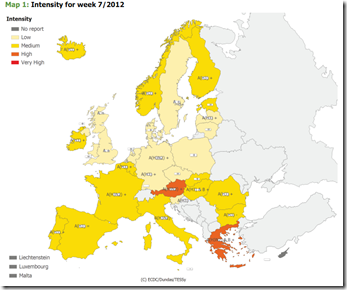
Just as we’ve been seeing in North America, Europe’s flu season has been slow to get going this winter. Of 28 EU countries reporting this week, 10 continue to report low levels of influenza activity.
Only Austria and Greece are reporting high levels of influenza intensity. However, 19 countries are reporting that flu cases are still increasing, while nations 6 report cases as being stable, and three appear to be post-peak, and on the decline.
Credit- ECDC
# 6175
Just as we’ve been seeing in North America, Europe’s flu season has been slow to get going this winter. Of 28 EU countries reporting this week, 10 continue to report low levels of influenza activity.
Only Austria and Greece are reporting high levels of influenza intensity. However, 19 countries are reporting that flu cases are still increasing, while nations 6 report cases as being stable, and three appear to be post-peak, and on the decline.
As is noted in the abstract, some of the H3 and B strains now circulating have moved antigenically away from those in the current flu vaccine, prompting a change in next season’s flu vaccine (see WHO: Northern Hemisphere 2012-2013 Flu Vaccine Composition).
Here is the ECDC’s latest surveillance report.
Weekly influenza surveillance overview, 24 February 2012 - week 7
Surveillance reports - 24 Feb 2012

ABSTRACT
The 2011-2012 influenza season started later than in recent seasons and has been without any clear geographic progression.
Medium or high intensity was reported by 18 countries and increasing trends by 19 countries.
Of 1 873 sentinel specimens tested, 927 (49.5%) were positive for influenza virus, which is a similar percentage to that observed during the two previous weeks.
Of the 2 901 influenza viruses detected from sentinel and non-sentinel sources during week 7/2012, 96.1% were type A and 3.9% were type B. Of the 1 085 influenza A viruses subtyped, 98.2% were A(H3) and 1.8% were A(H1)pdm09.
No resistance to the neuraminidase inhibitors (oseltamivir and zanamivir) has been reported so far this season.
The influenza A(H3) and B viruses circulating this season have moved genetically and antigenically away from 2011–2012 seasonal vaccine viruses. This prompted WHO to recommend different vaccine viruses for the 2012-2013 seasonal vaccine.
The national influenza season epidemics in Europe may be approaching their peak in the first affected countries and remain dominated by A(H3) viruses.
Posted by Michael Coston at 7:12 AMSurveillance reports - 24 Feb 2012
ABSTRACT
The 2011-2012 influenza season started later than in recent seasons and has been without any clear geographic progression.
Medium or high intensity was reported by 18 countries and increasing trends by 19 countries.
Of 1 873 sentinel specimens tested, 927 (49.5%) were positive for influenza virus, which is a similar percentage to that observed during the two previous weeks.
Of the 2 901 influenza viruses detected from sentinel and non-sentinel sources during week 7/2012, 96.1% were type A and 3.9% were type B. Of the 1 085 influenza A viruses subtyped, 98.2% were A(H3) and 1.8% were A(H1)pdm09.
No resistance to the neuraminidase inhibitors (oseltamivir and zanamivir) has been reported so far this season.
The influenza A(H3) and B viruses circulating this season have moved genetically and antigenically away from 2011–2012 seasonal vaccine viruses. This prompted WHO to recommend different vaccine viruses for the 2012-2013 seasonal vaccine.
The national influenza season epidemics in Europe may be approaching their peak in the first affected countries and remain dominated by A(H3) viruses.