

sharon sanders
Editor-in-Chief & President
Companion Animals And Novel H1N1
# 5315
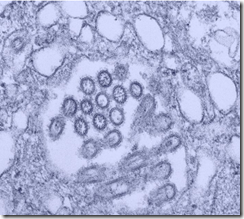
Colorized transmission electron micrograph (TEM) of HN1 virus ? Credit CDC PHIL)
Unlike `normal? strains of human-adapted seasonal influenza - which are thought to rarely (if ever) infect dogs, cats, and other companion animals - the 2009 H1N1 virus has been observed a number of times in pets over the past 18 months.
First some excerpts from the press release, then I?ll be back with more on pets and influenza.
They also maintain several FAQs on H1N1 and pets.
Over the past year or so, we?ve seen ample evidence of non-human infection by the novel H1N1 virus (e.g. turkeys, swine, ferrets, dogs, cats . . . even a cheetah).
This influenza?s propensity to cross species has also been observed with the H5N1 bird flu virus as well.
A few past blogs on the unusually promiscuous nature of the swine H1N1 influenza strain include:
Last October we saw a study (see EID Journal: Pandemic H1N1 Infection In Cats) that looked at the pathogenesis of novel H1N1 in domestic felines.
None of this is to suggest that your pet presents a serious H1N1 infection risk to you or your family. Quite the opposite, in fact.
So we watch for signs of species jumping of any influenza with considerable interest.
# 5315

Colorized transmission electron micrograph (TEM) of HN1 virus ? Credit CDC PHIL)
Unlike `normal? strains of human-adapted seasonal influenza - which are thought to rarely (if ever) infect dogs, cats, and other companion animals - the 2009 H1N1 virus has been observed a number of times in pets over the past 18 months.
Given that relatively few companion animals get tested for the H1N1 virus, and the likelihood that some animals only experience mild or sub-clinical symptoms of infection, the true prevalence of H1N1 infection among household pets is unknown.
Yesterday, another veterinary industry alert was issued by IDEXX Laboratories - a company that produces a veterinary influenza test kit - regarding the first known H1N1 infection of 2011 in a domestic cat.
First some excerpts from the press release, then I?ll be back with more on pets and influenza.
First confirmed 2011 case of H1N1 influenza virus infection reported in a domestic cat
February 14, 2011
One cat with severe respiratory disease from Wisconsin has tested positive for the H1N1 influenza virus with the IDEXX H1N1 Influenza Virus RealPCR? Test.
Two cats from the same household presented to a veterinary emergency hospital in respiratory distress. The owners reported to have been suffering from the flu themselves at the time the cats developed severe respiratory signs.
After intensive supportive care that included ventilator support, the 6-year-old male domestic shorthair (DSH) was euthanized. The IDEXX Feline Upper Respiratory Disease (URD) RealPCR? Panel was performed using fluid obtained at the time of intubation for ventilation and was positive for the H1N1 influenza virus. The second cat, a 10-year-old female DSH, originally responded to supportive therapy but relapsed and was euthanized 8 days after presentation.
An oropharyngeal swab was obtained at the time of euthanasia for testing, but it was negative for H1N1 influenza virus. Given the strong-positive quantitative real-time PCR result in the first cat, the H1N1 influenza virus is still the presumptive cause of respiratory disease in the second cat. The shedding period of influenza viruses is short, which may have been responsible for the negative PCR result.
(Continue . . .)
The AVMA (American Veterinary Medical Association), which represents 80,000 Veterinarians around the nation, understandably keeps track of these cases.February 14, 2011
One cat with severe respiratory disease from Wisconsin has tested positive for the H1N1 influenza virus with the IDEXX H1N1 Influenza Virus RealPCR? Test.
Two cats from the same household presented to a veterinary emergency hospital in respiratory distress. The owners reported to have been suffering from the flu themselves at the time the cats developed severe respiratory signs.
After intensive supportive care that included ventilator support, the 6-year-old male domestic shorthair (DSH) was euthanized. The IDEXX Feline Upper Respiratory Disease (URD) RealPCR? Panel was performed using fluid obtained at the time of intubation for ventilation and was positive for the H1N1 influenza virus. The second cat, a 10-year-old female DSH, originally responded to supportive therapy but relapsed and was euthanized 8 days after presentation.
An oropharyngeal swab was obtained at the time of euthanasia for testing, but it was negative for H1N1 influenza virus. Given the strong-positive quantitative real-time PCR result in the first cat, the H1N1 influenza virus is still the presumptive cause of respiratory disease in the second cat. The shedding period of influenza viruses is short, which may have been responsible for the negative PCR result.
(Continue . . .)
They also maintain several FAQs on H1N1 and pets.
? Veterinarians 2009 H1N1 FAQs
? Pet owners 2009 H1N1 FAQs
? General 2009 H1N1 FAQs
? Pandemic preparedness for veterinarians
? Pet owners 2009 H1N1 FAQs
? General 2009 H1N1 FAQs
? Pandemic preparedness for veterinarians
Over the past year or so, we?ve seen ample evidence of non-human infection by the novel H1N1 virus (e.g. turkeys, swine, ferrets, dogs, cats . . . even a cheetah).
This influenza?s propensity to cross species has also been observed with the H5N1 bird flu virus as well.
A few past blogs on the unusually promiscuous nature of the swine H1N1 influenza strain include:
US: Dog Tests Positive For H1N1
US: Turkey Farm Reports H1N1
Study: H1N1 And Birds
Cat Got Your Virus?
Cats seem to be more severely affected than dogs, at least based on the limited number of cases detected. Of eleven known feline cases, only 4 have recovered. US: Turkey Farm Reports H1N1
Study: H1N1 And Birds
Cat Got Your Virus?
Last October we saw a study (see EID Journal: Pandemic H1N1 Infection In Cats) that looked at the pathogenesis of novel H1N1 in domestic felines.
Experimental Pandemic (H1N1) 2009 Virus Infection of Cats
DOI: 10.3201/eid1611.100845
van den Brand JMA, Stittelaar KJ, van Amerongen G, van de Bildt M, Leijten LL, Kuiken T, et al. Experimental pandemic (H1N1) 2009 virus infection of cats. Emerg Infect Dis. 2010 Nov; [Epub ahead of print]
Conclusions
Intratracheal infection of domestic cats with pandemic (H1N1) 2009 virus resulted in mild-to-moderate clinical signs and virus replication throughout the respiratory tract that caused diffuse alveolar damage.
Pathogenic changes in the respiratory tract in cats were similar to those that occur in humans, macaques, and ferrets (7,11?13). Seroconversion of sentinel cats indicated cat-to-cat transmission.
The full study runs about 4 pages, with heavy emphasis on the necropsy and histological examination of these laboratory cats several days post infection.DOI: 10.3201/eid1611.100845
van den Brand JMA, Stittelaar KJ, van Amerongen G, van de Bildt M, Leijten LL, Kuiken T, et al. Experimental pandemic (H1N1) 2009 virus infection of cats. Emerg Infect Dis. 2010 Nov; [Epub ahead of print]
Conclusions
Intratracheal infection of domestic cats with pandemic (H1N1) 2009 virus resulted in mild-to-moderate clinical signs and virus replication throughout the respiratory tract that caused diffuse alveolar damage.
Pathogenic changes in the respiratory tract in cats were similar to those that occur in humans, macaques, and ferrets (7,11?13). Seroconversion of sentinel cats indicated cat-to-cat transmission.
Those discomforted by such details might want to skip the full paper.
While usually producing less dramatic symptoms, cats infected with the pandemic H1N1 virus showed similar pathogenic processes to cats infected with the HPAI H5N1 bird flu virus.
None of this is to suggest that your pet presents a serious H1N1 infection risk to you or your family. Quite the opposite, in fact.
Your pet is far more likely to contract the virus from you or other members of your household.
But promiscuous flu viruses - those capable of expanding their host range to other species - are a bit more worrisome because they have more opportunities to mutate, reassort, or evolve.
So we watch for signs of species jumping of any influenza with considerable interest.