

sharon sanders
Editor-in-Chief & President
hat tip Michael Coston
Because, Sometimes Shift Happens
# 7047
While its far too soon to know how much of an impact it will have, yesterday?s announcement (see China: Two Deaths From H7N9 Avian Flu), has suddenly thrust the specter of bird flu back onto the front page.
The genetic sequences have been deposited in GISAID, and hopefully we?ll start seeing some authoritative analysis on the make up of this virus in the next day or so.
Yesterday (h/t Ironorehopper on FluTrackers), China?s CDC website featured a graphic suggesting that this H7N9 virus might be a reassortant between the H7N9 and H9N2 virus.
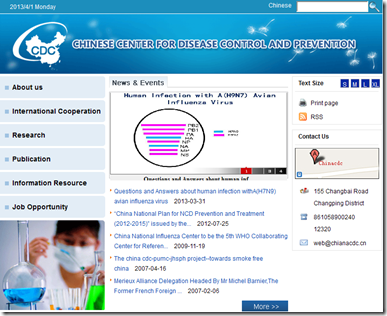
Clicking this graphic takes us to a Q&A on the H7N9 virus (which does not mention reassortment), called:
While details on this emerging H7N9 virus remain elusive, we do know that Influenza viruses evolve via two well established routes;
Shift occurs when one virus swap out chunks of their genetic code with gene segments from another virus. This is known as reassortment. While far less common than drift, shift can produce abrupt, dramatic, and sometimes pandemic inducing changes to the virus (see NIAID Video: How Influenza Pandemics Occur).
We?ll simply have to wait to see what surveillance, genetic analysis, and epidemiological tracing has to tell us over the coming days and weeks.
Posted by Michael Coston at <a class="timestamp-link" href="http://afludiary.blogspot.com/2013/04/because-sometimes-shift-happens.html" rel="bookmark" title="permanent link"><abbr class="published" title="2013-04-01T08:19:00-04:00">8:19 AM</abbr>
Because, Sometimes Shift Happens
# 7047
While its far too soon to know how much of an impact it will have, yesterday?s announcement (see China: Two Deaths From H7N9 Avian Flu), has suddenly thrust the specter of bird flu back onto the front page.
Details remains sketchy, but it appears that at least 3 people ? possibly more (see More Details Emerge On Shanghai H7N9 Case) ? have contracted a previously-unseen-in-humans version of avian influenza.
In the past, H7 infections in humans have been both rare and mild (see A Brief History Of H7 Avian Flu Infections). The deaths of two (or perhaps three) cases in Shanghai are the first known fatalities from an H7 virus since 2003.
The genetic sequences have been deposited in GISAID, and hopefully we?ll start seeing some authoritative analysis on the make up of this virus in the next day or so.
Yesterday (h/t Ironorehopper on FluTrackers), China?s CDC website featured a graphic suggesting that this H7N9 virus might be a reassortant between the H7N9 and H9N2 virus.
As I?m not a virologist, I can offer no opinion as to whether this is a correct (or even reasonable) characterization of this virus.
Nevertheless, here is the screenshot taken from http://www.chinacdc.cn/en/ as of 0600 hrs EDT 4/1/13

Questions and Answers about human infection with A(H7N9) avian influenza virus
(Excerpt)
6. Can A(H7N9) avian influenza virus transmitted from person to person?
Given the limited number of confirmed cases to date, it is still uncertain how this virus is being transmitted from birds. Epidemiology links between the 3 confirmed cases haven?t been discovered. Investigation is ongoing, but so far no further cases were identified among the contacts of the case. Up to date, no subclinical infections have been determined from all the blood taken in contacts. But we cannot rule out the possibility of human to human transmission until we know more about the virus characteristics and results from ongoing investigations.
7. Has any close contacts become ill or dead?
According to China?s regulations on management of the unknown pneumonia, the Departments of Health in Shanghai, Anhui and Jiangsu have implemented strictly medical observation to all the close contacts of the confirmed cases. All the close contacts of the confirmed cases from Shanghai and Anhui haven?t show the similar symptom so far.
<SNIP>
13. What kinds of the control measures and investigation had been implemented?
The local health authorities pay high attention to the event. The treatment of patients, field epidemiological investigation, specimen collection and inspection, medical observation to the close contacts, and the enhancement of surveillance for the pneumonia cases of unknown origin have already being carried out.
After receiving the case reports and the sample collected from the patients, China Center for Disease Control and Prevention had carried out risk assessment for potential spread. The laboratory identification and confirmation have been performed timely. Genetic characteristics of the newly identified virus in humans in currently being analyzed to determine potential factors that can explain transmission from birds to humans.
Due to constant evolving nature of influenza viruses, China participated in the WHO associated global monitoring of influenza viruses in animals and people. H7N9 as an avian influenza newly discovered in humans, has been reported to WHO under IHR (2005).
(Continue . . .)
While not providing any details, an interview published today on http://news.southcn.com/ has Dr Yuelong Shu of China?s CDC, describing this virus as a reassortant.(Excerpt)
6. Can A(H7N9) avian influenza virus transmitted from person to person?
Given the limited number of confirmed cases to date, it is still uncertain how this virus is being transmitted from birds. Epidemiology links between the 3 confirmed cases haven?t been discovered. Investigation is ongoing, but so far no further cases were identified among the contacts of the case. Up to date, no subclinical infections have been determined from all the blood taken in contacts. But we cannot rule out the possibility of human to human transmission until we know more about the virus characteristics and results from ongoing investigations.
7. Has any close contacts become ill or dead?
According to China?s regulations on management of the unknown pneumonia, the Departments of Health in Shanghai, Anhui and Jiangsu have implemented strictly medical observation to all the close contacts of the confirmed cases. All the close contacts of the confirmed cases from Shanghai and Anhui haven?t show the similar symptom so far.
<SNIP>
13. What kinds of the control measures and investigation had been implemented?
The local health authorities pay high attention to the event. The treatment of patients, field epidemiological investigation, specimen collection and inspection, medical observation to the close contacts, and the enhancement of surveillance for the pneumonia cases of unknown origin have already being carried out.
After receiving the case reports and the sample collected from the patients, China Center for Disease Control and Prevention had carried out risk assessment for potential spread. The laboratory identification and confirmation have been performed timely. Genetic characteristics of the newly identified virus in humans in currently being analyzed to determine potential factors that can explain transmission from birds to humans.
Due to constant evolving nature of influenza viruses, China participated in the WHO associated global monitoring of influenza viruses in animals and people. H7N9 as an avian influenza newly discovered in humans, has been reported to WHO under IHR (2005).
(Continue . . .)
Shu Yuelong:
Quote:
??This virus is characterized by a new reassortant virus, As for its biological characteristics, its pathogenic spread of power, we currently do not have the basis of analysis and judgment. This is the global reported for the first time such a reassortant virus causes severe pneumonia, it is hard to evaluate the toxicity of the virus.??
The full translation is available on FluTrackers (link). You?ll find continual updates on this thread as well. Quote:
??This virus is characterized by a new reassortant virus, As for its biological characteristics, its pathogenic spread of power, we currently do not have the basis of analysis and judgment. This is the global reported for the first time such a reassortant virus causes severe pneumonia, it is hard to evaluate the toxicity of the virus.??
While details on this emerging H7N9 virus remain elusive, we do know that Influenza viruses evolve via two well established routes;
Antigenic drift & Antigenic Shift (reassortment).
Antigenic drift causes small, incremental changes in the virus over time. Drift is the standard evolutionary process of influenza viruses, and often come about due to replication errors that are common with single-strand RNA viruses (see NIAID Video: Antigenic Drift).
Shift occurs when one virus swap out chunks of their genetic code with gene segments from another virus. This is known as reassortment. While far less common than drift, shift can produce abrupt, dramatic, and sometimes pandemic inducing changes to the virus (see NIAID Video: How Influenza Pandemics Occur).
For shift to happen, a host (human, swine, bird) must be infected by two influenza different viruses at the same time.
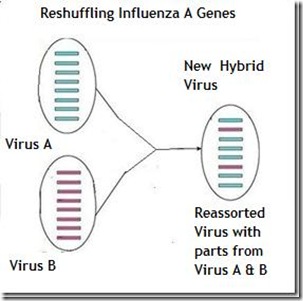
Influenza A viruses have 8 gene segments (PB2, PB1, PA, HA, NP, NA, M1, M2, NS1, NS2).
Reassortment of two Flu viruses
Influenza A viruses have 8 gene segments (PB2, PB1, PA, HA, NP, NA, M1, M2, NS1, NS2).
Reassortment of two Flu viruses
While successful reassortment is relatively rare, as any virologist will tell you . . . Shift happens.
This is basically how the 2009 H1N1 pandemic virus evolved, although it took multiple gene swaps over a decade or longer before it finally emerged from swine into the human population.
We know that reassortments do happen, but only rarely do they result in a biologically fit virus capable of causing a pandemic.
Most hybrid viruses are evolutionary dead-ends, are unable to compete, and die out within the host.
As far as this emerging H7N9 strain goes (whether it is a reassortant virus, or the product of antigenic drift), a handful of cases doesn?t tell us much about its potential. Most hybrid viruses are evolutionary dead-ends, are unable to compete, and die out within the host.
We?ll simply have to wait to see what surveillance, genetic analysis, and epidemiological tracing has to tell us over the coming days and weeks.
But whether this H7N9 virus thrives, or eventually fails, we know that nature?s laboratory is open 24/7, is not constrained by budgets, politics, or a social conscience - and given enough time - will surely deliver another pandemic virus.
Stay tuned.
Posted by Michael Coston at <a class="timestamp-link" href="http://afludiary.blogspot.com/2013/04/because-sometimes-shift-happens.html" rel="bookmark" title="permanent link"><abbr class="published" title="2013-04-01T08:19:00-04:00">8:19 AM</abbr>


