

Rwilmer
Well-known member
Australian Study: H1N1 Hospitalized Patients
# 4016
Another look at patient demographics, comorbid conditions, and illness presentation from this study that looked at 112 hospital admissions for H1N1 influenza in Melbourne, Australia between May 1st and July 31st of 2009.
The complete and accurate title of the study, just released by eMJA (The Medical Journal of Australia) is:
Follow this link to read the entire study.
# 4016
Another look at patient demographics, comorbid conditions, and illness presentation from this study that looked at 112 hospital admissions for H1N1 influenza in Melbourne, Australia between May 1st and July 31st of 2009.
The complete and accurate title of the study, just released by eMJA (The Medical Journal of Australia) is:
Hospitalised adult patients with pandemic (H1N1) 2009 influenza in Melbourne, Australia
Justin T Denholm, Claire L Gordon, Paul D Johnson, Saliya S Hewagama, Rhonda L Stuart, Craig Aboltins, Cameron Jeremiah, James Knox, Garry P Lane, Adrian R Tramontana, Monica A Slavin, Thomas R Schulz, Michael Richards, Chris J Birch and Allen C Cheng
Abstract
Objective: To describe the case characteristics and outcomes of patients hospitalised with pandemic (H1N1) 2009 influenza infection during the first 2 months of the epidemic.
Design, participants and setting:
Prospective case series of 112 patients admitted to seven hospitals in Melbourne with laboratory-confirmed pandemic (H1N1) 2009 influenza between 1 May and 17 July 2009.
Main outcome measures:
Details of case characteristics, risk factors for severe disease, treatment and clinical course.
Results:
Of 112 hospitalised patients, most presented with cough (88%) and/or fever (82%), but several (4%) had neither symptom. A quarter of female patients (15) were pregnant or in the post-partum period. Patients presenting with multifocal changes on chest x-ray had significantly longer hospital lengths of stay, and were more likely to require intensive care unit admission. Thirty patients required admission to an intensive care unit, and three died during their acute illness. The median length of intensive care admission was 10.5 days (interquartile range, 5?16 days).
Conclusions:
This study highlights risk factors for severe disease, particularly pregnancy. Clinical and public health planning for upcoming influenza seasons should take into account the spectrum and severity of clinical infection demonstrated in this report, and the need to concentrate resources effectively in high-risk patient groups.
Justin T Denholm, Claire L Gordon, Paul D Johnson, Saliya S Hewagama, Rhonda L Stuart, Craig Aboltins, Cameron Jeremiah, James Knox, Garry P Lane, Adrian R Tramontana, Monica A Slavin, Thomas R Schulz, Michael Richards, Chris J Birch and Allen C Cheng
Abstract
Objective: To describe the case characteristics and outcomes of patients hospitalised with pandemic (H1N1) 2009 influenza infection during the first 2 months of the epidemic.
Design, participants and setting:
Prospective case series of 112 patients admitted to seven hospitals in Melbourne with laboratory-confirmed pandemic (H1N1) 2009 influenza between 1 May and 17 July 2009.
Main outcome measures:
Details of case characteristics, risk factors for severe disease, treatment and clinical course.
Results:
Of 112 hospitalised patients, most presented with cough (88%) and/or fever (82%), but several (4%) had neither symptom. A quarter of female patients (15) were pregnant or in the post-partum period. Patients presenting with multifocal changes on chest x-ray had significantly longer hospital lengths of stay, and were more likely to require intensive care unit admission. Thirty patients required admission to an intensive care unit, and three died during their acute illness. The median length of intensive care admission was 10.5 days (interquartile range, 5?16 days).
Conclusions:
This study highlights risk factors for severe disease, particularly pregnancy. Clinical and public health planning for upcoming influenza seasons should take into account the spectrum and severity of clinical infection demonstrated in this report, and the need to concentrate resources effectively in high-risk patient groups.
Chart 1 of 4
Demographic characteristics and comorbid conditions of the first 112 patients admitted to participating hospitals with pandemic (H1N1) 2009 influenza
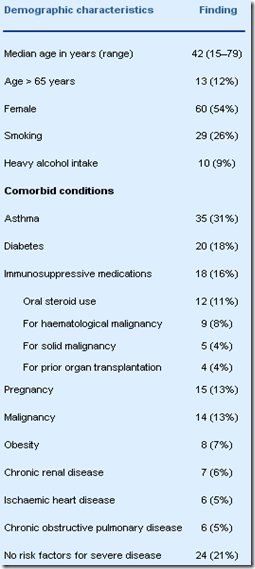
An interesting look at those ill enough to require hospitalization in the earliest days of the influenza outbreak. Fever and cough were the most prevalent clinical signs, but were not present in all cases. Only 88% presented with cough, and 82% with fever. Demographic characteristics and comorbid conditions of the first 112 patients admitted to participating hospitals with pandemic (H1N1) 2009 influenza

Follow this link to read the entire study.