Re: CDC: New Respiratory Bug Has Killed 10
Re: CDC: New Respiratory Bug Has Killed 10
[SIZE=-1]
The Journal of Infectious Diseases 2007;196:1465-1473
This article is in the public domain, and no copyright is claimed.
0022-1899/2007/19610-0008[/SIZE]
<HR><TABLE cellPadding=5><TBODY><TR><TD align=middle bgColor=#990000>[FONT=helvetica, arial]
MAJOR<SUP> </SUP>ARTICLE[/FONT]</TD><SUP></SUP></TR></TBODY></TABLE>
[SIZE=+2]
Abrupt<SUP> </SUP>Emergence<SUP> </SUP>of<SUP> </SUP>Diverse<SUP> </SUP>Species<SUP> </SUP>B<SUP> </SUP>Adenoviruses<SUP> </SUP>at<SUP> </SUP>US<SUP> </SUP>Military<SUP> </SUP>Recruit<SUP> </SUP>Training<SUP> </SUP>Centers<SUP></SUP><SUP></SUP><SUP> </SUP>[/SIZE]
[FONT=helvetica, arial][SIZE=-1]
David Metzgar,<SUP>1</SUP><SUP> </SUP>Miguel Osuna,<SUP>1</SUP><SUP> </SUP>Adriana E. Kajon,<SUP>2</SUP><SUP> </SUP>Anthony W. Hawksworth,<SUP>1</SUP><SUP> </SUP>Marina Irvine,<SUP>1</SUP><SUP> </SUP>and<SUP> </SUP>Kevin L. Russell<SUP>1</SUP><SUP> </SUP>[/SIZE][/FONT][FONT=helvetica, arial][SIZE=-1]<SUP>1</SUP>Respiratory<SUP> </SUP>Disease<SUP> </SUP>Laboratory,<SUP> </SUP>Department<SUP> </SUP>of<SUP> </SUP>Defense<SUP> </SUP>Center<SUP> </SUP>for<SUP> </SUP>Deployment<SUP> </SUP>Health<SUP> </SUP>Research,<SUP> </SUP>Naval<SUP> </SUP>Health<SUP> </SUP>Research<SUP> </SUP>Center,<SUP> </SUP>San<SUP> </SUP>Diego,<SUP> </SUP>California;<SUP> </SUP><SUP>2</SUP>Infectious<SUP> </SUP>Disease<SUP> </SUP>Program,<SUP> </SUP>Lovelace<SUP> </SUP>Respiratory<SUP> </SUP>Research<SUP> </SUP>Institute,<SUP> </SUP>Albuquerque,<SUP> </SUP>New<SUP> </SUP>Mexico<SUP> </SUP>[/SIZE][/FONT]
<SUP></SUP></B>
<CENTER><TABLE cellSpacing=0 cellPadding=0 width="80%" border=0><TBODY><TR><TD>
Background. Adenoviruses (Ads) cause continuous<SUP> </SUP>outbreaks of acute respiratory<SUP> </SUP>disease (ARD) in US<SUP> </SUP>military training facilities. In<SUP> </SUP>1996, the loss of<SUP> </SUP>vaccines targeting the dominant<SUP> </SUP>recruit-associated serotypes precipitated the<SUP> </SUP>reemergence of Ads in<SUP> </SUP>these populations. Between 1999<SUP> </SUP>and 2002, serotype 4<SUP> </SUP>accounted for >95% of<SUP> </SUP>Ads isolated from recruits<SUP> </SUP>and for >50% of<SUP> </SUP>ARD cases in training<SUP> </SUP>facilities (15,000 cases/year).
Methods. Ads (
<!--Start Italic-->n<!--End Italic--><SUP> </SUP>= 1867) collected between<SUP> </SUP>2002 and 2006 from<SUP> </SUP>recruits with ARD at<SUP> </SUP>8 military training facilities<SUP> </SUP>in the United States<SUP> </SUP>were serotyped by serum<SUP> </SUP>neutralization and polymerase chain<SUP> </SUP>reaction.<SUP> </SUP>
Results. The dominance of Ad4<SUP> </SUP>continued through 2005, followed<SUP> </SUP>by a simultaneous emergence<SUP> </SUP>of diverse species B<SUP> </SUP>serotypes at the majority<SUP> </SUP>of sites. This included<SUP> </SUP>the subspecies B1 serotypes<SUP> </SUP>3, 7, and 21<SUP> </SUP>and the subspecies B2<SUP> </SUP>serotype 14. Ad14 was<SUP> </SUP>the most prevalent species<SUP> </SUP>B serotype, appearing in<SUP> </SUP>high numbers at 3<SUP> </SUP>sites and becoming dominant<SUP> </SUP>at 1.<SUP> </SUP>
Conclusions. Subspecies B2 Ads<SUP> </SUP>have rarely been associated<SUP> </SUP>with ARD, and only<SUP> </SUP>in Eurasia. This survey<SUP> </SUP>represents the first report<SUP> </SUP>of AdB2-associated ARD in<SUP> </SUP>the Western Hemisphere. The<SUP> </SUP>simultaneous emergence of several<SUP> </SUP>species B Ads suggests<SUP> </SUP>a common external source<SUP> </SUP>(the civilian population) and<SUP> </SUP>a decrease in preexisting<SUP> </SUP>immunity to species B<SUP> </SUP>Ads.<SUP> </SUP>
</TD></TR></TBODY></TABLE></CENTER><HR>
[SIZE=-1] Received 17 April 2007; accepted 11 May 2007; electronically published 31 October 2007.[/SIZE]<SUP> </SUP>
[SIZE=-1] Potential conflicts of interest:<SUP> </SUP>none reported.<SUP> </SUP>
Financial support: Department<SUP> </SUP>of Defense Global Emerging<SUP> </SUP>Infections Surveillance and Response<SUP> </SUP>System under research work<SUP> </SUP>unit 60701 (Naval Health<SUP> </SUP>Research Center report 07-12).<SUP> </SUP>
The<SUP> </SUP>views expressed in this<SUP> </SUP>work are those of<SUP> </SUP>the authors and do<SUP> </SUP>not reflect the official<SUP> </SUP>policy or position of<SUP> </SUP>the Department of the<SUP> </SUP>Navy, Department of the<SUP> </SUP>Army, the Department of<SUP> </SUP>Defense, or the US<SUP> </SUP>government.<SUP> </SUP>[/SIZE]
[SIZE=-1] (See the editorial commentary<SUP> </SUP>by
Binn et al., on pages<SUP> </SUP>1436?7.)<SUP> </SUP>[/SIZE]
[SIZE=-1] Reprints<SUP> </SUP>or<SUP> </SUP>correspondence:<SUP> </SUP>Dr.<SUP> </SUP>David<SUP> </SUP>Metzgar,<SUP> </SUP>Naval<SUP> </SUP>Health<SUP> </SUP>Research<SUP> </SUP>Center,<SUP> </SUP>PO<SUP> </SUP>Box<SUP> </SUP>85122,<SUP> </SUP>San<SUP> </SUP>Diego,<SUP> </SUP>CA<SUP> </SUP>92186<SUP> </SUP>(
david.metzgar@med.navy.mil).[/SIZE]
<HR> Adenoviruses (Ads) were discovered<SUP> </SUP>in 1953 [
1]. The<SUP> </SUP>diverse human pathogens in<SUP> </SUP>this family are categorized<SUP> </SUP>by hemagglutination into species<SUP> </SUP>A?F. They are further<SUP> </SUP>characterized by serum neutralization,<SUP> </SUP>and there are 51<SUP> </SUP>currently recognized serotypes (Ad1?51)<SUP> </SUP>[
2http://www.journals.uchicago.edu/JID/journal/issues/v196n10/38728/38728.text.html#rf3?
4]. Higher resolution is<SUP> </SUP>offered by whole-genome restriction<SUP> </SUP>enzyme analysis (genome typing)<SUP> </SUP>[
5]. Ad genomes are<SUP> </SUP>stable and recombinations are<SUP> </SUP>rare, allowing inference of<SUP> </SUP>species and serotype from<SUP> </SUP>single-locus polymerase chain reaction<SUP> </SUP>(PCR) or sequence data<SUP> </SUP>[
6http://www.journals.uchicago.edu/JID/journal/issues/v196n10/38728/38728.text.html#rf7http://www.journals.uchicago.edu/JID/journal/issues/v196n10/38728/38728.text.html#rf8?
9].<SUP> </SUP>
Human Ads of species<SUP> </SUP>B (specifically, subspecies B1),<SUP> </SUP>C, and E are<SUP> </SUP>globally distributed pathogens responsible<SUP> </SUP>for outbreaks of respiratory<SUP> </SUP>disease and conjunctivitis [
10,<SUP> </SUP>
11]. Species C Ads<SUP> </SUP>are ubiquitous and endemic<SUP> </SUP>and are primarily responsible<SUP> </SUP>for childhood illness. Healthy<SUP> </SUP>adults are more likely<SUP> </SUP>to suffer from respiratory<SUP> </SUP>disease caused by AdE<SUP> </SUP>and AdB1 [
10], against<SUP> </SUP>which a larger proportion<SUP> </SUP>of adults lack protective<SUP> </SUP>antibodies [
11,
12]. Subspecies<SUP> </SUP>B1 Ads, most commonly<SUP> </SUP>serotypes 3 and 7,<SUP> </SUP>cause recurring epidemics of<SUP> </SUP>febrile acute respiratory disease<SUP> </SUP>(ARD) in civilian populations,<SUP> </SUP>with symptoms ranging from<SUP> </SUP>influenza-like fever and discomfort<SUP> </SUP>to pneumonia and death<SUP> </SUP>[
6,
10,
11]. These<SUP> </SUP>serotypes, along with the<SUP> </SUP>AdB1 serotype 21 and<SUP> </SUP>the AdE serotype 4,<SUP> </SUP>are also responsible for<SUP> </SUP>essentially continuous epidemics of<SUP> </SUP>ARD at military recruit<SUP> </SUP>training facilities worldwide [
12http://www.journals.uchicago.edu/JID/journal/issues/v196n10/38728/38728.text.html#rf13http://www.journals.uchicago.edu/JID/journal/issues/v196n10/38728/38728.text.html#rf14?
15].<SUP> </SUP>Prevaccination data from US<SUP> </SUP>military training facilities showed<SUP> </SUP>that 20% of all<SUP> </SUP>trainees had to be<SUP> </SUP>removed from training for<SUP> </SUP>a week or more<SUP> </SUP>for recovery from Ad-associated<SUP> </SUP>illness, 40% became ill,<SUP> </SUP>and 80% were infected<SUP> </SUP>[
16]. Current data, collected<SUP> </SUP>since the loss of<SUP> </SUP>the Ad4 and Ad7<SUP> </SUP>vaccines previously used by<SUP> </SUP>the US military, reflect<SUP> </SUP>similar trends (6.4% removed<SUP> </SUP>from training, 25% ill,<SUP> </SUP>98% of those initially<SUP> </SUP>seronegative seroconverted) [
17]. US<SUP> </SUP>recruits suffer 22,000 cases<SUP> </SUP>of reported febrile ARD<SUP> </SUP>per year, 15,000 of<SUP> </SUP>which are associated with<SUP> </SUP>Ads [
18]. Many more<SUP> </SUP>Ad infections go unreported<SUP> </SUP>in this population. Studies<SUP> </SUP>have shown that less<SUP> </SUP>than half of recruits<SUP> </SUP>with ARD seek medical<SUP> </SUP>care [
17,
18].<SUP> </SUP>
Between 1971<SUP> </SUP>and 1996, the United<SUP> </SUP>States used Ad4 and<SUP> </SUP>Ad7 vaccines to successfully<SUP> </SUP>control adenoviral illness in<SUP> </SUP>recruit populations, decreasing ARD<SUP> </SUP>by 50%?60% and decreasing<SUP> </SUP>Ad-associated ARD by >95%<SUP> </SUP>[
11,
13,
18]. Other<SUP> </SUP>subspecies B1 Ads, including<SUP> </SUP>Ad3 and Ad21, appeared<SUP> </SUP>in vaccinated recruit populations,<SUP> </SUP>although they did not<SUP> </SUP>cause a return to<SUP> </SUP>prevaccination levels of ARD<SUP> </SUP>[
14,
19,
20].<SUP> </SUP>
Subspecies B2<SUP> </SUP>Ads are generally associated<SUP> </SUP>with sporadic diseases of<SUP> </SUP>the kidney and urinary<SUP> </SUP>tract [
3]. The literature<SUP> </SUP>has, however, recorded occasional<SUP> </SUP>respiratory disease outbreaks associated<SUP> </SUP>with 2 AdB2 serotypes,<SUP> </SUP>Ad11 and Ad14 [
21,<SUP> </SUP>
22].<SUP> </SUP>
The US military has<SUP> </SUP>conducted population-based ARD surveillance<SUP> </SUP>at 8 US training<SUP> </SUP>facilities since the loss<SUP> </SUP>of vaccine production in<SUP> </SUP>1996, through the subsequent<SUP> </SUP>gradual reduction in vaccination<SUP> </SUP>between 1997 and 1999,<SUP> </SUP>and through the following<SUP> </SUP>period of no vaccination<SUP> </SUP>[
13,
18,
20]. We<SUP> </SUP>present here data describing<SUP> </SUP>the serotype distributions at<SUP> </SUP>those facilities during the<SUP> </SUP>years 2002?2006. As part<SUP> </SUP>of ongoing population-based surveillance<SUP> </SUP>at these sites, 14,548<SUP> </SUP>samples were collected and<SUP> </SUP>tested for Ad. The<SUP> </SUP>resulting numbers, paired with<SUP> </SUP>data on population size,<SUP> </SUP>were used to generate<SUP> </SUP>estimates of Ad-associated ARD<SUP> </SUP>rates. From the resulting<SUP> </SUP>set of cultured isolates,<SUP> </SUP>1867 samples were randomly<SUP> </SUP>chosen and typed by<SUP> </SUP>either serotype-specific antibody neutralization<SUP> </SUP>(through March 2004) or<SUP> </SUP>serotype-specific PCR (beginning in<SUP> </SUP>April 2004; a PCR<SUP> </SUP>flow chart is shown<SUP> </SUP>in
figure 1). The resulting<SUP> </SUP>serotype identifications were verified<SUP> </SUP>in a subset of<SUP> </SUP>cases by sequencing the<SUP> </SUP>primary antigenic determinant [
8]<SUP> </SUP>and by genome typing<SUP> </SUP>[
5].<SUP> </SUP>
<TABLE cellSpacing=10><TBODY><TR><TD vAlign=top align=middle>

[SIZE=-1](49 kB)[/SIZE]</TD><TD vAlign=top align=left>[FONT=arial,helvetica][SIZE=-1]
Figure 1. [/SIZE][/FONT][FONT=arial,helvetica][SIZE=-1]Flow chart representing the<SUP> </SUP>series of polymerase chain<SUP> </SUP>reactions (PCRs) used to<SUP> </SUP>identify adenovirus (Ad) strains<SUP> </SUP>in this study. The<SUP> </SUP>PCR indicated by the<SUP> </SUP>asterisks discriminates the highly<SUP> </SUP>divergent genome types Ad4a<SUP> </SUP>and Ad4p on the<SUP> </SUP>basis of an amplicon<SUP> </SUP>length polymorphism (see
table 1).<SUP> </SUP>ARD, acute respiratory disease.[/SIZE][/FONT]
</TD></TR></TBODY></TABLE>
To<SUP> </SUP>address the epidemiological consequences<SUP> </SUP>of serotype turnover events,<SUP> </SUP>rate data are presented<SUP> </SUP>for 1 site at<SUP> </SUP>which a particularly sharp<SUP> </SUP>serotype emergence occurred. Serotyping<SUP> </SUP>results are discussed in<SUP> </SUP>relation to both general<SUP> </SUP>Ad epidemiology and in<SUP> </SUP>relation to the current<SUP> </SUP>effort to reinstitute the<SUP> </SUP>Ad4 and Ad7 vaccines.<SUP> </SUP>
[FONT=helvetica, arial][SIZE=+1]
MATERIALS AND METHODS<SUP> </SUP>[/SIZE][/FONT]
ARD case definition and sample collection. Collaborators<SUP> </SUP>and Naval Health Research<SUP> </SUP>Center (NHRC) staff at<SUP> </SUP>each site monitor trainee<SUP> </SUP>populations for symptoms of<SUP> </SUP>febrile respiratory illness. A<SUP> </SUP>case of febrile respiratory<SUP> </SUP>illness is defined as<SUP> </SUP>occurring when a recruit<SUP> </SUP>presents for medical care<SUP> </SUP>and meets the following<SUP> </SUP>2 criteria: fever with<SUP> </SUP>oral temperature
38?C (100.5?F)<SUP> </SUP>and a respiratory symptom<SUP> </SUP>(cough or sore throat).<SUP> </SUP>Clinical specimens are obtained<SUP> </SUP>as pharyngeal swabs in<SUP> </SUP>viral transport medium (Remel)<SUP> </SUP>from a subset of<SUP> </SUP>recruits who seek medical<SUP> </SUP>care. These samples are<SUP> </SUP>then sent on dry<SUP> </SUP>ice to the NHRC<SUP> </SUP>to be tested for<SUP> </SUP>respiratory pathogens.<SUP> </SUP>
Origin of virus strains. Serotyping work was<SUP> </SUP>done on a collection<SUP> </SUP>of 1867 Ad strains<SUP> </SUP>isolated from the pharyngeal<SUP> </SUP>swabs of military trainees<SUP> </SUP>presenting with symptoms of<SUP> </SUP>ARD between 2002 and<SUP> </SUP>2006 at 8 training<SUP> </SUP>sites in the Unites<SUP> </SUP>States: Fort Jackson, South<SUP> </SUP>Carolina; Fort Benning, Georgia;<SUP> </SUP>Fort Leonard Wood, Missouri<SUP> </SUP>(all Army); Naval Recruit<SUP> </SUP>Training Command, Great Lakes,<SUP> </SUP>Illinois; Lackland Air Force<SUP> </SUP>Base, San Antonio, Texas;<SUP> </SUP>Coast Guard Training Center,<SUP> </SUP>Cape May, New Jersey;<SUP> </SUP>Marine Corps Recruit Depot<SUP> </SUP>(MCRD) Parris Island, Parris<SUP> </SUP>Island, South Carolina; and<SUP> </SUP>MCRD San Diego, San<SUP> </SUP>Diego, California. Initial identifications<SUP> </SUP>were made in the<SUP> </SUP>College of American Pathologists?accredited<SUP> </SUP>NHRC diagnostic microbiology laboratory<SUP> </SUP>either by culture/immunofluorescence in<SUP> </SUP>A549 cell monolayers or<SUP> </SUP>by PCR. PCR identifications<SUP> </SUP>were followed by culture/immunofluorescence<SUP> </SUP>to verify the result<SUP> </SUP>and produce high-titer stocks<SUP> </SUP>for molecular serotype analysis.<SUP> </SUP>
Serotype determination. The<SUP> </SUP>serotype identifications presented in<SUP> </SUP>this study were done<SUP> </SUP>using a microneutralization assay<SUP> </SUP>[
23], PCR, or both.<SUP> </SUP>PCR primers, as well<SUP> </SUP>as the source of<SUP> </SUP>the primers and references<SUP> </SUP>to previous validations in<SUP> </SUP>the hands of the<SUP> </SUP>original authors, are shown<SUP> </SUP>in
table 1. PCR methods<SUP> </SUP>have been used as<SUP> </SUP>a primary means of<SUP> </SUP>serotype identification since April<SUP> </SUP>2004, when type-specific serum<SUP> </SUP>became increasingly difficult to<SUP> </SUP>obtain [
6]. These methods<SUP> </SUP>have also been retrospectively<SUP> </SUP>applied to thousands of<SUP> </SUP>archived samples collected before<SUP> </SUP>2003, which were initially<SUP> </SUP>serotyped by traditional neutralization<SUP> </SUP>(by both ourselves [
6,<SUP> </SUP>
20, and unpublished data]<SUP> </SUP>and others [
7,
9])<SUP> </SUP>to validate the ability<SUP> </SUP>of PCR to predict<SUP> </SUP>serotype. All such validations<SUP> </SUP>have shown an exceptionally<SUP> </SUP>high level of correlation<SUP> </SUP>between different methods.<SUP> </SUP>
<TABLE cellSpacing=10><TBODY><TR><TD vAlign=top align=middle>

</TD><TD vAlign=top align=left>[FONT=helvetica, arial][SIZE=-1]
Table 1. [/SIZE][/FONT] [FONT=arial,helvetica][SIZE=-1]Primers.[/SIZE][/FONT]</TD></TR></TBODY></TABLE>
We performed<SUP> </SUP>a validation of PCR<SUP> </SUP>relative to serum neutralization<SUP> </SUP>by using PCR to<SUP> </SUP>reanalyze isolates previously serotyped<SUP> </SUP>by neutralization, including all<SUP> </SUP>serotypes that had been<SUP> </SUP>collected by the laboratory<SUP> </SUP>during the previous 5<SUP> </SUP>years of recruit surveillance<SUP> </SUP>activity. Initially, PCR identifications<SUP> </SUP>of species B and<SUP> </SUP>E were made using<SUP> </SUP>the B/E portion of<SUP> </SUP>the A?F species multiplex<SUP> </SUP>[
9], as described elsewhere<SUP> </SUP>[
6]. Later, we developed<SUP> </SUP>the BCE multiplex (described<SUP> </SUP>below) in order to<SUP> </SUP>capture all respiratory species<SUP> </SUP>(B, C, and E)<SUP> </SUP>while simultaneously differentiating the<SUP> </SUP>2 very distinct genome<SUP> </SUP>types of Ad4, 4a<SUP> </SUP>and 4p [
24]. Both<SUP> </SUP>methods were validated using<SUP> </SUP>the same set of<SUP> </SUP>cultured clinical specimens, and<SUP> </SUP>both yielded identical results.<SUP> </SUP>Results are shown only<SUP> </SUP>for the BCE multiplex.<SUP> </SUP>A similar validation was<SUP> </SUP>performed for the published<SUP> </SUP>Ad3/Ad7/Ad21 serotype-specific multiplex [
7]<SUP> </SUP>used in this study.<SUP> </SUP>The numbers of clinical<SUP> </SUP>isolates used in each<SUP> </SUP>validation, along with the<SUP> </SUP>resulting sensitivity and specificity<SUP> </SUP>measures, are shown in<SUP> </SUP>
table 2.<SUP> </SUP>
<TABLE cellSpacing=10><TBODY><TR><TD vAlign=top align=middle>

</TD><TD vAlign=top align=left>[FONT=helvetica, arial][SIZE=-1]
Table 2. [/SIZE][/FONT] [FONT=arial,helvetica][SIZE=-1]Performance of polymerase chain<SUP> </SUP>reaction (PCR)?based adenovirus (Ad)<SUP> </SUP>identification, species typing, and<SUP> </SUP>serotyping with respect to<SUP> </SUP>culture/immunofluorescence and serum neutralization.[/SIZE][/FONT]</TD></TR></TBODY></TABLE>
The<SUP> </SUP>primers used to test<SUP> </SUP>for Ad11 and Ad14<SUP> </SUP>[
6] were developed in-house<SUP> </SUP>using all available sequence<SUP> </SUP>data and tested for<SUP> </SUP>sensitivity against appropriate control<SUP> </SUP>strains from the American<SUP> </SUP>Type Culture Collection. These<SUP> </SUP>serotypes had never been<SUP> </SUP>seen before in US<SUP> </SUP>recruit ARD surveillance; therefore,<SUP> </SUP>clinical samples previously identified<SUP> </SUP>as Ad11 or Ad14<SUP> </SUP>were unavailable for validation.<SUP> </SUP>Positive identifications made using<SUP> </SUP>these primers were verified<SUP> </SUP>by secondary analysis of<SUP> </SUP>a subset of samples,<SUP> </SUP>including 1 each from<SUP> </SUP>San Diego, Great Lakes,<SUP> </SUP>and Fort Benning, by<SUP> </SUP>sequencing hypervariable region (HVR)<SUP> </SUP>7 of the hexon<SUP> </SUP>gene [
8]. BLAST analysis<SUP> </SUP>[
25] of these sequences<SUP> </SUP>by means of
GenBank<SUP> </SUP>allowed sequence-based assignment of<SUP> </SUP>serotype. The analyzed gene<SUP> </SUP>includes the primary serotype<SUP> </SUP>determinants and, hence, offers<SUP> </SUP>the most direct opportunity<SUP> </SUP>for molecular inference of<SUP> </SUP>serotype [
8].<SUP> </SUP>
All PCRs were<SUP> </SUP>subjected to specificity tests<SUP> </SUP>against control samples of<SUP> </SUP>a wide variety of<SUP> </SUP>respiratory pathogens, commensals, and<SUP> </SUP>environmentally common bacteria (40<SUP> </SUP>bacteria and 50 viruses),<SUP> </SUP>including several serotypes of<SUP> </SUP>Ad. No cross-reactions were<SUP> </SUP>detected (data not shown).<SUP> </SUP>Specificity testing also included<SUP> </SUP>a large number of<SUP> </SUP>culture-negative patient specimens, as<SUP> </SUP>indicated in
table 2.<SUP> </SUP>
Secondary verification<SUP> </SUP>of the serotype of<SUP> </SUP>all Ad3, Ad7, Ad14,<SUP> </SUP>and Ad21 isolates and<SUP> </SUP>>100 Ad4 isolates was<SUP> </SUP>performed at the Lovelace<SUP> </SUP>Respiratory Research Institute by<SUP> </SUP>traditional whole-genome restriction enzyme<SUP> </SUP>analysis with
<!--Start Italic-->Bam<!--End Italic-->HI (genome<SUP> </SUP>typing) [
24].<SUP> </SUP>
PCR. PCRs were done<SUP> </SUP>as shown in the<SUP> </SUP>flow chart (
figure 1). Both<SUP> </SUP>monoplex and multiplex PCRs<SUP> </SUP>were formulated as described<SUP> </SUP>elsewhere [
6], under essentially<SUP> </SUP>standard conditions with the<SUP> </SUP>addition of the solvent<SUP> </SUP>betaine (Q-Solution; Qiagen). The<SUP> </SUP>only exception to the<SUP> </SUP>previously described conditions was<SUP> </SUP>for the BCE multiplex,<SUP> </SUP>which used 0.1
mol/L<SUP> </SUP>concentration of each primer<SUP> </SUP>instead of 0.2
mol/L.<SUP> </SUP>
Cycling<SUP> </SUP>conditions included a 10-min<SUP> </SUP>final extension at 72?C<SUP> </SUP>and a final hold<SUP> </SUP>at 4?C. Regarding other<SUP> </SUP>parameters, reactions were cycled<SUP> </SUP>as shown in
table 3.<SUP> </SUP>
<TABLE cellSpacing=10><TBODY><TR><TD vAlign=top align=middle>

</TD><TD vAlign=top align=left>[FONT=helvetica, arial][SIZE=-1]
Table 3. [/SIZE][/FONT] [FONT=arial,helvetica][SIZE=-1]Polymerase<SUP> </SUP>chain reaction (PCR) conditions.[/SIZE][/FONT]</TD></TR></TBODY></TABLE>
All<SUP> </SUP>products were analyzed by<SUP> </SUP>standard agarose gel electrophoresis<SUP> </SUP>and ethidium bromide/UV visualization,<SUP> </SUP>as described elsewhere [
6].<SUP> </SUP>
Development of a new PCR test for respiratory Ads. The<SUP> </SUP>novel BCE PCR test<SUP> </SUP>used in the present<SUP> </SUP>work was developed to<SUP> </SUP>target the relevant species<SUP> </SUP>(B, C, and E)<SUP> </SUP>by use of a<SUP> </SUP>gene (E1A) that is<SUP> </SUP>very well conserved within<SUP> </SUP>species but that is<SUP> </SUP>highly divergent between species<SUP> </SUP>while simultaneously discriminating between<SUP> </SUP>the 2 primary genome<SUP> </SUP>types of species E,<SUP> </SUP>Ad4a and Ad4p. Discrimination<SUP> </SUP>of Ad4a and Ad4p<SUP> </SUP>is based on a<SUP> </SUP>30-bp insertion/deletion mutation in<SUP> </SUP>the E1A gene. This<SUP> </SUP>PCR was briefly described<SUP> </SUP>in an earlier work<SUP> </SUP>[
24], in which it<SUP> </SUP>was used to confirm<SUP> </SUP>the results of another<SUP> </SUP>test.<SUP> </SUP>
Sequence analysis of hexon genes. Fragments of 599 bp<SUP> </SUP>spanning HVR7 of the<SUP> </SUP>hexon gene of Ad14<SUP> </SUP>were amplified and sequenced<SUP> </SUP>using the primers HVR7f<SUP> </SUP>(5
-GTCTTATGTACTATAACAGTACTGG-3
) and HVR7r (5
-GTGGTTGAATGGGTTGAC-3
).<SUP> </SUP>Amplification reactions contained 1.5<SUP> </SUP>mmol/L MgCl2, 1 U<SUP> </SUP>of iProof
<!--Start Italic-->Taq<!--End Italic--> polymerase<SUP> </SUP>(Bio-Rad Laboratories), 200
mol/L<SUP> </SUP>dNTP, 1? iProof high-fidelity<SUP> </SUP>buffer, and 1
mol/L<SUP> </SUP>each primer in a<SUP> </SUP>total volume of 50<SUP> </SUP>
L. Cycling conditions consisted<SUP> </SUP>of denaturation for 30<SUP> </SUP>s at 94?C followed<SUP> </SUP>by 50 cycles of<SUP> </SUP>30 s at 94?C,<SUP> </SUP>45 s at 51?C,<SUP> </SUP>and 45 s at<SUP> </SUP>72?C. A final extension<SUP> </SUP>for 5 min at<SUP> </SUP>72?C was added. Amplicons<SUP> </SUP>were purified with Montage<SUP> </SUP>PCR columns and Micropure-EZ<SUP> </SUP>columns (Millipore). Sequencing reactions<SUP> </SUP>used the same primers<SUP> </SUP>and standard conditions. Sequencing<SUP> </SUP>services were contracted from<SUP> </SUP>the DNA Research Services<SUP> </SUP>of the University of<SUP> </SUP>New Mexico Health Sciences<SUP> </SUP>Center.<SUP> </SUP>
Sequence data analysis was<SUP> </SUP>done using SeqMan software<SUP> </SUP>for contig assembly and<SUP> </SUP>MegAlign software for sequence<SUP> </SUP>alignments (Lasergene 7.0.0; DNAStar).<SUP> </SUP>Ad14 hexon sequences were<SUP> </SUP>deposited in
GenBank under<SUP> </SUP>accession numbers EF503568, EF503569,<SUP> </SUP>and EF503570.<SUP> </SUP>
Ethics. This research has<SUP> </SUP>been conducted in compliance<SUP> </SUP>with all applicable federal<SUP> </SUP>and international regulations governing<SUP> </SUP>the protection of human<SUP> </SUP>subjects in research (Department<SUP> </SUP>of Defense protocol NHRC.2005.0017).<SUP> </SUP>
[FONT=helvetica, arial][SIZE=+1]
RESULTS<SUP> </SUP>[/SIZE][/FONT]
Serotype<SUP> </SUP>data are shown in<SUP> </SUP>
figure 2. Ad4 (species E)<SUP> </SUP>was identified in >95%<SUP> </SUP>of recruit ARD samples<SUP> </SUP>collected from 2002 through<SUP> </SUP>2005, following the trend<SUP> </SUP>seen in the preceding<SUP> </SUP>surveillance period [
20]. Ad3,<SUP> </SUP>Ad7, and Ad21 (all<SUP> </SUP>subspecies B1) were occasionally<SUP> </SUP>seen during this time<SUP> </SUP>period, as were 3<SUP> </SUP>scattered cases of species<SUP> </SUP>C Ads. Ad3 cases<SUP> </SUP>were concentrated at San<SUP> </SUP>Diego and Fort Benning<SUP> </SUP>in 2004. Ad7 cases<SUP> </SUP>were clustered at Great<SUP> </SUP>Lakes in 2004, and<SUP> </SUP>Ad21 was primarily identified<SUP> </SUP>at Parris Island in<SUP> </SUP>2005.<SUP> </SUP>
<TABLE cellSpacing=10><TBODY><TR><TD vAlign=top align=middle>

[SIZE=-1](120 kB)[/SIZE]</TD><TD vAlign=top align=left>[FONT=arial,helvetica][SIZE=-1]
Figure 2. [/SIZE][/FONT][FONT=arial,helvetica][SIZE=-1]Serotype identification of 1867<SUP> </SUP>adenovirus (Ad) isolates from<SUP> </SUP>military recruits at 8<SUP> </SUP>US training centers, 2002?2006.<SUP> </SUP>Each block represents 1<SUP> </SUP>sample from a recruit<SUP> </SUP>with febrile acute respiratory<SUP> </SUP>disease. Split blocks represent<SUP> </SUP>coinfections with 2 serotypes.<SUP> </SUP>The sample to the<SUP> </SUP>right of the asterisk<SUP> </SUP>was a triple infection<SUP> </SUP>with Ad4, Ad7, and<SUP> </SUP>Ad14. The decrease in<SUP> </SUP>sampling density at Lackland<SUP> </SUP>after 2004 resulted from<SUP> </SUP>a decrease in trainee<SUP> </SUP>density that essentially ended<SUP> </SUP>Ad outbreaks at that<SUP> </SUP>site. Otherwise, changes in<SUP> </SUP>sample volume are not<SUP> </SUP>representative of changes in<SUP> </SUP>disease rate but rather<SUP> </SUP>of changes in sampling<SUP> </SUP>effort. The relative proportions<SUP> </SUP>of different serotypes are<SUP> </SUP>representative of the relative<SUP> </SUP>frequency of isolation: Ad-positive<SUP> </SUP>samples were chosen randomly<SUP> </SUP>for serotyping. Results before<SUP> </SUP>April 2004 are from<SUP> </SUP>traditional serum neutralization; later<SUP> </SUP>results are from type-specific<SUP> </SUP>polymerase chain reaction.[/SIZE][/FONT]
</TD></TR></TBODY></TABLE>
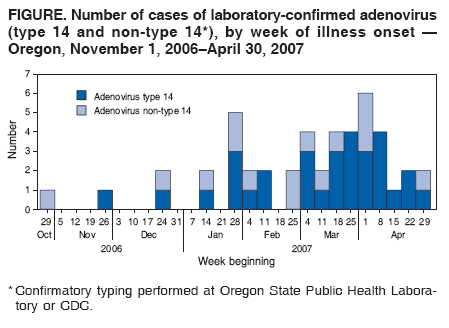
In March<SUP> </SUP>and April of 2006,<SUP> </SUP>Ad14 (subspecies B2) simultaneously<SUP> </SUP>emerged at 5 training<SUP> </SUP>centers, including San Diego,<SUP> </SUP>Lackland, Fort Leonard Wood,<SUP> </SUP>Great Lakes, and Fort<SUP> </SUP>Benning, thereby affecting all<SUP> </SUP>services except the Coast<SUP> </SUP>Guard (Cape May). At<SUP> </SUP>3 of these centers,<SUP> </SUP>Ad14 first appeared in<SUP> </SUP>coinfections with AdB1 serotypes<SUP> </SUP>and in 1 case<SUP> </SUP>as part of a<SUP> </SUP>triple infection with Ad4<SUP> </SUP>and Ad7. Ad14 maintained<SUP> </SUP>a consistent presence at<SUP> </SUP>Fort Benning, San Diego,<SUP> </SUP>and Great Lakes during<SUP> </SUP>summer 2006. At the<SUP> </SUP>same time, a variety<SUP> </SUP>of AdB1 serotypes emerged<SUP> </SUP>at all sites except<SUP> </SUP>Cape May. Ad3 cases<SUP> </SUP>were clustered at Fort<SUP> </SUP>Jackson, Ad7 at Fort<SUP> </SUP>Leonard Wood and Parris<SUP> </SUP>Island, and Ad21 at<SUP> </SUP>Parris Island and Fort<SUP> </SUP>Benning. All 6 identified<SUP> </SUP>serotypes were seen at<SUP> </SUP>Fort Benning during one<SUP> </SUP>2-month period. Many coinfections<SUP> </SUP>were identified, the majority<SUP> </SUP>of which were coinfections<SUP> </SUP>with Ad4 and one<SUP> </SUP>of the species B<SUP> </SUP>serotypes.<SUP> </SUP>
All whole-genome
<!--Start Italic-->Bam<!--End Italic-->HI restriction<SUP> </SUP>patterns (genome types) were<SUP> </SUP>concordant with PCR-inferred serotypes<SUP> </SUP>(or subspecies type, in<SUP> </SUP>the case of many<SUP> </SUP>of the AdB serotypes?
<!--Start Italic-->Bam<!--End Italic-->HI<SUP> </SUP>patterns can readily distinguish<SUP> </SUP>B1 from B2 subspecies,<SUP> </SUP>but many serotype determinations<SUP> </SUP>require analysis with additional<SUP> </SUP>enzymes). Likewise, all identifications<SUP> </SUP>based on hexon sequencing<SUP> </SUP>were concordant with the<SUP> </SUP>original PCR-inferred identifications. ARD<SUP> </SUP>rates at MCRD San<SUP> </SUP>Diego, the site with<SUP> </SUP>the most complete turnover<SUP> </SUP>between Ad4 and Ad14<SUP> </SUP>(i.e., between species E<SUP> </SUP>and subspecies B2), did<SUP> </SUP>not shift noticeably during<SUP> </SUP>the most distinct period<SUP> </SUP>of Ad14 dominance (
figure 3).<SUP> </SUP>Note that the general<SUP> </SUP>increase in the isolation<SUP> </SUP>rate over time is<SUP> </SUP>not a function of<SUP> </SUP>increased disease burden but<SUP> </SUP>rather of increased sampling<SUP> </SUP>effort.<SUP> </SUP>
<TABLE cellSpacing=10><TBODY><TR><TD vAlign=top align=middle>

[SIZE=-1](51 kB)[/SIZE]</TD><TD vAlign=top align=left>[FONT=arial,helvetica][SIZE=-1]
Figure 3. [/SIZE][/FONT][FONT=arial,helvetica][SIZE=-1]Acute respiratory disease (ARD)<SUP> </SUP>rate at the Marine<SUP> </SUP>Corps Recruit Depot (MCRD)<SUP> </SUP>San Diego, 2002?2006. The<SUP> </SUP>red line indicates the<SUP> </SUP>approximate time at which<SUP> </SUP>adenovirus (Ad) 14 emerged<SUP> </SUP>as a significant contributor<SUP> </SUP>to the Ad burden<SUP> </SUP>at this site. The<SUP> </SUP>figure suggests that the<SUP> </SUP>emergence of Ad14 did<SUP> </SUP>not cause a greatly<SUP> </SUP>increased level of ARD<SUP> </SUP>but rather that Ad14<SUP> </SUP>partially replaced Ad4 as<SUP> </SUP>a causative agent, with<SUP> </SUP>little impact on the<SUP> </SUP>overall rate of ARD.[/SIZE][/FONT]
</TD></TR></TBODY></TABLE>
[FONT=helvetica, arial][SIZE=+1]
DISCUSSION<SUP> </SUP>[/SIZE][/FONT]
All<SUP> </SUP>AdB1 serotypes previously seen<SUP> </SUP>in recruit training centers<SUP> </SUP>in the United States<SUP> </SUP>(Ad3, Ad7, and Ad21)<SUP> </SUP>have simultaneously reemerged against<SUP> </SUP>the background of Ad4<SUP> </SUP>(
figure 2). For the first<SUP> </SUP>time, an AdB2 serotype<SUP> </SUP>(Ad14) has emerged as<SUP> </SUP>a significant contributor to<SUP> </SUP>ARD in the Western<SUP> </SUP>Hemisphere. The simultaneous emergence<SUP> </SUP>of many serotypes has<SUP> </SUP>been broadly spread across<SUP> </SUP>many geographically isolated facilities,<SUP> </SUP>although Ad4 remains common<SUP> </SUP>at all sites. Population-based<SUP> </SUP>ARD rate data do<SUP> </SUP>not suggest that the<SUP> </SUP>emergence and subsequent dominance<SUP> </SUP>of Ad14 at San<SUP> </SUP>Diego in early 2006<SUP> </SUP>had any effect on<SUP> </SUP>the overall rate of<SUP> </SUP>ARD (
figure 3).<SUP> </SUP>
Soon after the<SUP> </SUP>original identification of Ads<SUP> </SUP>as agents of adult<SUP> </SUP>ARD in the 1950s<SUP> </SUP>[
16], 4 scattered ARD<SUP> </SUP>outbreaks associated with the<SUP> </SUP>AdB2 serotype 14 were<SUP> </SUP>reported in military and<SUP> </SUP>civilian adult populations. Ad14<SUP> </SUP>was initially discovered in<SUP> </SUP>an outbreak of ARD<SUP> </SUP>in Dutch recruits in<SUP> </SUP>1955 [
21]. Civilian outbreaks<SUP> </SUP>were reported in Great<SUP> </SUP>Britain in 1955 [
26],<SUP> </SUP>in Uzbekistan in 1962<SUP> </SUP>[
27], and in Czechoslovakia<SUP> </SUP>in 1963 (the only<SUP> </SUP>sustained outbreak of Ad14<SUP> </SUP>ever previously recorded) [
28].<SUP> </SUP>An apparent Ad11/Ad14 intermediate<SUP> </SUP>strain (denominated Ad14?11) was<SUP> </SUP>isolated after a large<SUP> </SUP>outbreak during a military<SUP> </SUP>training exercise in Spain<SUP> </SUP>in 1969 [
29]. In<SUP> </SUP>general, AdB2 serotypes are<SUP> </SUP>more commonly associated with<SUP> </SUP>sporadic illness, most often<SUP> </SUP>kidney and urinary tract<SUP> </SUP>infections [
3,
6].<SUP> </SUP>
Although both<SUP> </SUP>military and civilian surveys<SUP> </SUP>of Ad-associated ARD have<SUP> </SUP>commonly included assays capable<SUP> </SUP>of detecting and identifying<SUP> </SUP>Ad14 [
30,
31], this<SUP> </SUP>serotype was not reported<SUP> </SUP>in large outbreaks of<SUP> </SUP>ARD between the 1960s<SUP> </SUP>and the turn of<SUP> </SUP>the century. Such surveys<SUP> </SUP>reported, for example, no<SUP> </SUP>Ad14 at all (0<SUP> </SUP>of 1792 Ad isolates<SUP> </SUP>from children with respiratory<SUP> </SUP>illness in the United<SUP> </SUP>States) [
30] or very<SUP> </SUP>little (<1% of AdB<SUP> </SUP>serotypes other than Ad3<SUP> </SUP>or Ad7 among 3313<SUP> </SUP>Ad isolates from children<SUP> </SUP>and adults with respiratory<SUP> </SUP>illness in the United<SUP> </SUP>Kingdom) [
31].<SUP> </SUP>
A few recent<SUP> </SUP>studies yielded greater numbers<SUP> </SUP>of AdB2 identifications. A<SUP> </SUP>survey of adults and<SUP> </SUP>children with ARD in<SUP> </SUP>Egypt yielded a surprising<SUP> </SUP>proportion of Ad11 (4%<SUP> </SUP>of isolated Ads) [
6],<SUP> </SUP>and recent studies in<SUP> </SUP>Taiwan yielded similar proportions<SUP> </SUP>of Ad14 (2%?11% of<SUP> </SUP>isolates) [
32,
33]. Ad11<SUP> </SUP>was recently identified in<SUP> </SUP>2 German military troops<SUP> </SUP>returning from an exercise<SUP> </SUP>in Turkey [
22]. The<SUP> </SUP>affected troops had severe<SUP> </SUP>ARD symptoms and were<SUP> </SUP>strictly quarantined while the<SUP> </SUP>agent was identified. The<SUP> </SUP>exercise itself was subject<SUP> </SUP>to a widespread outbreak<SUP> </SUP>of ARD, which may<SUP> </SUP>well have been associated<SUP> </SUP>with the identified strain<SUP> </SUP>of Ad11.<SUP> </SUP>
These data point<SUP> </SUP>to a recent emergence<SUP> </SUP>of AdB2 serotypes as<SUP> </SUP>agents of ARD in<SUP> </SUP>healthy adults and children<SUP> </SUP>in Eurasia. This is<SUP> </SUP>similar to the current<SUP> </SUP>emergence of AdB2 in<SUP> </SUP>US military recruits, as<SUP> </SUP>described here. However, given<SUP> </SUP>that the serotypes involved<SUP> </SUP>are diverse, it seems<SUP> </SUP>unlikely that the simultaneous<SUP> </SUP>emergence of AdB2 serotypes<SUP> </SUP>as respiratory pathogens in<SUP> </SUP>multiple continents is resulting<SUP> </SUP>from the spread of<SUP> </SUP>recently evolved and adaptively<SUP> </SUP>superior strains.<SUP> </SUP>
The temporal distribution<SUP> </SUP>of Ads causing ARD<SUP> </SUP>in recruits can be<SUP> </SUP>highly varied. Sometimes single<SUP> </SUP>serotypes will dominate in<SUP> </SUP>a specific region, being<SUP> </SUP>very sharply replaced by<SUP> </SUP>other serotypes at intervals<SUP> </SUP>of a few years<SUP> </SUP>(see van der Veen<SUP> </SUP>et al. [
34], for<SUP> </SUP>example). Sometimes 2 or<SUP> </SUP>3 types will share<SUP> </SUP>dominance in specific outbreaks;<SUP> </SUP>this is commonly seen<SUP> </SUP>with Ad3 and Ad7<SUP> </SUP>(see Ryan et al.<SUP> </SUP>[
15], for example). Before<SUP> </SUP>the institution of vaccination<SUP> </SUP>protocols, subspecies B1 (Ad3<SUP> </SUP>and/or Ad7) and species<SUP> </SUP>E (Ad4) were often<SUP> </SUP>seen in significant numbers<SUP> </SUP>in the same year<SUP> </SUP>at the same site<SUP> </SUP>in US recruit facilities<SUP> </SUP>[
35], and many vaccinated<SUP> </SUP>recruits with Ad-associated ARD<SUP> </SUP>were found to harbor<SUP> </SUP>species E and B<SUP> </SUP>serotypes simultaneously [
36]. However,<SUP> </SUP>since the gradual withdrawal<SUP> </SUP>of vaccination measures in<SUP> </SUP>the United States between<SUP> </SUP>1996 and 1999, Ad4<SUP> </SUP>has dominated recruit training<SUP> </SUP>facilities. Ad4 has been<SUP> </SUP>associated with >98% of<SUP> </SUP>Ad-associated ARD cases from<SUP> </SUP>1999 through 2005 ([
20]<SUP> </SUP>and
figure 2), and AdE/AdB<SUP> </SUP>coinfections have been rare<SUP> </SUP>([
36] and
figure 2). The<SUP> </SUP>data presented here, which<SUP> </SUP>show many AdE/AdB coinfections<SUP> </SUP>associated with the general<SUP> </SUP>AdB reemergence in 2006,<SUP> </SUP>suggest that coinfections are<SUP> </SUP>the result of cocirculation<SUP> </SUP>and that neither coinfection<SUP> </SUP>nor cocirculation is directly<SUP> </SUP>related to vaccination status.<SUP> </SUP>
Coinfections<SUP> </SUP>are shown as split<SUP> </SUP>boxes in
figure 2. Coinfections<SUP> </SUP>are important because they<SUP> </SUP>provide the opportunity for<SUP> </SUP>Ad strains to recombine<SUP> </SUP>and form new variants<SUP> </SUP>[
6,
36]. Strains responsible<SUP> </SUP>for recent outbreak waves,<SUP> </SUP>including Ad7h and the<SUP> </SUP>genome type of Ad4<SUP> </SUP>that has dominated most<SUP> </SUP>of the recruit training<SUP> </SUP>facilities for the last<SUP> </SUP>10 years (Ad4a) [
24],<SUP> </SUP>appear to be interserotypic<SUP> </SUP>recombinants [
37,
38]. Coinfections<SUP> </SUP>with multiple Ads have<SUP> </SUP>only recently been recognized,<SUP> </SUP>owing to the advent<SUP> </SUP>of PCR typing [
36].<SUP> </SUP>Immunological methods such as<SUP> </SUP>neutralization are often done<SUP> </SUP>with low challenge doses<SUP> </SUP>(
100 TCID<SUB>50</SUB>) using single<SUP> </SUP>antisera and, as such,<SUP> </SUP>are unlikely to identify<SUP> </SUP>mixtures of multiple serotypes.<SUP> </SUP>
Ad4<SUP> </SUP>is ubiquitous in the<SUP> </SUP>recruits' physical environment, and<SUP> </SUP>transmission appears to be<SUP> </SUP>independent of regular import<SUP> </SUP>from outside sources to<SUP> </SUP>training centers [
17]. During<SUP> </SUP>the past 10 years<SUP> </SUP>of high Ad4 prevalence,<SUP> </SUP>different genome types have<SUP> </SUP>predominated at different sites,<SUP> </SUP>with a pattern of<SUP> </SUP>circulation that suggests that<SUP> </SUP>Ad4 population dynamics are<SUP> </SUP>driven by internal, possibly<SUP> </SUP>environmental, reservoirs [
24]. The<SUP> </SUP>data presented here suggest<SUP> </SUP>different dynamics for AdB<SUP> </SUP>serotypes. The emergence of<SUP> </SUP>Ad14, Ad21, and Ad7<SUP> </SUP>at multiple sites, all<SUP> </SUP>in the course of<SUP> </SUP>1 year and following<SUP> </SUP>a decade during which<SUP> </SUP>these types had little<SUP> </SUP>or no impact at<SUP> </SUP>all, suggests that these<SUP> </SUP>emergences are driven by<SUP> </SUP>importation from shared outside<SUP> </SUP>reservoirs. This reservoir is<SUP> </SUP>most likely the US<SUP> </SUP>civilian population, from which<SUP> </SUP>the affected trainees are<SUP> </SUP>recruited.<SUP> </SUP>
Dozens of publications from<SUP> </SUP>around the world during<SUP> </SUP>the last 40 years<SUP> </SUP>have documented the consistent<SUP> </SUP>circulation and clinical importance<SUP> </SUP>of Ad3, Ad7, and<SUP> </SUP>Ad21 in civilian populations.<SUP> </SUP>US recruit camps process<SUP> </SUP>tens of thousands of<SUP> </SUP>recruits from all parts<SUP> </SUP>of the United States<SUP> </SUP>every year. It would<SUP> </SUP>seem reasonable to assume<SUP> </SUP>that the influx of<SUP> </SUP>so many people from<SUP> </SUP>so many places would<SUP> </SUP>generate a constant influx<SUP> </SUP>of these common strains<SUP> </SUP>to the camps. It<SUP> </SUP>is therefore a mystery<SUP> </SUP>why all of the<SUP> </SUP>AdB1 serotypes that have<SUP> </SUP>ever been implicated in<SUP> </SUP>major ARD outbreaks in<SUP> </SUP>US recruits suddenly reemerged<SUP> </SUP>during the same year<SUP> </SUP>along with a previously<SUP> </SUP>rare AdB2 serotype.<SUP> </SUP>
We hypothesize<SUP> </SUP>that the main factor<SUP> </SUP>determining the variable presence<SUP> </SUP>of AdB serotypes among<SUP> </SUP>recruits is preexisting immunity<SUP> </SUP>in the recruit source<SUP> </SUP>population. In 1993, seropositivity<SUP> </SUP>for Ad7 among incoming<SUP> </SUP>recruits was estimated at<SUP> </SUP>27% [
39]. A study<SUP> </SUP>from the postvaccination era,<SUP> </SUP>when Ad4 was dominant,<SUP> </SUP>estimated incoming recruit seropositivity<SUP> </SUP>for Ad7 at 61%<SUP> </SUP>[
17]. The same 2<SUP> </SUP>studies reported a relatively<SUP> </SUP>constant level of incoming<SUP> </SUP>seropositivity for Ad4 (29%<SUP> </SUP>and 34%, respectively). Unfortunately,<SUP> </SUP>comparable data from 2006<SUP> </SUP>or from prevaccination periods<SUP> </SUP>of greater Ad diversity<SUP> </SUP>are not available. We<SUP> </SUP>hope that future work<SUP> </SUP>can address seropositivity on<SUP> </SUP>a more regular basis,<SUP> </SUP>because changes in source-population<SUP> </SUP>susceptibility may well predict<SUP> </SUP>the relative activity of<SUP> </SUP>different Ad serotypes in<SUP> </SUP>recruit facilities.<SUP> </SUP>
The previously deployed<SUP> </SUP>Ad4 and Ad7 vaccines,<SUP> </SUP>essentially identical to those<SUP> </SUP>currently in testing for<SUP> </SUP>future redeployment, do not<SUP> </SUP>directly target some of<SUP> </SUP>the currently circulating Ad<SUP> </SUP>serotypes. During previous periods<SUP> </SUP>of vaccination, Ad3 and<SUP> </SUP>Ad21 did continue to<SUP> </SUP>circulate among recruits, yet<SUP> </SUP>they never caused a<SUP> </SUP>return to prevaccination levels<SUP> </SUP>of disease. In fact,<SUP> </SUP>the vaccines appeared to<SUP> </SUP>prevent >95% of Ad-associated<SUP> </SUP>ARD and >50% of<SUP> </SUP>total recruit ARD despite<SUP> </SUP>the presence of these<SUP> </SUP>heterotypic Ads [
18]. In<SUP> </SUP>studies using serum obtained<SUP> </SUP>from military recruits vaccinated<SUP> </SUP>with the Ad4 and<SUP> </SUP>Ad7 vaccines, Ad7 immunization<SUP> </SUP>was shown to generate<SUP> </SUP>a significant increase in<SUP> </SUP>levels of neutralizing antibodies<SUP> </SUP>against Ad3 and Ad14<SUP> </SUP>[
40]. The cross-protective interaction<SUP> </SUP>between Ad7 and Ad14<SUP> </SUP>may be reflected in<SUP> </SUP>the data presented here<SUP> </SUP>(
figure 2): Ad7 and Ad14<SUP> </SUP>are almost exclusively clustered<SUP> </SUP>at different sites. It<SUP> </SUP>will be important to<SUP> </SUP>track the response of<SUP> </SUP>different serotypes if and<SUP> </SUP>when the vaccines are<SUP> </SUP>redeployed. It would certainly<SUP> </SUP>be possible to develop<SUP> </SUP>vaccines against other ARD-associated<SUP> </SUP>Ads in the advent<SUP> </SUP>that currently circulating strains<SUP> </SUP>of Ad3, Ad14, or<SUP> </SUP>Ad21 are found to<SUP> </SUP>cause high rates of<SUP> </SUP>disease after reinstitution of<SUP> </SUP>the Ad4 and Ad7<SUP> </SUP>vaccines, although previous evidence<SUP> </SUP>suggested that the addition<SUP> </SUP>of Ad21 to the<SUP> </SUP>Ad4/Ad7 combination decreased the<SUP> </SUP>effectiveness of all 3<SUP> </SUP>[
41].<SUP> </SUP>
[FONT=helvetica, arial]
Acknowledgments<SUP> </SUP>[/FONT]
We thank Dr. Leonard<SUP> </SUP>Binn for suggesting critical<SUP> </SUP>historical references. We acknowledge<SUP> </SUP>the administrative support of<SUP> </SUP>the Henry M. Jackson<SUP> </SUP>Foundation for Military Medicine<SUP> </SUP>and the efforts of<SUP> </SUP>the entire Naval Health<SUP> </SUP>Research Center team, especially<SUP> </SUP>the technicians and collection<SUP> </SUP>personnel whose efforts are<SUP> </SUP>represented in this work.<SUP> </SUP>We also acknowledge the<SUP> </SUP>clinic commanders and medical<SUP> </SUP>staff at Fort Benning,<SUP> </SUP>GA; Fort Jackson, SC;<SUP> </SUP>Fort Leonard Wood, MO<SUP> </SUP>(US Army); Lackland Air<SUP> </SUP>Force Base, San Antonio,<SUP> </SUP>TX (US Air Force);<SUP> </SUP>Naval Training Center, Great<SUP> </SUP>Lakes, IL (US Navy);<SUP> </SUP>Marine Corps Recruit Depot,<SUP> </SUP>San Diego, CA; Marine<SUP> </SUP>Corps Recruit Depot, Parris<SUP> </SUP>Island, SC (US Marine<SUP> </SUP>Corps); and Coast Guard<SUP> </SUP>Training Center, Cape May,<SUP> </SUP>NJ (US Coast Guard)<SUP> </SUP>for the permissions, access,<SUP> </SUP>and assistance necessary to<SUP> </SUP>conduct these studies.<SUP> </SUP>
<TABLE cellSpacing=0 cellPadding=0>[FONT=helvetica, arial]
References<SUP> </SUP>[/FONT]
<TBODY><TR><TD vAlign=top align=right>1. </TD><TD vAlign=top align=left>Rowe WP, Huebner RJ, Gilmore LK, Parrott RH, Ward TG. Isolation of a cytopathogenic agent from human adenoids undergoing spontaneous degeneration in tissue culture. Proc Soc Exp Biol Med
1953; 84:570?3.
First citation in article |
PubMed<SUP> </SUP></TD></TR><TR><TD vAlign=top align=right>2. </TD><TD vAlign=top align=left>Hierholzer JC, Stone YO, Broderson JR. Antigenic relationships among the 47 human adenoviruses determined in reference horse serum. Arch Virol
1991; 121:179?97.
First citation in article |
PubMed |
CrossRef<SUP> </SUP></TD></TR><TR><TD vAlign=top align=right>3. </TD><TD vAlign=top align=left>Wadell G. Adenoviruses. In: Encyclopedia of virology. Vol. 1. New York: Academic Press,
1994:1?7.
First citation in article<SUP> </SUP></TD></TR><TR><TD vAlign=top align=right>4. </TD><TD vAlign=top align=left>Wadell G. Molecular epidemiology of human adenoviruses. Curr Top Microbiol Immunol
1984; 110:191?20.
First citation in article |
PubMed<SUP> </SUP></TD></TR><TR><TD vAlign=top align=right>5. </TD><TD vAlign=top align=left>Li QG, Wadell G. Analysis of 15 different genome types of adenovirus type 7 isolated on five continents. J Virol
1986; 60:331?5.
First citation in article |
PubMed<SUP> </SUP></TD></TR><TR><TD vAlign=top align=right>6. </TD><TD vAlign=top align=left>Metzgar D, Osuna M, Yingst S, et al. PCR analysis of Egyptian respiratory adenovirus isolates, including identification of species, serotypes, and coinfections. J Clin Microbiol
2005; 43:5743?52.
First citation in article |
PubMed |
CrossRef<SUP> </SUP></TD></TR><TR><TD vAlign=top align=right>7. </TD><TD vAlign=top align=left>Xu W, Erdman DD. Type-specific identification of human adenovirus 3, 7, and 21 by a multiplex PCR assay. J Med Virol
2001; 64:537?42.
First citation in article |
PubMed |
CrossRef<SUP> </SUP></TD></TR><TR><TD vAlign=top align=right>8. </TD><TD vAlign=top align=left>Sarantis H, Johnson G, Brown M, Petric M, Tellier R. Comprehensive detection and serotyping of human adenoviruses by PCR and sequencing. J Clin Microbiol
2004; 42:3963?9.
First citation in article |
PubMed |
CrossRef<SUP> </SUP></TD></TR><TR><TD vAlign=top align=right>9. </TD><TD vAlign=top align=left>Xu W, McDonough MC, Erdman DD. Species-specific identification of human adenoviruses by a multiplex PCR assay. J Clin Microbiol
2000; 38:4114?20.
First citation in article |
PubMed<SUP> </SUP></TD></TR><TR><TD vAlign=top align=right>10. </TD><TD vAlign=top align=left>Schmitz H, Wigand R, Heinrich W. Worldwide epidemiology of adenovirus infections. Am J Epidemiol
1983; 117:455?66.
First citation in article |
PubMed<SUP> </SUP></TD></TR><TR><TD vAlign=top align=right>11. </TD><TD vAlign=top align=left>Rubin BA. Clinical picture and epidemiology of adenovirus infections. Acta Microbiol Hung
1993; 40:303?23.
First citation in article |
PubMed<SUP> </SUP></TD></TR><TR><TD vAlign=top align=right>12. </TD><TD vAlign=top align=left>Van der Veen J. The role of adenoviruses in respiratory disease. Am Rev Respir Dis
1963; 88:167?80.
First citation in article |
PubMed<SUP> </SUP></TD></TR><TR><TD vAlign=top align=right>13. </TD><TD vAlign=top align=left>Gray GC, Goswami PR, Malasig MD, et al. Adult adenovirus infections: loss of orphaned vaccines precipitates military respiratory disease epidemics. Clin Infect Dis
2000; 31:663?70.
First citation in article |
Full Text |
PubMed<SUP> </SUP></TD></TR><TR><TD vAlign=top align=right>14. </TD><TD vAlign=top align=left>Dudding BA, Top FH Jr, Winter PE, Buescher EL, Lamson TH, Leibovitz A. Acute respiratory disease in military trainees: the adenovirus surveillance program, 1966?1971. Am J Epidemiol
1973; 97:187?97.
First citation in article |
PubMed<SUP> </SUP></TD></TR><TR><TD vAlign=top align=right>15. </TD><TD vAlign=top align=left>Ryan MAK, Gray GC, Smith B, McKeehan JA, Hawksworth AW, Malasig MD. Large epidemic of respiratory illness due to adenovirus types 7 and 3 in healthy young adults. Clin Infect Dis
2002; 34:577?82.
First citation in article |
Full Text |
PubMed<SUP> </SUP></TD></TR><TR><TD vAlign=top align=right>16. </TD><TD vAlign=top align=left>Hilleman MR. Epidemiology of adenovirus respiratory infections in military recruit populations. Ann NY Acad Sci
1957; 67:262?72.
First citation in article |
PubMed |
CrossRef<SUP> </SUP></TD></TR><TR><TD vAlign=top align=right>17. </TD><TD vAlign=top align=left>Russell KL, Broderick MP, Franklin SE, et al. Transmission dynamics and prospective environmental sampling of adenovirus in a military recruit setting. J Infect Dis
2006; 194:877?85.
First citation in article |
PubMed<SUP> </SUP></TD></TR><TR><TD vAlign=top align=right>18. </TD><TD vAlign=top align=left>Russell KL, Hawksworth AW, Ryan MAK, et al. Vaccine-preventable adenoviral respiratory illness in US military recruits, 1999?2004. Vaccine
2006; 24:2835?42.
First citation in article |
PubMed |
CrossRef<SUP> </SUP></TD></TR><TR><TD vAlign=top align=right>19. </TD><TD vAlign=top align=left>Rose HM, Lamson TH, Buescher EL. Adenoviral infection in military recruits: emergence of type 7 and type 21 infections in recruits immunized with type 4 oral vaccine. Arch Environ Health
1970; 21:356?61.
First citation in article |
PubMed<SUP> </SUP></TD></TR><TR><TD vAlign=top align=right>20. </TD><TD vAlign=top align=left>Blasiole DA, Metzgar D, Daum LT, et al. Molecular analysis of adenovirus isolates from vaccinated and unvaccinated young adults. J Clin Microbiol
2004; 42:1686?93.
First citation in article |
PubMed |
CrossRef<SUP> </SUP></TD></TR><TR><TD vAlign=top align=right>21. </TD><TD vAlign=top align=left>Van der Veen J, Kok G. Isolation and typing of adenoviruses recovered from military recruits with acute respiratory disease in the Netherlands. Am J Hyg
1957; 65:119?29.
First citation in article |
PubMed<SUP> </SUP></TD></TR><TR><TD vAlign=top align=right>22. </TD><TD vAlign=top align=left>Chmielewicz B, Benzler J, Pauli G, Krause G, Bergmann F, Schweiger B. Respiratory disease caused by a species B2 adenovirus in a military camp in Turkey. J Med Virol
2005; 77:232?7.
First citation in article |
PubMed |
CrossRef<SUP> </SUP></TD></TR><TR><TD vAlign=top align=right>23. </TD><TD vAlign=top align=left>Malasig MD, Goswami PR, Crawford-Miksza LK, Schnurr DP, Gray GC. Simplified microneutralization test for serotyping adenovirus isolates. J Clin Microbiol
2001; 39:2984?6.
First citation in article |
PubMed |
CrossRef<SUP> </SUP></TD></TR><TR><TD vAlign=top align=right>24. </TD><TD vAlign=top align=left>Kajon AE, Moseley JM, Metzgar D, et al. Molecular epidemiology of adenovirus type 4 infections in US military recruits in the postvaccination era (1997?2003). J Infect Dis
2007; 196:67?75.
First citation in article |
Full Text |
PubMed<SUP> </SUP></TD></TR><TR><TD vAlign=top align=right>25. </TD><TD vAlign=top align=left>Altschul SF, Gish W, Miller W, Myers EW, Lipman DJ. Basic local alignment search tool. J Mol Biol
1990; 215:403?10.
First citation in article |
PubMed<SUP> </SUP></TD></TR><TR><TD vAlign=top align=right>26. </TD><TD vAlign=top align=left>Kendall EJC, Riddle RW, Tuck HA, Rodan KS, Andrews BE, McDonald JC. Pharyngo-conjunctival fever: school outbreaks in England during the summer of 1955 associated with adenovirus types 3, 7, and 14. BMJ
1957; 2:131?6.
First citation in article |
PubMed<SUP> </SUP></TD></TR><TR><TD vAlign=top align=right>27. </TD><TD vAlign=top align=left>Mevzos LM, Il'ina TS, Makhmudov OS, Zolotarskaia EE, Dreizin RS. [An outbreak of acute respiratory infections among adults caused by adenovirus serotype 14.] Vopr Virusol (Russian)
1966; 11:426?31.
First citation in article |
PubMed<SUP> </SUP></TD></TR><TR><TD vAlign=top align=right>28. </TD><TD vAlign=top align=left>Bruj J, Farnik J, Sedmidubsky V. [Epidemic of acute respiratory disease due to adenovirus type 14.] Cesk Epidemiol Mikrobiol Imunol (Czech)
1966; 15:165?71.
First citation in article |
PubMed<SUP> </SUP></TD></TR><TR><TD vAlign=top align=right>29. </TD><TD vAlign=top align=left>Hierholzer JC, Pumarola A. Antigenic characterization of intermediate adenovirus 14-11 strains associated with upper respiratory illness in a military camp. Infect Immun
1976; 13:354?9.
First citation in article |
PubMed<SUP> </SUP></TD></TR><TR><TD vAlign=top align=right>30. </TD><TD vAlign=top align=left>Brandt CD, Kim HW, Vargosko AJ, et al. Infections in 18,000 infants and children in a controlled study of respiratory tract disease. I. Adenovirus pathogenicity in relation to serologic type and illness syndrome. Am J Epidemiol
1969; 90:484?500.
First citation in article |
PubMed<SUP> </SUP></TD></TR><TR><TD vAlign=top align=right>31. </TD><TD vAlign=top align=left>Cooper RJ, Hallett R, Tullo AB, Klapper PE. The epidemiology of adenovirus infections in Greater Manchester, UK 1982?96. Epidemiol Infect
2000; 125:333?45.
First citation in article |
PubMed |
CrossRef<SUP> </SUP></TD></TR><TR><TD vAlign=top align=right>32. </TD><TD vAlign=top align=left>Lin KH, Lin YC, Chen HL, et al. A two-decade survey of respiratory adenovirus in Taiwan: the reemergence of adenovirus types 7 and 4. J Med Virol
2004; 73:274?9.
First citation in article |
PubMed |
CrossRef<SUP> </SUP></TD></TR><TR><TD vAlign=top align=right>33. </TD><TD vAlign=top align=left>Chen HL, Chiou SS, Hsiao HP, et al. Respiratory adenoviral infections in children: a study of hospitalized cases in southern Taiwan in 2001?2002. J Trop Pediatr
2004; 50:279?84.
First citation in article |
PubMed |
CrossRef<SUP> </SUP></TD></TR><TR><TD vAlign=top align=right>34. </TD><TD vAlign=top align=left>van der Veen J, Oei KG, Abarbanel MFW. Patterns of infections with adenovirus types 4, 7 and 21 in military recruits during a 9-year survey. J Hyg (Lond)
1969; 67:255?68.
First citation in article |
PubMed<SUP> </SUP></TD></TR><TR><TD vAlign=top align=right>35. </TD><TD vAlign=top align=left>Rosenbaum MJ, Edwards EA, Frank PF, Pierce WE, Crawford YE, Miller LF. Epidemiology and prevention of acute respiratory disease in naval recruits. I. Ten years' experience with microbial agents isolated from naval recruits with acute respiratory disease. Am J Public Health Nations Health
1965; 55:38?46.
First citation in article |
PubMed<SUP> </SUP></TD></TR><TR><TD vAlign=top align=right>36. </TD><TD vAlign=top align=left>Vora GJ, Lin B, Gratwick K, et al. Coinfections of adenovirus species in previously vaccinated patients. Emerg Infect Dis
2006; 12:921?30.
First citation in article |
PubMed<SUP> </SUP></TD></TR><TR><TD vAlign=top align=right>37. </TD><TD vAlign=top align=left>Houng HH, Clavio S, Graham K, et al. Emergence of a new human adenovirus type 4 (Ad4) genotype: identification of a novel inverted terminal repeated (ITR) sequence from a majority of Ad4 isolates from US military recruits. J Clin Virol
2006; 35:381?7.
First citation in article |
PubMed |
CrossRef<SUP> </SUP></TD></TR><TR><TD vAlign=top align=right>38. </TD><TD vAlign=top align=left>Kajon AE, Wadell G. Sequence analysis of the E3 region and fiber gene of human adenovirus genome type 7h. Virology
1996; 215:190?6.
First citation in article |
PubMed |
CrossRef<SUP> </SUP></TD></TR><TR><TD vAlign=top align=right>39. </TD><TD vAlign=top align=left>Ludwig SL, Brundage JF, Kelley PW, et al. Prevalence of antibodies to adenovirus serotypes 4 and 7 among unimmunized US Army trainees: results of a retrospective nationwide seroprevalence survey. J Infect Dis
1998; 178:1776?8.
First citation in article |
Full Text |
PubMed<SUP> </SUP></TD></TR><TR><TD vAlign=top align=right>40. </TD><TD vAlign=top align=left>van der Veen J, Prins A. Studies of the significance of the recall phenomenon in the antibody response to adenovirus vaccine and infection. J Immunol
1960; 84:562?8.
First citation in article |
PubMed<SUP> </SUP></TD></TR><TR><TD vAlign=top align=right>41. </TD><TD vAlign=top align=left>Takafuji ET, Gaydos JC, Allen RG, Top FH Jr. Simultaneous administration of live, enteric-coated adenovirus types 4, 7, and 21 vaccines: safety and immunogenicity. J Infect Dis
1979; 140:48?53.
First citation in article |
PubMed<SUP> </SUP></TD></TR>
</TABLE>



 -13.
-13.