

Michael Coston
Editor, Senior Moderator
A Reminder About The `Other' Novel Flu Threat
#12,606
During the summer and early fall avian flu reports begin to dwindle, and our attention often shifts to novel swine viruses instead. Although swine influenza viruses circulate year-round in pigs, it is during the summer and fall that pigs and the community have the most contact, via hundreds of state and county fairs around the country.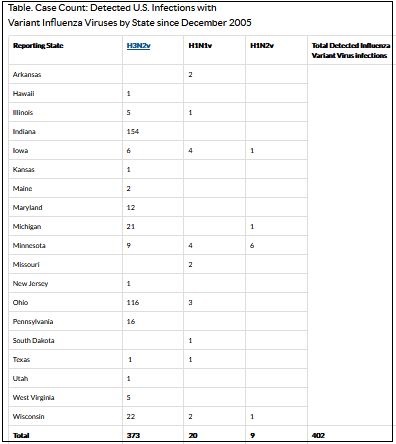
The CDC describes Swine Variant viruses in their Key Facts FAQ.
Pigs are viewed as excellent `mixing vessels' for influenza viruses, due to having both mammalian α2,6 receptor cells and avian-like α2,3 receptor cells, and having frequent contact with humans and birds. They are often infected with human seasonal flu, along with their own swine flu viruses.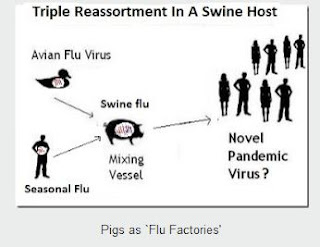
The 2009 H1N1 pandemic virus was a triple-reassortment of swine, human, and avian flu viruses, and only leapt from pigs to humans after a decade of evolution while circulating unnoticed in pigs.
While we've only seen a couple of swine variant cases announced this year (see CDC FluView Reports Novel H3N2v Case From Texas), over the winter we saw a number of reports from other countries of novel flu strains either in pigs or in humans.
In December of 2015, in PNAS: The Pandemic Potential Of Eurasian Avian-like H1N1 (EAH1N1) Swine Influenza, we looked at the isolation and characterization of a number avian H1N1 virus variants circulating in Chinese pigs that researchers there believe have considerable pandemic potential.
In the `Significance' section the authors boiled it down to this:
Key Facts for People Exhibiting Pigs at Fairs[545 KB, 2 pages]
Take Action to Prevent the Spread of Flu Between People and Pigs[1.3 MB, 2 pages]
Educational Posters[389 KB, 1 page]
Compendium of Measures to Prevent Disease Associated with Animals in Public Settings, 2013.
Reduce Your Risk (English)[22 KB, 1 page] | (Spanish)[22 KB, 1 page]
Measures to Minimize Influenza Transmission at Swine Exhibitions, 2016 ? NASAHO and NASPHV[97 KB, 8 pages
http://afludiary.blogspot.com/2017/0...lu-threat.html
#12,606
During the summer and early fall avian flu reports begin to dwindle, and our attention often shifts to novel swine viruses instead. Although swine influenza viruses circulate year-round in pigs, it is during the summer and fall that pigs and the community have the most contact, via hundreds of state and county fairs around the country.
Over the past 10 years we've seen just over 400 human infections with swine variant viruses reported in the United States, with the H3N2v strain the most common (see chart below).
The CDC describes Swine Variant viruses in their Key Facts FAQ.
What is a variant influenza virus?
When an influenza virus that normally circulates in swine (but not people) is detected in a person, it is called a ?variant influenza virus.? For example, if a swine origin influenza A H3N2 virus is detected in a person, that virus will be called an ?H3N2 variant? virus or ?H3N2v? virus.
Prior to 2010, 1 or 2 cases were reported each year, although the real number is believed much higher. Most cases are mild, and indistinguishable from seasonal flu, and so very few cases are tested. When an influenza virus that normally circulates in swine (but not people) is detected in a person, it is called a ?variant influenza virus.? For example, if a swine origin influenza A H3N2 virus is detected in a person, that virus will be called an ?H3N2 variant? virus or ?H3N2v? virus.
In 2010 that number jumped to 8, and in 2011 to 12. The next year (2012), more than 300 cases were reported across 10 states. Indiana reported the most cases (n=138), followed by Ohio (n=106).
Things settled back down for a few years, with only a handful of cases reported between 2013 and 2015. Last August, however, over a period of several weeks 18 people - all fair attendees - were diagnosed with swine-variant H3N2v in two states; Michigan and Ohio. In October the MMWR: Investigation Into H3N2v Outbreak In Ohio & Michigan - Summer 2016revealed that 16 of the 18 cases analyzed belonged to a new genotype not previously detected in humans.
Since the influenza subtypes that commonly circulate in swine (H1, H2 & H3) are also the same HA subtypes as have caused all of the human pandemics going back 130 years (see Are Influenza Pandemic Viruses Members Of An Exclusive Club?), when swine variant viruses jump to humans, it captures our attention.Pigs are viewed as excellent `mixing vessels' for influenza viruses, due to having both mammalian α2,6 receptor cells and avian-like α2,3 receptor cells, and having frequent contact with humans and birds. They are often infected with human seasonal flu, along with their own swine flu viruses.
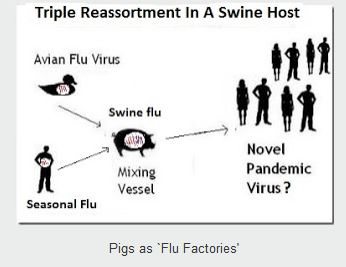
The 2009 H1N1 pandemic virus was a triple-reassortment of swine, human, and avian flu viruses, and only leapt from pigs to humans after a decade of evolution while circulating unnoticed in pigs.
While we've only seen a couple of swine variant cases announced this year (see CDC FluView Reports Novel H3N2v Case From Texas), over the winter we saw a number of reports from other countries of novel flu strains either in pigs or in humans.
- In March, I&ORV: Triple-Reassortant Novel H3 Virus of Human/Swine Origin Established In Danish Pigs we saw a novel reassortant virus that was of 7/8ths human origin (contributions from the seasonal H3 and H1N109 viruses), including the A(H1N1)pdm09 matrix gene, which the CDC has previously speculated:`. . . may confer increased transmissibility to and among humans, compared to other variant influenza viruses.? ? CDC HAN 2012.
- In February, in Eurosurveillance: Swine Origin H1N1 Infection Leading To Severe Illness - Italy, 2016, we saw a report of a man with indirect pig exposure (he lived with someone who worked with pigs), who became critically ill, and required ECMO life support, during his 30 day hospitalization for an H1N1v infection.
- And last December, in Eurosurveillance: Severe acute respiratory infection caused by swine influenza virus in a child, we looked at a report on a school-aged child in the Netherlands whose condition deteriorated enough to require ECMO (Extracorporeal membrane oxygenation) life support. In this case, the patient reported no direct contact with pigs, but had visited a piggery. The virus was H1N1v.
In December of 2015, in PNAS: The Pandemic Potential Of Eurasian Avian-like H1N1 (EAH1N1) Swine Influenza, we looked at the isolation and characterization of a number avian H1N1 virus variants circulating in Chinese pigs that researchers there believe have considerable pandemic potential.
In the `Significance' section the authors boiled it down to this:
Here, we found that, after long-term evolution in pigs, the EAH1N1 SIVs have obtained the traits to cause a human influenza pandemic.
Similarly, in August of 2015, we looked at a study that examined two recently discovered swine variant strains (see J. Virol: Novel Reassortant Human-like H3N2 & H3N1 Influenza A Viruses In Pigs) in North America. They described both of these novel subtypes as: ?. . . virulent and can sustain onward transmission in pigs, and the naturally occurring mutations in the HA were associated with antigenic divergence from H3 IAV from human and swine?? and goes on to warn that ``. . . the potential risk of these emerging swine IAV to humans should be considered?.
While avian flu viruses tend to produce more severe illness when they infect humans, swine influenza viruses are worrisome because they are already adapted to mammals, and are believed to have less of a `leap? to make in order to adapt to humans. With the summer state and county fair season underway, the odds go up that we will see additional, scattered reports of swine variant infection, as these venues tend to put a lot of people into close contact with pigs.
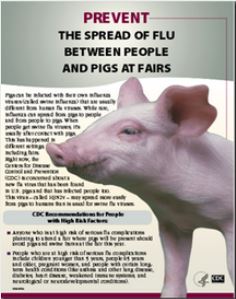
For more information on swine variant viruses, and how to protect yourself when in contact with farm animals, the CDC provides the following guides. Key Facts for People Exhibiting Pigs at Fairs[545 KB, 2 pages]
Take Action to Prevent the Spread of Flu Between People and Pigs[1.3 MB, 2 pages]
Educational Posters[389 KB, 1 page]
Compendium of Measures to Prevent Disease Associated with Animals in Public Settings, 2013.
Reduce Your Risk (English)[22 KB, 1 page] | (Spanish)[22 KB, 1 page]
Measures to Minimize Influenza Transmission at Swine Exhibitions, 2016 ? NASAHO and NASPHV[97 KB, 8 pages
http://afludiary.blogspot.com/2017/0...lu-threat.html
Last edited: