

Michael Coston
Editor, Senior Moderator
A Reminder About Naegleria Season
#12,492
The Memorial Day Weekend traditionally signals the start of the long awaited summer swimming season - but with that comes risks - including the dangers of rip currents (see How Not To Be Swept Away This Summer), potentially serious salt water skin infections (see Vulnerable To Vibrio), and an extraordinarily rare, but often fatal, brain infection from an amoebic parasite called Naegleria fowleri.
In 2011, however, we saw two cases reported in Neti pot users from Louisiana, prompting the Louisiana Health Department to recommend that people`use distilled, sterile or previously boiled water to make up the irrigation solution’ (seeNeti Pots & Naegleria Fowleri).
While extraordinarily rare in the United States, every year Pakistan reports a dozen or more infections from this `killer amoeba’, as chlorination of their water supplies is often inadequate, and for many, nasal ablutions are part of their daily ritual.
Last year we looked at an MMWR: Epidemiological Investigation Into A Case Of Primary Amebic Meningoencephalitis in California which suggested a poorly chlorinated spring-fed swimming pool was the likely source of infection and death of a 21 year old woman.
[TR]
[TD] [/TD]
[/TD]
[/TR]
[TR]
[TD="class: tr-caption"]Credit Florida DOH[/TD]
[/TR]
[/TABLE]
The State of Florida's Primary Amebic Meningoencephalitis (PAM) website recommends:
#12,492
The Memorial Day Weekend traditionally signals the start of the long awaited summer swimming season - but with that comes risks - including the dangers of rip currents (see How Not To Be Swept Away This Summer), potentially serious salt water skin infections (see Vulnerable To Vibrio), and an extraordinarily rare, but often fatal, brain infection from an amoebic parasite called Naegleria fowleri.
Dubbed the `brain eating amoeba' by the press - this infection is called PAM (Primary amebic meningoencephalitis) - and occurs when the amoeba enters the brain through the nasal passages, usually due to the forceful aspiration of contaminated water into the nose.
Until a few years ago, nearly all of the Naegleria infections reported in the United States were linked to swimming in warm, stagnant freshwater ponds and lakes (see Naegleria: Rare, 99% Fatal & Preventable), making this pretty much a summer time threat.In 2011, however, we saw two cases reported in Neti pot users from Louisiana, prompting the Louisiana Health Department to recommend that people`use distilled, sterile or previously boiled water to make up the irrigation solution’ (seeNeti Pots & Naegleria Fowleri).
While extraordinarily rare in the United States, every year Pakistan reports a dozen or more infections from this `killer amoeba’, as chlorination of their water supplies is often inadequate, and for many, nasal ablutions are part of their daily ritual.
Last year we looked at an MMWR: Epidemiological Investigation Into A Case Of Primary Amebic Meningoencephalitis in California which suggested a poorly chlorinated spring-fed swimming pool was the likely source of infection and death of a 21 year old woman.
This was also an unusual finding, and furthers the recent pattern of seeing PAM cases arise from atypical settings (Northern states, via neti pots and municipal water supplies, etc.) in the United States.
Up until a recently, infection with Naegleria fowleri was universally fatal, but in 2013 an investigational drug called miltefosine was used successfully for the first time to treat the infection. Early diagnosis, and administration of this drug, are crucial however. Even with this new drug, prevention is the key to saving lives, and leading the charge in educating the public is http://amoeba-season.com/, a USF Philip T. Gompf Memorial Fund project,which was set up by a pair of Florida doctors who tragically lost their 10 year-old son to this parasite in 2009.
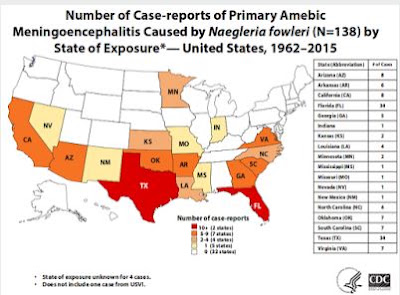
As a thermophilic (heat-loving), free-living amoeba, it is hardly surprising to see that Florida and Texas lead the nation in cases over the past three decades, although infections have occurred as far north as Minnesota. [TABLE="class: tr-caption-container, align: center, cellpadding: 0, cellspacing: 0"][TR]
[TD]
[/TD][/TR]
[TR]
[TD="class: tr-caption"]Credit Florida DOH[/TD]
[/TR]
[/TABLE]
The State of Florida's Primary Amebic Meningoencephalitis (PAM) website recommends:
The only known way to prevent Naegleria fowleri infections is to refrain from water-related activities. However, some common-sense measures that might reduce risk by limiting the chance of contaminated water going up the nose include:
- Avoiding water-related activities in bodies of warm freshwater, hot springs, and thermally-polluted water such as water around power plants.
- Avoiding water-related activities in warm freshwater during periods of high water temperature and low water levels.
- Holding the nose shut or using nose clips when taking part in water-related activities in bodies of warm freshwater such as lakes, rivers, or hot springs.
- Avoiding digging or stirring up sediment while taking part in water-related activities in shallow, warm freshwater areas.
Information about the risks associated with Naegleria fowleri infection should be included in public health messages discussing general issues of recreational water safety and risk.
When preparing solutions of tap water for sinus irrigation, the user should use tap water previously boiled for 1 minute (at elevations above 6,500 feet, boil for 3 minutes) and left to cool, use water filtered with an absolute filter pore size of 1 micron or smaller, or use clearly marked distilled or sterile water in the irrigation device. Rinse the irrigation device after each use with water that has been previously boiled, filtered, distilled, or sterilized and leave the device open to air dry completely.
For some of my earlier blogs on Naegleria you may wish to revisit: