Re: 2009 Influenza Sentinel Surveillance - ESR
Influenza viruses
There are two parts to the influenza surveillance system in New Zealand, one is general practice (GP)
sentinel surveillance and the other is
laboratory-based surveillance.
(
top)
Sentinel Surveillance
The sentinel surveillance system commenced in 1991 as part of the WHO (World Health Organisation) global programme for influenza surveillance. It is operated nationally by ESR and locally by surveillance co-ordinators within the public health service in each health district. The system operates during the 'influenza season', from May through September each year.
It is based on a network of voluntary sentinel GPs distributed on a population density basis of approximately 1 per 50,000. Sentinel General Practices carry out both disease and virological surveillance. Each sentinel practice records the daily number of consultations that fit a case definition for an influenza-like illness (ILI), along with the patient's age, on a standardised reporting sheet.
The influenza case definition is "an acute respiratory tract infection characterized by an abrupt onset of two of the following: fever, chills, headache and myalgia". This data is either collected by phone, or forwarded by fax each Friday. Consultation rates are calculated using the number of consultations as the numerator and the sum of the patient populations, reported by the participating practices, as the denominator.
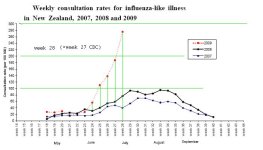
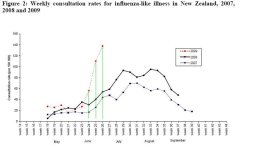
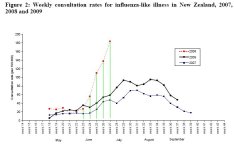
The national level of ILI activity is described using a set of threshold values: a weekly rate of 50-249 consultations per 100,000 patient population is considered indicative of normal seasonal activity; 250-399 indicates higher than expected activity, and >= 400 indicates an epidemic level of disease.
Each sentinel practice also provides respiratory samples from the first patient seen with an ILI on Monday, Tuesday and Wednesday of each week, which are forwarded to four regional virus diagnostic laboratories at Auckland, Waikato, Christchurch and Dunedin hospital and ESR virology laboratory for virus isolation and identification.
Weekly consultation data, along with virus isolation data, are forwarded by local co-ordinators to ESR each Monday. Collated national data are presented in reports
weekly,
monthly and
annually. (
top)
Laboratory-based Surveillance
The year-round laboratory-based surveillance of influenza and other viruses, is carried out by the four regional laboratories and by the ESR virology laboratory. These laboratories report all virus diagnoses made, largely from hospital in-patients and outpatients, to ESR. These data are reported nationally in the ESR
Virology Weekly Report.
(
top)
http://www.surv.esr.cri.nz/public_health_surveillance/influenza.php



 unctuationKerning/> <w:ValidateAgainstSchemas/> <w:SaveIfXMLInvalid>false</w:SaveIfXMLInvalid> <w:IgnoreMixedContent>false</w:IgnoreMixedContent> <w:AlwaysShowPlaceholderText>false</w:AlwaysShowPlaceholderText> <w:Compatibility> <w:BreakWrappedTables/> <w:SnapToGridInCell/> <w:WrapTextWithPunct/> <w:UseAsianBreakRules/> <w
 ontGrowAutofit/> </w:Compatibility> <w:BrowserLevel>MicrosoftInternetExplorer4</w:BrowserLevel> </w:WordDocument> </xml><![endif]--><!--[if gte mso 9]><xml> <w:LatentStyles DefLockedState="false" LatentStyleCount="156"> </w:LatentStyles> </xml><![endif]--><style> <!-- /* Style Definitions */ p.MsoNormal, li.MsoNormal, div.MsoNormal {mso-style-parent:""; margin:0cm; margin-bottom:.0001pt; mso-pagination:widow-orphan; font-size:12.0pt; font-family:"Times New Roman"; mso-fareast-font-family:"Times New Roman"; mso-ansi-language:EN-AU;} p.MsoBodyText, li.MsoBodyText, div.MsoBodyText {margin:0cm; margin-bottom:.0001pt; mso-pagination:none; font-size:12.0pt; mso-bidi-font-size:10.0pt; font-family:"Times New Roman"; mso-fareast-font-family:"Times New Roman"; mso-ansi-language:EN-GB;} @page Section1 {size:612.0pt 792.0pt; margin:72.0pt 90.0pt 72.0pt 90.0pt; mso-header-margin:36.0pt; mso-footer-margin:36.0pt; mso-paper-source:0;} div.Section1 {page:Section1;} --> </style><!--[if gte mso 10]> <style> /* Style Definitions */ table.MsoNormalTable {mso-style-name:"Table Normal"; mso-tstyle-rowband-size:0; mso-tstyle-colband-size:0; mso-style-noshow:yes; mso-style-parent:""; mso-padding-alt:0cm 5.4pt 0cm 5.4pt; mso-para-margin:0cm; mso-para-margin-bottom:.0001pt; mso-pagination:widow-orphan; font-size:10.0pt; font-family:"Times New Roman"; mso-ansi-language:#0400; mso-fareast-language:#0400; mso-bidi-language:#0400;} </style> <![endif]--> One hundred and sixty-seven swabs were sent from the sentinel surveillance in the past week. Two hundred and ten swabs were received by the virology laboratories. Of these, 85 influenza viruses were identified: novel influenza AH1N1 09 virus (68), seasonal influenza A virus (13), and seasonal influenza AH1N1 virus (4). The distribution by health district is shown in Table 1.<o