

Ronan Kelly
Retired 2020
http://www.paho.org/hq/index.php?op...-epidemiological-updates&Itemid=41691&lang=en
[h=1]Regional Zika Epidemiological Update (Americas) - 23 June 2016[/h]
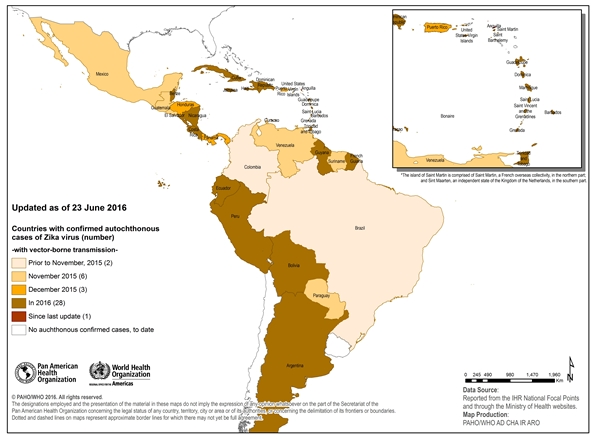
[h=2]Zika virus (ZIKV) ? Incidence and Trends[/h] To date, 40 countries and territories have confirmed local, vector-borne transmission of Zika virus disease in the Region of the Americas since 2015 (Figure 1). Since the last Pan American Health Organization/ World Health Organization (PAHO/WHO) Zika Epidemiological Update on 16 June 2016, Anguilla has confirmed vector-borne autochthonous transmission of Zika virus.
Figure 1. Countries and territories in the Americas with confirmed autochthonous (vector-borne) Zika virus cases, 2015-2016.
[h=2]Congenital syndrome associated with Zika virus infection[1][/h] No new countries or territories have reported cases of congenital syndrome associated with Zika virus infection (Table 1) since the last PAHO/WHO Zika Epidemiological Update on 16 June 2016. The Jamaica public health authorities reported that one of the four pregnant women confirmed with Zika virus infection was diagnosed with intra-uterine death during a routine ultrasound at 20 weeks of gestation.
Table 1. Countries and territories in the Americas with reported congenital syndrome associated with Zika virus infection.

Source: Data provided by the health authorities of countries and territories to PAHO/WHO
Guillain-Barr? syndrome (GBS) and other neurological disorders
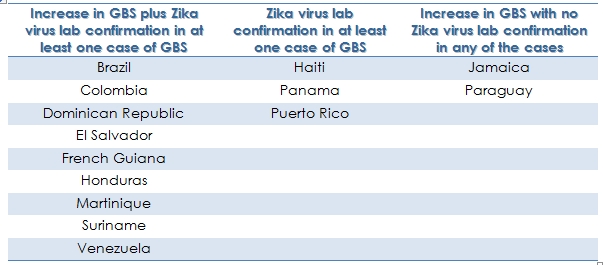
To date, 11 countries and territories in the Region have reported an increase in cases of Guillain-Barr? syndrome (GBS), and three other countries and territories have identified Zika-virus-associated GBS cases without recording an increase in GBS cases (Table 2).
Table 2. Countries and territories in the Americas with GBS in the context of Zika virus circulation.
The distribution of cases of Zika virus disease and GBS for Colombia, the Dominican Republic, El Salvador, Honduras, and Suriname is shown in Figure 2. Both curves are similarly shaped, indicating a temporal relation between cases of Zika virus disease and cases of GBS.
Figure 2. Cases of Zika virus disease and cases of GBS associated with Zika virus infection in Colombia, the Dominican Republic, El Salvador, Honduras, and Suriname, EW 32 of 2015 to EW 22 of 2016.

Source: Data provided by the Ministries of Health of Colombia, the Dominican Republic, El Salvador, Honduras and Suriname to PAHO/WHO
In Dominican Republic and Suriname, a significant increase of GBS cases was reported in the previous weeks. The situation in the Dominican Republic and Suriname is highlighted below.
Dominican Republic
Between EW 1 and EW 20 of 2016, the Dominican Republic reported 139 cases of GBS, including 15 deaths (Figure 3). Of the total reported cases, 38% were identified in the last 4 weeks (EW 17-20 of 2016). Of the total reported cases, 62% are residents from Santo Domingo Province, and the Distrito Nacional (56 and 30 cases, respectively).
Figure 3. Reported cases of GBS and suspected and confirmed cases of Zika virus disease, by epidemiological week. Dominican Republic, EW 1-20 of 2016.

Source: Data published by the Dominican Republic Ministry of Health and reproduced by PAHO/WHO
Suriname
Between EW 1 and EW 24 of 2016, Suriname identified 18 cases of GBS. The number of cases in 2016 is nearly double the number of cases notified in 2015, and is six times greater than the number notified in 2014 (Figure 4). Of the 18 GBS cases notified during the current year, Zika virus infection was confirmed in three cases.
Figure 4. Cases of GBS, by date of notification, Suriname, 2011-2016*

Source: Data provided by the Suriname Ministry of Health to PAHO/WHO. *Up to EW 24 of 2016.
-----------------------------
[1] Case definition available at: http://bit.ly/1TpcVIS
[2] Two microcephaly cases and one other fetal anomaly. See full report.
[3] This is a congenital anomaly case. See full report.
[4] Imported cases; one case linked to a stay in Brazil (see full report) and one case is linked to a brief stay of the mother in Belize, Guatemala and Mexico (see full report).
[5] In addition, the United States informed through the Centers for Disease Control and Prevention website of three fetal deaths with congenital anomalies. This includes miscarriages, stillbirths and voluntary abortions. Read the information.
-----------------------------
Suggested citation: Pan American Health Organization / World Health Organization. Zika Epidemiological Update ? 23 June 2016. Washington, D.C.: PAHO/WHO; 2016
Pan American Health Organization ? www.paho.org ? ? PAHO/WHO, 2016
[h=2]More Epidemiological Alerts and Updates[/h]
[h=1]Regional Zika Epidemiological Update (Americas) - 23 June 2016[/h]
[h=2]Zika virus (ZIKV) ? Incidence and Trends[/h] To date, 40 countries and territories have confirmed local, vector-borne transmission of Zika virus disease in the Region of the Americas since 2015 (Figure 1). Since the last Pan American Health Organization/ World Health Organization (PAHO/WHO) Zika Epidemiological Update on 16 June 2016, Anguilla has confirmed vector-borne autochthonous transmission of Zika virus.
Figure 1. Countries and territories in the Americas with confirmed autochthonous (vector-borne) Zika virus cases, 2015-2016.
[h=2]Congenital syndrome associated with Zika virus infection[1][/h] No new countries or territories have reported cases of congenital syndrome associated with Zika virus infection (Table 1) since the last PAHO/WHO Zika Epidemiological Update on 16 June 2016. The Jamaica public health authorities reported that one of the four pregnant women confirmed with Zika virus infection was diagnosed with intra-uterine death during a routine ultrasound at 20 weeks of gestation.
Table 1. Countries and territories in the Americas with reported congenital syndrome associated with Zika virus infection.
Source: Data provided by the health authorities of countries and territories to PAHO/WHO
Guillain-Barr? syndrome (GBS) and other neurological disorders
To date, 11 countries and territories in the Region have reported an increase in cases of Guillain-Barr? syndrome (GBS), and three other countries and territories have identified Zika-virus-associated GBS cases without recording an increase in GBS cases (Table 2).
Table 2. Countries and territories in the Americas with GBS in the context of Zika virus circulation.
The distribution of cases of Zika virus disease and GBS for Colombia, the Dominican Republic, El Salvador, Honduras, and Suriname is shown in Figure 2. Both curves are similarly shaped, indicating a temporal relation between cases of Zika virus disease and cases of GBS.
Figure 2. Cases of Zika virus disease and cases of GBS associated with Zika virus infection in Colombia, the Dominican Republic, El Salvador, Honduras, and Suriname, EW 32 of 2015 to EW 22 of 2016.
Source: Data provided by the Ministries of Health of Colombia, the Dominican Republic, El Salvador, Honduras and Suriname to PAHO/WHO
In Dominican Republic and Suriname, a significant increase of GBS cases was reported in the previous weeks. The situation in the Dominican Republic and Suriname is highlighted below.
Dominican Republic
Between EW 1 and EW 20 of 2016, the Dominican Republic reported 139 cases of GBS, including 15 deaths (Figure 3). Of the total reported cases, 38% were identified in the last 4 weeks (EW 17-20 of 2016). Of the total reported cases, 62% are residents from Santo Domingo Province, and the Distrito Nacional (56 and 30 cases, respectively).
Figure 3. Reported cases of GBS and suspected and confirmed cases of Zika virus disease, by epidemiological week. Dominican Republic, EW 1-20 of 2016.
Source: Data published by the Dominican Republic Ministry of Health and reproduced by PAHO/WHO
Suriname
Between EW 1 and EW 24 of 2016, Suriname identified 18 cases of GBS. The number of cases in 2016 is nearly double the number of cases notified in 2015, and is six times greater than the number notified in 2014 (Figure 4). Of the 18 GBS cases notified during the current year, Zika virus infection was confirmed in three cases.
Figure 4. Cases of GBS, by date of notification, Suriname, 2011-2016*
Source: Data provided by the Suriname Ministry of Health to PAHO/WHO. *Up to EW 24 of 2016.
-----------------------------
[1] Case definition available at: http://bit.ly/1TpcVIS
[2] Two microcephaly cases and one other fetal anomaly. See full report.
[3] This is a congenital anomaly case. See full report.
[4] Imported cases; one case linked to a stay in Brazil (see full report) and one case is linked to a brief stay of the mother in Belize, Guatemala and Mexico (see full report).
[5] In addition, the United States informed through the Centers for Disease Control and Prevention website of three fetal deaths with congenital anomalies. This includes miscarriages, stillbirths and voluntary abortions. Read the information.
-----------------------------
Suggested citation: Pan American Health Organization / World Health Organization. Zika Epidemiological Update ? 23 June 2016. Washington, D.C.: PAHO/WHO; 2016
Pan American Health Organization ? www.paho.org ? ? PAHO/WHO, 2016
[h=2]More Epidemiological Alerts and Updates[/h]
- 23 June 2016: Zika Virus Infection - Epidemiological Update
- 16 June 2016: Zika Virus Infection - Epidemiological Update
- 9 June 2016: Zika Virus Infection - Epidemiological Update
- 2 June 2016: Zika Virus Infection - Epidemiological Update
- 26 May 2016: Zika Virus Infection - Epidemiological Update
- 19 May 2016: Zika Virus Infection - Epidemiological Update
- 12 May 2016: Zika Virus Infection - Epidemiological Update
- 5 May 2016: Zika Virus Infection - Epidemiological Update
- 28 April 2016: Zika Virus Infection - Epidemiological Update
- 21 April 2016: Zika Virus Infection - Epidemiological Update
- 14 April 2016: Zika Virus Infection - Epidemiological Update
- 8 April 2016: Zika Virus Infection - Epidemiological Update
- 31 March 2016: Zika Virus Infection - Epidemiological Update
- 24 March 2016: Zika Virus Infection - Epidemiological Update
- 17 March 2016: Zika Virus Infection - Epidemiological Update
- 10 March 2016: Zika Virus Infection - Epidemiological Update
- 3 March 2016: Zika Virus Infection - Epidemiological Update
- 24 February 2016: Zika Virus Infection - Epidemiological Update
- 17 February 2016: Zika Virus Infection - Epidemiological Update
- 10 February 2016: Reported increase of congenital microcephaly and other central nervous system symptoms - Epidemiological Update
- 17 January 2016: Neurological syndrome, congenital malformations, and Zika virus infection ? Epidemiological Update
- 1 December 2015: Neurological syndrome, congenital malformations, and Zika virus infection. Implications for public health in the Americas ? Epidemiological Alert
- 17 November 2015: Increase of microcephaly in the northeast of Brazil - Epidemiological Alert
- 16 October 2015: Zika virus infection ? update
- 7 May 2015: Zika virus infection