• FluTrackers.com Inc. does not provide medical advice. Information on this web site is collected from various internet resources, and the FluTrackers board of directors makes no warranty to the safety, efficacy, correctness or completeness of the information posted on this site by any author or poster. The information collated here is for instructional and/or discussion purposes only and is NOT intended to diagnose or treat any disease, illness, or other medical condition. Every individual reader or poster should seek advice from their personal physician/healthcare practitioner before considering or using any interventions that are discussed on this website. By continuing to access this website you agree to consult your personal physican before using any interventions posted on this website, and you agree to hold harmless FluTrackers.com Inc., the board of directors, the members, and all authors and posters for any effects from use of any medication, supplement, vitamin or other substance, device, intervention, etc. mentioned in posts on this website, or other internet venues referenced in posts on this website.
  • We are not asking for any donations. Do not donate to any entity who says they are raising funds for us.

Discussion Thread I - 2019-nCov (new coronavirus)

Status
Not open for further replies.
Coronavirus spreading with no symptoms


https://www.cnn.com/asia/live-news/coronavirus-outbreak-hnk-intl-01-26-20/index.html


What would happen to our entire model of isolating people with symptoms if it spreads in people without symptoms? This seems to be a unique trait. How would this impact us containing it?

The outbreak management models are not very useful here, based on the experience to date. Just for openers, the mayor of Wuhan indicated that 5 million people had left the city.
Even factoring in the natural travel for the New Year holiday, it is not plausible that these several million people can be isolated wherever they are now.
The immediate infectiousness is an added feature of this contagion that totally defeats the isolation model. It also poses massive risk for the global spread of this epidemic.

The only coherent solution appears to be that reportedly suggested by one of the top Chinese virologists, for everyone to isolate in place for two weeks.
Unfortunately, that is impossible to do in a very complex and highly technology dependent society. So expect worse, we have not imho yet begun to see the real impact.
 
China stats just don't add up

https://www.forexlive.com/news/!/chi...-1975-20200126
China has now confirmed 56 deaths and 1,975.

For reference to total number of global SARS cases were 8089 and it cut around 1 percentage point from Chinese GDP. That pandemic also moved much more slowly. To me, this will undoubtedly be worse.

In any case, this is about the official number. It's now progressed like this:
  • Jan 17: 41
  • Jan 19: 62
  • Jan 20: 201
  • Jan 21: 291
  • Jan 22: 440
  • Jan 24: 830
  • Jan 25: 1,287
  • Jan 26: 1,975
Those numbers are terrifying but I'm about to scare you much more. Here's why the latest number is statistically impossible, and almost certainly far too low.

Canada became the latest country to confirm a case of coronavirus. That brings the total number of people infected abroad to at least 32 by my count. At least 30 of them have a direct connection to Wuhan city and yet thatprovince has only reported 761 cases.


That means there is one foreign case directly tied to Wuhan for every 25 cases in the city. Put differently, that means that in the short window of incubation -- two weeks at most but probably half that -- one in every 25 people in the city would have had to travel abroad -- or about 433,639 people.

To put that into perspective, Sweden is the most well-traveled country in the world and has almost the same population as Wuhan (11 million). The average number of international trips each day is just over 30,000. If you were adjust for people who took multiple trips per year that would conservatively fall to 20,000. Nevermind that Sweden is one of the richest countries in the world and travel to the rest of Europe is extremely cheap and easy. But citizens of Wuhan would have had to travel abroad at more than twice the rate of Swedes for the 761 number from Wuhan to be even remotely possible.

This is the exact methodology that the MRC Centre for Global Infectious Disease Analysis used on January 17, when China had reported just 41 cases they estimated 1700 cases.


This epidemic is far worse than the reported numbers, but China's efforts to seal off +50 million people and shut down a dozen cities already told you that.

Still not scared? A big debate in the virus community right now is the basic reproduction number of this virus. That's how many people each person passes it to, on average. If it's 10 that means it spreads very quickly, if it's less than 1 it inevitably dies out. A new paper from China pegs it at 3.3-5.5 and at this point that basically means it's unstoppable baring some intense quarantines and a bit of luck. Another paper initially had it at 3.8 but has scaled that back to 2.5 and another in the UK (cited below) has it at "2.6 or higher."

You can still stop an epidemic at that point but you need to contain 60% of cases.


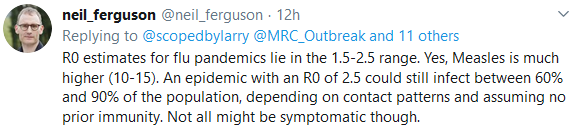
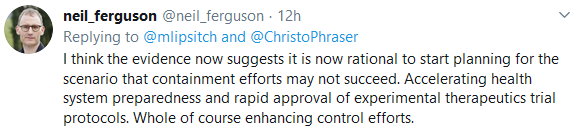
Yet even at that level, here's what Neil Ferguson, an infectious disease modeller/epidemiologist and Director of J-IDEA and the MRC Centre for Global Infectious Disease Analysis says the outlook is bleak:
2020-01-25_21-39-23.png
2020-01-25_21-38-38.png


Still not scared? Another paper estimatesthat the mortality rate of coronavirus is 15%.

 
The Virginia Department of Health is investigating three possible cases of the novel coronavirus.

The three patients, two in central Virginia and one in Northern Virginia, meet the clinical and epidemiologic criteria for the virus that's prompted China to put millions under quarantine, the Virginia Department of Health said Sunday.

The health department has not released more specific information about where the patients live, work or have traveled.


Specific details about the patients won't be released to protect their privacy, health officials say. Officials say they are working closely with the patients and those they've had close contact with recently.

Health officials in Virginia say that patients under investigation generally went to their doctor with specific symptoms and had traveled to China within 14 days of feeling ill. Samples will be collected and sent to the Centers for Disease Control and Prevention for testing.

At this point, coronavirus has not been confirmed in the three patients....:tiphat:https://www.nbcwashington.com/news/...igating-3-possible-coronavirus-cases/2204229/
 
Has there been any confirmed transmission outside of China? The only potential one I had seen was in Malaysia. And if it was it was within the family.
 
The Bordeaux patient in France believes he was infected at the Wuhan railway station , where the fish market is located (where the virus was first detected), or on the train. “I started coughing a few days later. "

https://flutrackers.com/forum/forum...-confirmed-none-traveled-from-the-netherlands

This train station is only a few blocks from the seafood market. It was closed on January 23.

--------------------------------------
Huanan Seafood Wholesale Market

The market occupies over 50,000 square meters and houses over 1,000 tenants,[8][9] and is conveniently located within a couple blocks from the Hankou railway station.[10] It is the largest seafood wholesale market in Wuhan and Central China.[11][12]

https://en.wikipedia.org/wiki/Huanan_Seafood_Wholesale_Market

------------------------------------------------
Hankou railway station

The station's location near the Huanan Seafood Wholesale Market may have contributed to the spread of the Wuhan coronavirus.[2] On 23 January 2020, the station was closed, along with all other transport infrastructure in the city, due to the Wuhan coronavirus outbreak.[3] This unprecedented measure in human history became known as the 2020 Wuhan lockdown.

https://en.wikipedia.org/wiki/Hankou_railway_station
 
Anyone else finding this..ummm...very concerning?

Dr. Erik Feigl-Ding
https://twitter.com/DrEricDing/statu...15156838109185

"The early outbreak data largely follows the exponential growth. We estimated that the mean R0 ranges from 3.30 (95%CI: 2.73-3.96) to 5.47 (95%CI: 4.16-7.10) associated with 0-fold to 2-fold increase in the reporting rate. With rising report rate, the mean R0 is likely to be below 5 but above 3. Conclusion: The mean estimate of R0 for the 2019-nCoV ranges from 3.30 (95%CI: 2.73-3.96) to 5.47 (95%CI: 4.16-7.10), and significantly larger than 1. Our findings indicate the potential of 2019-nCoV to cause outbreaks."

https://www.biorxiv.org/content/10.1...01.23.916395v1
 
[h=1]VIRGINIA DEPARTMENT OF HEALTH ANNOUNCES PREPARATIONS AND ACTIVITIES RELATED TO THE NOVEL CORONAVIRUS (2019-NCOV) OUTBREAK[/h]
FOR IMMEDIATE RELEASE – January 26, 2020
Media Contact: Lorrie Andrew-Spear, lorrie.andrew-spear@vdh.virginia.gov

Virginia Department of Health Announces Preparations and Activities
Related to the Novel Coronavirus (2019-nCoV) Outbreak


(Richmond, Va.) – The Virginia Department of Health (VDH) and local health officials statewide are monitoring developments surrounding the respiratory outbreak first detected in Wuhan, China caused by a new coronavirus (2019-nCoV). This is a rapidly evolving situation. To provide the latest local information and updates to Virginians, VDH has developed a novel coronavirus webpage. This webpage provides important information about the outbreak and offers resources for healthcare providers.

Common coronaviruses can cause mild to moderate upper-respiratory tract illness, like the common cold. Public health officials are still learning about 2019-CoV and how it affects people. Some people who have become ill with 2019-CoV have had mild symptoms. Others have had more severe illness, including some deaths. Symptoms include fever, cough, and trouble breathing, and can appear anywhere from two to 14 days after exposure. Although 2019-nCoV is spreading between people in parts of Asia, scientists do not yet know how easily it spreads. Closely related viruses that cause Severe Acute Respiratory Syndrome (SARS) and Middle East Respiratory Syndrome (MERS) mainly spread from person-to-person through close contact or respiratory droplets produced when an infected person coughs or sneezes.

VDH is encouraging health care providers to ask patients about recent international travel and consider 2019-nCoV infection in patients who have traveled to Wuhan, China within 14 days of the onset of symptoms, including fever and respiratory symptoms. When potential cases are reported, laboratory samples are collected and submitted to the Centers for Disease Control and Prevention for testing. These cases are called Patients Under Investigation.

Currently Virginia is investigating three residents in the central (2) and northern (1) regions of Virginia who meet both clinical and epidemiologic criteria for 2019-nCoV. Beginning January 27, VDH will post the number of Patients Under Investigation (PUIs) who meet both clinical and epidemiologic criteria for 2019-nCoV testing at the Centers for Disease Control and Prevention (CDC) on the VDH novel coronavirus webpage. To protect patient confidentiality, specific details about these patients will not be provided. Public health is working closely with these patients and anyone who was in close contact to prevent the spread of illness.


VDH is also reminding Virginians that there are steps everyone should take to prevent respiratory illness – especially with the influenza (flu) and respiratory disease season underway in Virginia. These include getting a flu vaccine, washing hands with soap and water for at least 20 seconds, staying home when sick, and taking flu antivirals as prescribed.

VDH recommends travelers to China protect themselves by avoiding contact with sick people, animals (alive or dead), animal markets, and products that come from animals (such as uncooked meat). CDC has issued a Travel Warning to avoid nonessential travel to Hubei Province, China, including Wuhan. CDC has also issued a Travel Watch to practice usual precautions for China. (See https://wwwnc.cdc.gov/travel/destinations/traveler/none/china#travel-notices.)

For more information on the novel coronavirus 2019-nCoV, visit www.vdh.virginia.gov/surveillance-and-investigation/novel-coronavirus/.:tiphat:http://www.vdh.virginia.gov/news/20...-to-the-novel-coronavirus-2019-ncov-outbreak/
 
Urgent CDC Presser At 3PM - Two Confirmed Cases In California 1 in Arizona

CDC Telebriefing: Update on 2019 Novel Coronavirus (2019-nCoV)


What
The Centers for Disease Control and Prevention (CDC) will provide an update on the 2019 Novel Coronavirus response.


Who
Nancy Messonnier, Director, National Center for Immunization and Respiratory Diseases


When
3 p.m. ET Sunday, January 26, 2020


Dial-In

Media: 888-942-8391

Non-Media: 888-677-5724


Has anyone called in to listen? Apparently you need a pass code, I do not have one.
 
106 min podcast : http://www.microbe.tv/twiv/twiv-584/...4XEBY_KzooeYS0 inks for this episode
-----------------------------------------
why do I always have the feeling that people are not saying what they really think but rather
what serves their position, their career, their employer ?
joking, having fun while facing a pandemic estimating 50% mortality for those >65 among them
when infected

It mustn't be talked about the pandemic risk ?!?!?
[[ Should people flee the cities now, before it's too late ? ]]

Ralph Baric seems skeptical that China will succeed to contain it
1:02 , the deletion in the genome may disappear during the pandemic making it even more transmissable
1:07 joking about the doomsday people , it won't become more virulent
(as if it weren't bad enough)
1:18 H5N1 discussion , ridiculing the anticipated danger of these people [50% could die]
(and now we have 60M quarantined threatening a pandemic)
 
Last edited:
[h=1]2019 Novel Coronavirus (2019-nCoV), Wuhan, China[/h]
This is an emerging, rapidly evolving situation and CDC will provide updated information as it becomes available, in addition to updated guidance.

Updated January 26, 2020 [h=2]Situation Summary[/h]
CDC is closely monitoring an outbreak of respiratory illness caused by a novel (new) coronavirus (termed “2019-nCoV”) that was first detected in Wuhan City, Hubei Province, China and which continues to expand. Chinese health officials have reported more than a thousand infections with 2019-nCoV in China, including outside of Hubei Province. Infections with 2019-nCoV also are being reported in a growing number of international locations, including the United States, where 5 cases in travelers from Wuhan have been confirmed in four states (AZ, CA, IL, WA) as of January 26, 2020.

Source and Spread of the Virus

Chinese health authorities were the first to post the full genome of the 2019-nCoV in GenBankexternal icon, the NIH genetic sequence database, and in the Global Initiative on Sharing All Influenza Data (GISAIDexternal icon) portal, an action which has facilitated detection of this virus. On January 24, 2020, CDC posted in GenBank the full genome of the 2019-nCoV virus detected in the first U.S. patient from Washington state. The virus genetic sequence from the patient in Washington is nearly identical to the sequences posted from China. The available sequences suggest a likely single, recent emergence from a virus related to bat coronaviruses and the SARS coronavirus. The available sequence information does not provide any information about severity of associated illness or transmissibility of the virus.

Early on, many of the patients in the outbreak in Wuhan, China reportedly had some link to a large seafood and animal market, suggesting animal-to-person spread. However, a growing number of patients reportedly have not had exposure to animal markets, and there is evidence that person-to-person spread is occurring. At this time, it’s unclear how easily or sustainably this virus is spreading between people. Learn what is known about the spread of newly emerged coronaviruses.

Illness Severity

Both MERS and SARS have been known to cause severe illness in people. The complete clinical picture with regard to 2019-nCoV is still not fully clear. Reported illnesses have ranged from infected people with little to no symptoms to people being severely ill and dying. Learn more about the symptoms associated with 2019-nCoV.

There are ongoing investigations to learn more. This is a rapidly evolving situation and information will be updated as it becomes available.

On This Page
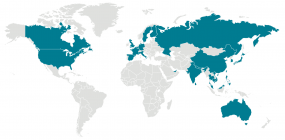
outbreak-coronavirus-world - World map of coronavirus outbreaks.

View Larger Image [h=3]Confirmed 2019-nCoV Cases Globally[/h] See a list of locations [h=2]Risk Assessment[/h]
Outbreaks of novel virus infections among people are always of public health concern. The risk from these outbreaks depends on characteristics of the virus, including whether and how well it spreads between people, the severity of resulting illness, and the medical or other measures available to control the impact of the virus (for example, vaccine or treatment medications).

Investigations are ongoing to learn more, but person-to-person spread of 2019-nCoV is occurring. Chinese officials report that sustained person-to-person spread in the community is occurring in China. Person-to-person spread in the United States has not yet been detected, but it’s likely to occur to some extent. It’s important to note that person-to-person spread can happen on a continuum. Some viruses are highly contagious (like measles), while other viruses are less so. It’s important to know this in order to better assess the risk posed by this virus. While CDC considers this is a very serious public health threat, based on current information, the immediate health risk from 2019-nCoV to the general American public is considered low at this time. Nevertheless, CDC is taking proactive preparedness precautions. [h=2]What to Expect[/h]
More cases are likely to be identified in the coming days, including more cases in the United States. Given what has occurred previously with MERS and SARS, it’s likely that person-to-person spread will continue to occur. It would not be surprising if person-to-person spread in the United States were to occur. Cases in healthcare settings, like hospitals, may also occur. [h=2]CDC Response[/h]
  • CDC is closely monitoring this situation and is working with WHO.
  • CDC established a 2019-nCoV Incident Management Structure on January 7, 2020. On January 21, 2020, CDC activated its Emergency Response System to better provide ongoing support to the 2019-nCoV response.
  • On January 23, 2020, CDC again raised its travel alert for the coronavirus outbreak. The travel notice for Wuhan City was raised from Level 2: Practice Enhanced Precautions to Level 3: Avoid Nonessential Travel. CDC also issued a Level 1: Practice Usual Precautions for the rest of China.
  • CDC also is conducting entry screening of passengers on direct and connecting flights from Wuhan, China to five major airports: Atlanta (ATL), Chicago (ORD), Los Angeles, (LAX) New York city (JFK), and San Francisco (SFO).
  • CDC issued an updated interim Health Alert Notice (HAN) Advisory to inform state and local health departments and health care providers about this outbreak on January 17, 2020.
  • CDC teams have been deployed to support the ongoing investigation in Washington and Illinois to support the ongoing investigations of the two cases in the United States.
  • CDC has developed a real time Reverse Transcription-Polymerase Chain Reaction (rRT-PCR) test that can diagnose 2019-nCoV in respiratory and serum samples from clinical specimens. On January 24, 2020, CDC publicly posted the assay protocol for this test. Currently, testing for this virus must take place at CDC, but in the coming days and weeks, CDC will share these tests with domestic and international partners through the agency’s International Reagent Resourceexternal icon.
  • CDC uploaded the entire genome of the virus from the first reported case in the United States to GenBank.
  • CDC also is growing the virus in cell culture, which is necessary for further studies, including for additional genetic characterization.
[h=2]CDC Recommends[/h]
While the immediate risk of this new virus to the American public is believed to be low at this time, everyone can do their part to help us respond to this emerging public health threat:
[h=3]Other Available Resources[/h]
The following resources are available with information on 2019-nCoV
 
Did China Steal Coronavirus From Canada And Weaponize It?


https://www.zerohedge.com/geopolitic...d-weaponize-it


related from October 2019
Canadian government scientist under investigation trained staff at Level 4 lab in China

Still no answers in probe of government scientists expelled from National Microbiology Lab in Winnipeg


https://www.cbc.ca/news/canada/manit...hina-1.5307424


Just posting to add it to discussion forum.

The virus under study was Ebola, not SARS or MERS, so I think it is far fetched to believe the researcher transferred a weaponized Corona virus. Indeed, seen that China is the foremost victim of this current outbreak, if true it would be a usefully cautionary example about the risks of bio warfare.
What seems more likely is that the researcher freely shared best practices and research tips, to an extent that was deemed excessive by her employers in Canada.
 
The virus under study was Ebola, not SARS or MERS, so I think it is far fetched to believe the researcher transferred a weaponized Corona virus. Indeed, seen that China is the foremost victim of this current outbreak, if true it would be a usefully cautionary example about the risks of bio warfare.
What seems more likely is that the researcher freely shared best practices and research tips, to an extent that was deemed excessive by her employers in Canada.

Yes, I agree. I hesitated posting it, but figured I would add it to discussion forum.
 
as I understood it was research on multiple pathogens and a government examination for espionage and her lab is in Wuhan
 
CDC Definition of close contact - from - https://www.cdc.gov/coronavirus/2019-nCoV/clinical-criteria.html
[SUP]2[/SUP]Close contact is defined as—

a) being within approximately 6 feet (2 meters), or within the room or care area, of a novel coronavirus case for a prolonged period of time while not wearing recommended personal protective equipment or PPE (e.g., gowns, gloves, NIOSH-certified disposable N95 respirator, eye protection); close contact can include caring for, living with, visiting, or sharing a health care waiting area or room with a novel coronavirus case.– or ....

Yet from
https://abcnews.go.com/Internationa...ource_4380645_2_heads_hero_live_headlines_hed

"Tam said officials are locating passengers who were within a 2-meter radius of the man's seat or anyone who may have served or helped him."

Surely all passengers from an enclosed aircraft who fly with a confirmed case - should be informed so that they can protect their families/colleagues and monitor themselves better.
 
Status
Not open for further replies.
Back
Top