Announcement

Collapse
No announcement yet.

Brazilian experts found the Zika virus in the salivary glands of the 'common mosquito' (Culex), an indication that this species may also carry the disease

Collapse
X
 
  • Filter
  • Time
  • Show
Clear All
new posts

  • Brazilian experts found the Zika virus in the salivary glands of the 'common mosquito' (Culex), an indication that this species may also carry the disease

    28 Jan 2016

    Scientists in Brazil believe the devastating Zika virus may have already crossed over to the common mosquito, dramatically increasing the risk of it spreading worldwide.

    Mosquito types


    Up until now, it was thought the Aedes aegypti mosquito, which is confined to the tropics, was solely spreading the virus.
    But scientists at the Oswaldo Cruz Foundation in Recife, Pernambuco State, in the northeast of the country, believe otherwise.
    They say they are as little as a month away from confirming that the virus is also being carried and transmitted by the much more common Culex mosquito.
    There are 20 times more Culex mosquitos in existence as the Aedes aegypti and they are significantly more widespread - breeding throughout most of the Americas, parts of Africa and Asia - so increasing the chances of the virus spreading.
    Huge implications

    The lead research scientist at the foundation, Constancia Ayres, says the implications are huge:
    "It means much more combined efforts from a lot of other countries are going to be needed to combat this virus," she said.
    Scientists in Brazil believe the devastating Zika virus may have already crossed over to the common mosquito, dramatically increasing the risk of...

  • #2
    Brazilian experts investigate if 'common mosquito' is transmitting zika virus

    Brazil would face an even greater struggle against zika If the common "culex" mosquito is passing on the virus

    27 Jan 2016


    Brazil could be facing a greater fight against the zika virus than previously feared as researchers investigate whether the common mosquito is transmitting the disease.

    The Aedes aegypti species of mosquito was thought to be solely responsible for spreading the virus. But scientists are now studying whether the “culex” mosquito – the variety most commonly found in Brazil - could also be passing on the infection.

    "This may be the reason for the virus replicating faster,” said Constancia Ayres, the research coordinator of the Oswaldo Cruz Foundation. “The interaction of the mosquito with the virus may explain the epidemiological profile of disease transmission.”

    The study is expected to last three weeks and aims to understand precisely how quickly the epidemic is spreading. Mrs Ayres pointed out that the culex mosquito “transmits other viruses close to zika” and asked: “What's to say that it could not transmit Zika?"


    Brazil would face an even greater struggle against zika If the common "culex" mosquito is passing on the virus

    Comment


    • #3
      common name: southern house mosquito
      scientific name: Culex quinquefasciatus Say (Insecta: Diptera: Culicidae)


      Introduction - Synonymy - Distribution - Description - Life Cycle - Medical Importance - Management - Selected References

      Introduction (Back to Top)

      Culex quinquefasciatus Say, commonly known as the southern house mosquito, is a medium-sized brown mosquito that exists throughout the tropics and the lower latitudes of temperate regions. This species is found in the southern United States and is present throughout Florida. This nighttime-active, opportunistic blood feeder is a vector of many of pathogens, several of which affect humans. Throughout much of the southern U.S., Cx. quinquefasciatus is the primary vector of St. Louis encephalitis virus (SLEv). Culex quinquefasciatus also transmits West Nile virus (WNv).
      Synonymy (Back to Top)

      Culex quinquefasciatus Say, 1823
      Culex pungens Wiedemann, 1828 (ITIS 2007)
      Culex fatigans Wiedemann, 1828 (Bates 1949)
      Culex auestuans Wiedemann, 1828 (WRBU)
      Culex acer Walker, 1848 (WRBU)
      Culex cingulatus Doleschall, 1856 (WRBU)

      Distribution (Back to Top)

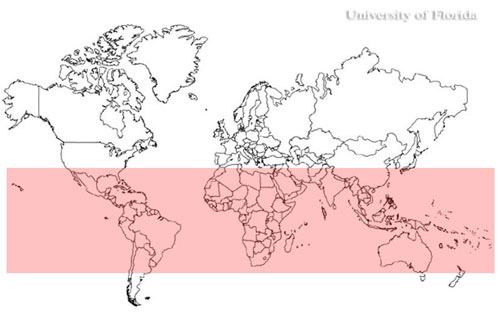
      Culex quinquefasciatus is a sub-tropical species usually found within the latitudes 36? N and 36? S. However, in the U.S. between 36? N and 39? N there is a broad hybrid zone where Culex quinquefasciatus freely mates with Culex pipiens Linnaeus, which is usually not found south of 39? N. Mating between these two members of the Culex pipiens complex produce viable offspring within the hybrid zone. The extent of the hybridization is extensive and, as a result, the members are sometimes considered to be subspecies, Culex pipiens quinquefasciatus and Culex p. pipiens respectively. Culex quinquefasciatus is found in North America, South America, Australia, Asia, Africa, the Middle East, and New Zealand.

      In the U.S., this species ranges from Virginia across the southern plains to southern California, and from as far north as southern Iowa, south to Texas and Florida. There are reports of Culex quinquefasciatus as far north as Indiana in the U.S. The species has also been collected in Hawaii (Barr 1957). In Florida, Culex quinquefasciatus is found in all 67 counties.

      Figure 1. World distribution of the southern house mosquito, Culex quinquefasciatus Say. Illustration by Stephanie Hill, University of Florida.
      Description (Back to Top)

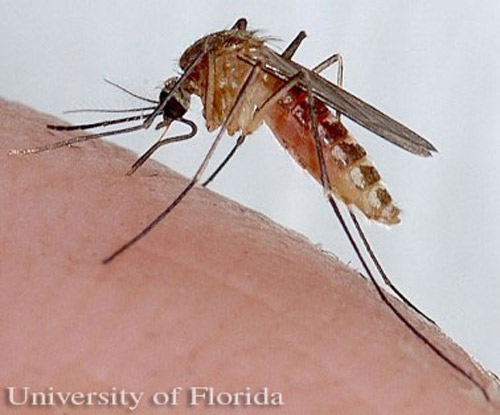
      Adults: Adult Culex quinquefasciatus vary from 3.96 to 4.25 mm in length (Lima et al. 2003). The mosquito is brown with the proboscis, thorax, wings, and tarsi darker than the rest of the body. The head is light brown with the lightest portion in the center. The antennae and the proboscis are about the same length, but in some cases the antennae are slightly shorter than the proboscis. The flagellum has thirteen segments that have few to no scales (Sirivanakarn et al. 1987). The scales of the thorax are narrow and curved. The abdomen has pale, narrow, rounded bands on the basal side of each tergite. The bands barely touch the basolateral spots taking on a half-moon shape (Darsie and Ward 2005).


      Figure 2. Adult female southern house mosquito, Culex quinquefasciatus Say, feeding. Photograph by James Newman, University of Florida.
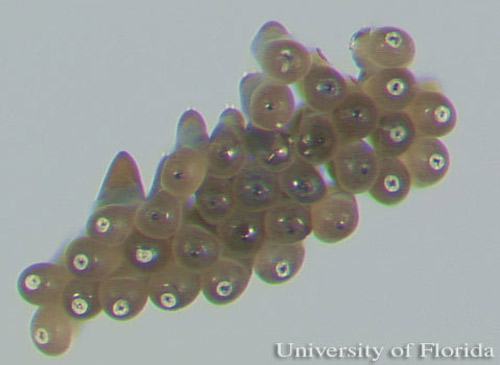
      Eggs: Common to the Culex genus, the eggs of Culex quinquefasciatus are laid in oval rafts loosely cemented together with 100 or more eggs in a raft which will normally hatch 24 to 30 hours after being oviposited (Bates 1949).


      Figure 3. Eggs of the southern house mosquito, Culex quinquefasciatus Say. Photograph by Stephanie Hill, University of Florida.
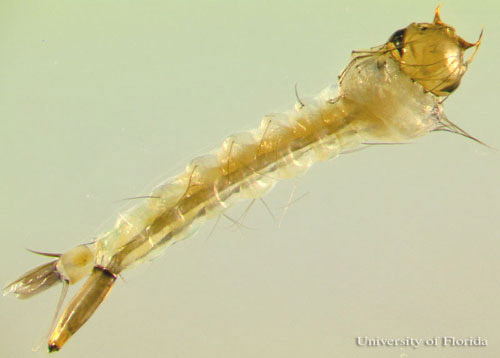
      Larvae: The larval head is short and stout becoming darker toward the base. The mouth brushes have long yellow filaments that are used for filtering organic materials. The abdomen consists of eight segments, the siphon, and the saddle. Each segment has a unique setae pattern (Sirivanakarn and White 1978). The siphon is on the dorsal side of the abdomen, and in Culex quinquefasciatus the siphon is four times longer than it is wide with multiple setae tufts (Darsie and Morris 2000). The saddle is barrel shaped and located on the ventral side of the abdomen with four long anal papillae protruding from the posterior end (Sirivanakarn and White 1978). For more detailed morphological images, see the UF/IFAS Identification Guide to Common Mosquitoes of Florida Web site.

      Figure 4. Larva of the southern house mosquito, Culex quinquefasciatus Say. Head in upper right. Photograph by Stephanie Hill, University of Florida.
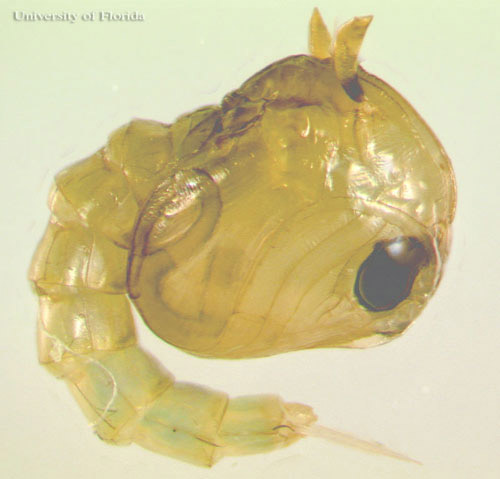
      Pupae: Similar to other mosquito species, Culex quinquefasciatus pupae are comma shaped and consist of a fused head and thorax (cephalothorax and an abdomen). The cephalothorax color varies with habitat and darkens on the posterior side. The trumpet, which is used for breathing, is a tube that widens and becomes lighter in color as it extends away from the body. The abdomen has eight segments. The first four segments are the darkest, and the color lightens towards the posterior. The paddle, at the apex of the abdomen, is translucent and robust with two small setae on the posterior end (Sirivanakarn and White 1978).

      Figure 5. Pupa of the southern house mosquito, Culex quinquefasciatus Say. Photograph by Stephanie Hill, University of Florida.

      Life Cycle (Back to Top)

      Gravid Culex quinquefasciatus females fly during the night to nutrient-rich standing water where they will lay their eggs. They will oviposit in waters ranging from waste water areas to bird baths, old tires, or any container that holds water. If the water evaporates before the eggs hatch or the larvae complete their life cycle, they die (Mosquito Information Website 2007).
      The larvae feed on biotic material in the water and require between five to eight days to complete their development at 30?C (Gerberg et al. 1994). The larvae progress through four larval instars, and towards the end of the fourth instar they stop eating and molt to the pupal stage. Following 36 hours at 27?C the adults emerge from the pupal stage (Gerberg et al. 1994). The time of development under natural conditions for all stages is variable and dependant on temperature.
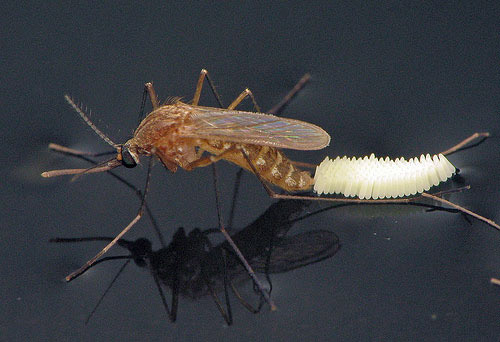
      Both males and females take sugar meals from plants. Following mating, the female seeks a blood meal. Culex quinquefasciatus are opportunistic feeders, feeding on mammals and/or birds throughout the night. Males survive only on sugar meals, while the female will take multiple blood meals. After a female mosquito digests the blood meal and the eggs develop, she finds a suitable place to lay her eggs, and the cycle begins again. A single female can lay up to five rafts of eggs in a lifetime (Gerberg et al. 1994). The number of eggs per raft varies with climatic conditions.

      Figure 6. Female southern house mosquito, Culex quinquefasciatus Say, ovipositing an egg raft. Photograph by Sean McCann.
      Medical Importance (Back to Top)

      Culex quinquefasciatus is a vector of many pathogens of humans, and both domestic and wild animals. Viruses transmitted by this species include WNv, SLEv and Western equine encephalitis virus (WEEv). Culex quinquefasciatus is the principal vector of SLEv in the southern U.S. The virus increases its numbers in birds and then infects mosquitoes feeding on birds during the bird nesting season in the spring. The mosquito may then transmit the virus to humans. St. Louis encephalitis is age-dependent, affecting older humans more than the young. Symptoms of the disease are flu-like and can range from fever and headaches to stiffness and confusion. After a period of several days the brain may begin to swell, accompanied by depression, extreme excitement, sleepiness, or sleeplessness (CDC June 2007). Humans do not develop high levels of the virus in the blood and therefore are considered dead-end hosts unable to infect mosquitoes (Foster and Walker 2002). In Florida, major St. Louis encephalitis epidemics occurred in 1959, 1961, 1962, 1977, and 1990 (Day and Stark 2000, Shroyer 2004). Other epidemics in the U.S. include Colorado 1985, Arkansas 1991, New York 1999, and Louisiana 2001 (CDC October 2007). For more information on St. Louis encephalitis in Florida, see the UF/IFAS publication Saint Louis Encephalitis: A Florida Problem.
      Although Culex quinquefasciatus is not considered the likely primary vector of WNv in Florida, it likely plays an important role in maintaining the virus within bird populations, and is capable to transmitting it to humans. For more information on West Nile virus in Florida, see the UF/IFAS publication West Nile Virus.
      Outside the U.S., Culex quinquefasciatus is responsible for transmitting the filarial nematode,Wuchereria bancrofti (Tropical Africa and Southeast Asia), and Rift Valley fever virus (RVF) (Africa) (Foster and Walker 2002). Wuchereria bancrofti is a filarial nematode that can cause lymphatic filariasis. Currently, worldwide there are approximately 120 million cases of lymphatic filariasis (WHO 2000). The mosquito picks up the microfilaria from an infected vertebrate. The nematode develops inside the mosquito, and is passed on to another vertebrate (Foster and Walker 2002). Rift Valley fever has been responsible for major epidemics in Africa and Asia. In 1997, 300 human cases of RVF were reported in Kenya and southern Somalia (DHPE 2005).
      Management (Back to Top)

      Cultural control. Personal protection, reduction of larval habitats, and chemical control are the best ways to reduce mosquito bites and therefore the transmission of mosquito-borne pathogens. BecauseCulex quinquefasciatus feeds at night, long sleeve shirts and insect repellent are recommended for outside nighttime activity. Reducing the amount of outside activity also lowers the risk of Culex quinquefasciatus bites (Mosquito Information Website 2007).


      Culex quinquefasciatus is dependent upon humans for the creation of its nutrient-rich aquatic habitats. It is essential to reduce or eliminate this type of aquatic environment. Around the home this can be done by not over watering plants, changing water in pet water dishes frequently, changing water in bird baths at least once a week, removing unnecessary water-holding containers, and and keeping ponds stocked with mosquito fish (Kern 2007). Water-holding containers that cannot be removed can be covered or turned upside down, old tires need to be removed, and drainage ditches need to be kept clear of debris that will obstruct flow (Mosquito Information Website 2007).
      Large man-made aquatic habitats such as storm-water catch basins and waste water containers should be eliminated or reduced (O'Meara 1993).
      Chemical control. Insecticides can be used to control larvae and adults. Larvicides are applied to bodies of water near where the larvae are concentrated. This method reduces the greatest number of immature mosquitoes with the least amount of pesticide. Adulticides are used to quickly reduce the population of adult mosquitoes in an area. In general, mosquito resistance to specific insecticides may reduce the effectiveness of chemical control. Some chemicals require a licensed pesticide applicator to perform the application. Before proceeding with a chemical control, contact your local Cooperative Extension Service (CES) or Mosquito Control District (AMCA 2005). In Florida, you can find your local CES office through the UF/IFAS listing of those offices.

      ...
      http://entnemdept.ufl.edu/creatures/...e_mosquito.htm

      Comment


      • #4
        Translation Google

        Researchers found Zika virus in the salivary glands of the common mosquito

        Rio de Janeiro, Mar 2 (EFE) .- A group of Brazilian researchers announced today that it has found Zika virus in the salivary glands of the mosquito or common mosquito (Culex), which is an indication that this species may also transmit the illness.

        BRAZIL ZIKA | March 2, 2016

        Rio de Janeiro, Mar 2 (EFE) .- A group of Brazilian researchers announced today that it has found Zika virus in the salivary glands of the mosquito or common mosquito (Culex), which is an indication that this species may also transmit the illness.

        The discovery was made by researchers from the Brazilian public laboratory Oswaldo Cruz Foundation (Fiocruz) and was announced during a seminar on the zika in Recife, capital of Pernambuco state, which is the Brazilian region most affected by the zika and microcephaly in newly born.

        Ayres Const?ncia biologist explained that the experiment was conducted in laboratory, with about 200 Culex mosquitoes, but warned that these results are inconclusive, so we still can not say that this species can infect humans.

        Ayres said "there is a great likelihood" that the common mosquito transmits the zika to humans, just as it also infects other arboviruses, local media reported.

        Fiocruz researchers are capturing common mosquitoes in their natural habitat in areas affected by the virus, to identify whether the Culex also carries the virus in nature.

        According to Ayres, the field study will last six to eight months before the research can yield a final result.

        Until now it considered that the Aedes aegypti mosquito is the main transmitter of zika, as well as other viral diseases such as dengue and chikungunya.

        The presence of Culex in urban areas in Brazil exceeds 20 times that of Aedes aegypti, the researchers said.

        That mosquito, which is spread almost all over the world, lays its eggs in pools of dirty water, unlike the Aedes, which breeds in clean water.

        The Culex mosquito proliferates especially in urban areas lacking in basic sanitation infrastructure, a common problem in poor areas of all major cities in Brazil.

        The seminar on the zika, called "A, B, C, D and E Zika Virus" took place between Monday and Tuesday in Recife, with the presence of about 40 researchers.

        http://www.diariolasamericas.com/505...ito-comun.html
        Last edited by Gert van der Hoek; March 4, 2016, 02:23 PM.

        Comment


        • #5

          Life | Thu Mar 3, 2016 6:25pm GMT Related: HEALTH

          Research indicates other mosquitoes may be able to carry Zika

          RIO DE JANEIRO | BY PAULO PRADA

          Research by scientists in Brazil indicates that a mosquito more common than the one primarily known to transmit Zika infections may possibly be able to carry the virus, a development that could further complicate efforts to limit its spread.

          The mosquito species Aedes aegypti has been identified as the primary transmitter of Zika infections, which have been linked to thousands of birth defects as the virus spreads rapidly in Brazil and other countries in Latin America and the Caribbean.

          But the scientists in Brazil announced on Wednesday that they were able to infect another species, Culex quinquefasciatus, with the virus in a laboratory, raising concerns that Zika could be carried by a species more prevalent than Aedes aegypti. They said much more research is needed to learn whether the Culex mosquitoes can transmit Zika infections.

          In Brazil, Culex quinquefasciatus is 20 times more common than Aedes aegypti, the researchers said.

          The research, conducted by scientists at the government-funded Oswaldo Cruz Foundation in the northeastern city of Recife, is part of an ongoing trial in which researchers injected 200 of the Culex quinquefasciatus mosquitoes with rabbit blood infected by Zika.

          The virus, they said, circulated through the mosquitoes' bodies and into their salivary glands, meaning they might be able to transmit a Zika infection by biting a person.

          "We saw an ease of infection and an ease of dissemination of the virus to the salivary glands," Constancia Ayres, the lead scientist in the study, told Globo, Brazil's leading television network.

          The research has yet to be published in a scientific journal or reviewed by scientific peers elsewhere.
          ...

          Comment


          • #6
            Translation Google

            03/03/2016


            Fiocruz Pernambuco research presence of zika in mosquitoes

            Source: Fiocruz Pernambuco

            An unprecedented survey conducted by Fiocruz Pernambuco detected in inoculation in the laboratory, the presence of zika virus in the salivary gland of the mosquito Culex quinquefasciatus (domestic muri?oca or gnat).This is a preliminary result, which will be studied in the next steps of the research will be investigated when Culex collected in the field in many places where there are cases of records. The goal is to verify that the situation found in the laboratory also occurs in nature.

            The choice of Culex was motivated by the observation of the first urban area had an outbreak the Micronesia where Aedes aegypti is rare and other Aedes present were negative for virus. C. quinquefasciatus is the most abundant species in the environment mosquitoes urban tropical and subtropical areas, where usually present at a density twenty times larger than the A. aegypti .

            The studies were initially compared between species. But the idea is that, throughout the project, be included other species, Aedes albopictus , which occurs in many temperate countries. The goal is to compare some species of mosquitoes in the Metropolitan Region of Recife in relation to its competence as vectors for arbovirus transmission, including dengue and chikungunya. In this first stage, the zika virus was prioritized due to the current outbreak of the disease and its link with microcephaly.

            In each mosquitoes collected was taken dissection (body parts separation process) to extract the gut and salivary gland. In total, 450 samples were obtained (adding the intestines and salivary glands of both studied mosquitoes). Analyses are being processed and the final result of the research can only be obtained after the field stage.


            Comment

            Working...
            X