

Pathfinder
Editor, Senior Moderator
Voices from New Orleans
Workers who helped rebuild after Hurricane Katrina offer advice to their compatriots in Haiti.
byOlya Schechter<TIME property="dc:created" datetime="2010-02-02">February 02, 2010</TIME>
Excerpt:
Dr. Mark Peters, president and CEO of the East Jefferson General Hospital in Louisiana:
From what we've seen in New Orleans, the most effective solutions are the ones that are envisioned and executed by local communities. Folks on the ground that have the local knowledge should take the lead on the recovery process. The best thing that the international aid organizations can do is to provide resources and expertise to a limited extent, but it is the people on the ground that are really going to have to be in the driver's seat.
...
Thom Pepper, director of Common Ground Relief, Inc. , a nonprofit organization providing short- and long-term support for hurricane victims in the New Orleans area:
The locals have got to have jobs. One of the problems we faced in New Orleans was that there were so many workers who were from out of the area that there were no real jobs for the local residents.
It is important to provide jobs locally to empower residents and have as much building material produced and purchased locally in order to provide jobs, expand the local economy, and increase tax revenue. Hopefully that will happen in Haiti, instead of having paid workers from the Caribbean or all over the world displacing eager and hardworking Haitians who can help their own country.
Besides food and water, some living conditions must be provided. But you also can't make people live in tents forever. We've learned that lesson here in New Orleans. Following Hurricane Katrina, New Orleans allowed residents to return to areas that the city was ill prepared to police and where municipal services were limited. The FEMA trailers, meant as temporary shelters, became home for many people for several years. The logistics of housing and feeding a million or more residents is a monumental challenge, but it is something that Haiti's friends and neighbors must address. Letting residents return to live in uninspected, unsafe structures with no electricity and no water is just as bad as leaving people to live in tent cities in hurricane-prone areas.
The big lesson that people should take away from Hurricane Katrina and from what we have seen in the Gulf Coast is that every success is a result of a small local initiative. Every big plan that has been proposed by any level of government has failed. We view these communities as an opportunity to start them again from scratch, new and better off. But there are deep ties; there is a lot of knowledge that is embedded within formal and informal community organizations. And it is important for us to listen to that.
[...]
http://www.newsweek.com/2010/02/01/voices-from-new-orleans.html
--------------------------------------------------
Haiti, 10 months later
12
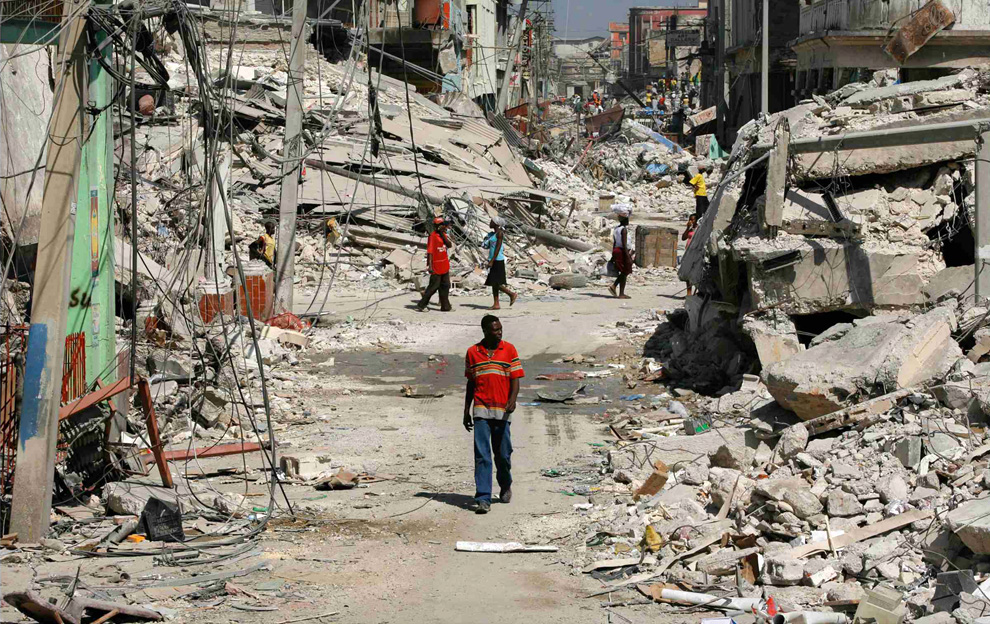
(1 of 2) A "before" photograph shows Haitians walking in a badly damaged street after an earthquake in Port-au-Prince, on February 3, 2010. See below for the "after" photo. (REUTERS/Eduardo Munoz) #
13
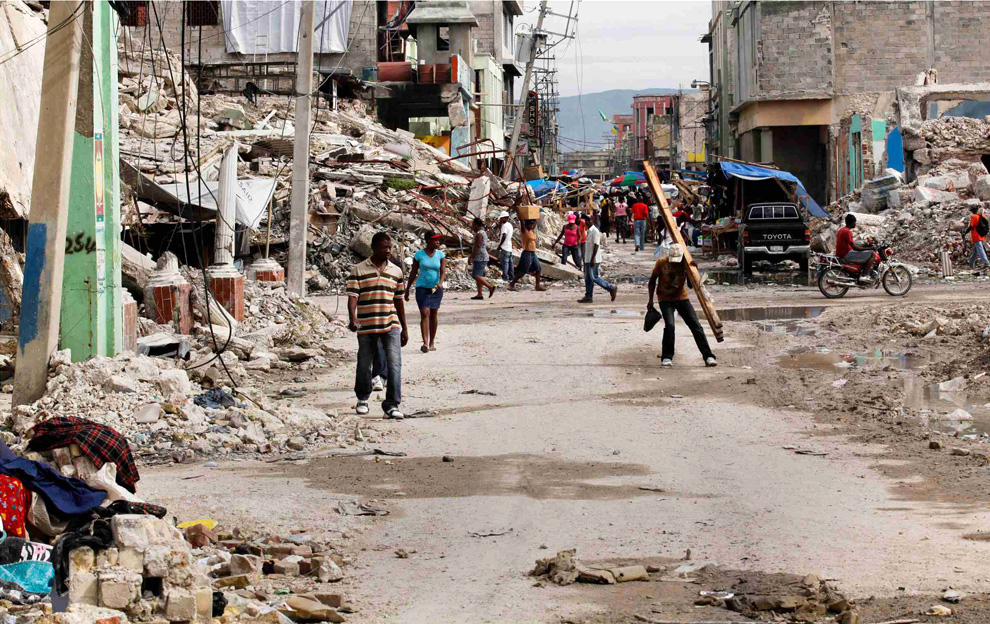
(2 of 2) An "after" photograph from September 30, 2010 - seven months later - shows Haitians walking on the same street as above. By some estimates, only 2 percent of the 250 million cubic meters of debris in Port-au-Prince has been cleared, for reasons ranging from lack of equipment and money to an abysmal property records system. Meanwhile, most Haitians just live and work around the piles of debris. (REUTERS/Eduardo Munoz) #
http://www.boston.com/bigpicture/2010/11/haiti_ten_months_later.html
Workers who helped rebuild after Hurricane Katrina offer advice to their compatriots in Haiti.
byOlya Schechter<TIME property="dc:created" datetime="2010-02-02">February 02, 2010</TIME>
Excerpt:
Dr. Mark Peters, president and CEO of the East Jefferson General Hospital in Louisiana:
From what we've seen in New Orleans, the most effective solutions are the ones that are envisioned and executed by local communities. Folks on the ground that have the local knowledge should take the lead on the recovery process. The best thing that the international aid organizations can do is to provide resources and expertise to a limited extent, but it is the people on the ground that are really going to have to be in the driver's seat.
...
Thom Pepper, director of Common Ground Relief, Inc. , a nonprofit organization providing short- and long-term support for hurricane victims in the New Orleans area:
The locals have got to have jobs. One of the problems we faced in New Orleans was that there were so many workers who were from out of the area that there were no real jobs for the local residents.
It is important to provide jobs locally to empower residents and have as much building material produced and purchased locally in order to provide jobs, expand the local economy, and increase tax revenue. Hopefully that will happen in Haiti, instead of having paid workers from the Caribbean or all over the world displacing eager and hardworking Haitians who can help their own country.
Besides food and water, some living conditions must be provided. But you also can't make people live in tents forever. We've learned that lesson here in New Orleans. Following Hurricane Katrina, New Orleans allowed residents to return to areas that the city was ill prepared to police and where municipal services were limited. The FEMA trailers, meant as temporary shelters, became home for many people for several years. The logistics of housing and feeding a million or more residents is a monumental challenge, but it is something that Haiti's friends and neighbors must address. Letting residents return to live in uninspected, unsafe structures with no electricity and no water is just as bad as leaving people to live in tent cities in hurricane-prone areas.
The big lesson that people should take away from Hurricane Katrina and from what we have seen in the Gulf Coast is that every success is a result of a small local initiative. Every big plan that has been proposed by any level of government has failed. We view these communities as an opportunity to start them again from scratch, new and better off. But there are deep ties; there is a lot of knowledge that is embedded within formal and informal community organizations. And it is important for us to listen to that.
[...]
http://www.newsweek.com/2010/02/01/voices-from-new-orleans.html
--------------------------------------------------
Haiti, 10 months later
12
(1 of 2) A "before" photograph shows Haitians walking in a badly damaged street after an earthquake in Port-au-Prince, on February 3, 2010. See below for the "after" photo. (REUTERS/Eduardo Munoz) #
13
(2 of 2) An "after" photograph from September 30, 2010 - seven months later - shows Haitians walking on the same street as above. By some estimates, only 2 percent of the 250 million cubic meters of debris in Port-au-Prince has been cleared, for reasons ranging from lack of equipment and money to an abysmal property records system. Meanwhile, most Haitians just live and work around the piles of debris. (REUTERS/Eduardo Munoz) #
http://www.boston.com/bigpicture/2010/11/haiti_ten_months_later.html