

AlaskaDenise
In Memoriam
Women having unsafe sex may be at more risk of HIV than thought after tests revealed the virus could breach even healthy vaginal tissue.
It had been believed that only damaged skin inside the vagina could provide a route to infection.
However, US-based researchers say HIV can get past this intact barrier within hours.
UK HIV charities said it reinforced the need for women to avoid unprotected sex unless their partner's health is known.
The lining of the vagina - the squamous epithelium - had been believed by many to be capable of keeping HIV at bay.
While transmission of the virus from men to women through unprotected sex is commonplace in many parts of the world, it was thought that HIV was most likely travelling through cuts or sores in the vaginal tract, or penetrating a much thinner layer of skin further up the reproductive tract.
The scientists from Northwestern University in Chicago found that, far from this being the truth, HIV could move quickly between the skin cells themselves.
The weak point, they said, occurs when skin cells are about to be shed, as the cells are no longer as tightly bound together.
Using HIV "tagged" with a marker which gives off light, they observed that, within four hours, the virus had reached a fraction of a millimetre below the surface.
At this depth, according to the researchers, it could encounter the immune cells it needed to invade to establish itself in the body.
Professor Thomas Hope, leading the research, said: "This is an important and unexpected result - we have a new understanding of how HIV can invade the female vaginal tract."
"We urgently need new prevention strategies or therapeutics to block the entry of HIV through a woman's genital skin."
Condom call
He said that while condoms were highly effective in blocking the virus, people often rejected them for cultural and other reasons.
Lisa Power, from the Terrence Higgins Trust said: "This is sadly not surprising, though it is an important finding.
"We have long known that it is easier for a man to transmit HIV sexually to a woman than for a woman to transmit it to a man and this helps us understand why.
"This will help in developing better prevention mechanisms - but until then, it's more clear than ever that a condom is a vital part of safer sex."
The charity AVERT echoed this advice, adding: "While there is evidence given by scientists that unprotected heterosexual sex is not as risky as other routes of HIV transmission, AVERT would still advocate the need for the use of condoms in all sexual encounters unless the HIV status of those involved was known.
"This study serves to strengthen that argument and will hopefully give weight to the need for safer heterosexual sex to be advocated further by governments and practitioners worldwide."
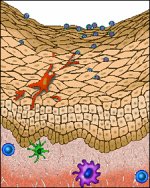 HIV virus (red) slips between loosely connected skin cells to reach its immune cell targets such as the Langerhans cells (orange), macrophages (purple), dendritic cells (green) and CD4 positive T cells (blue)
Story from BBC NEWS:
http://news.bbc.co.uk/go/pr/fr/-/2/hi/health/7785124.stm
It had been believed that only damaged skin inside the vagina could provide a route to infection.
However, US-based researchers say HIV can get past this intact barrier within hours.
UK HIV charities said it reinforced the need for women to avoid unprotected sex unless their partner's health is known.
The lining of the vagina - the squamous epithelium - had been believed by many to be capable of keeping HIV at bay.
While transmission of the virus from men to women through unprotected sex is commonplace in many parts of the world, it was thought that HIV was most likely travelling through cuts or sores in the vaginal tract, or penetrating a much thinner layer of skin further up the reproductive tract.
The scientists from Northwestern University in Chicago found that, far from this being the truth, HIV could move quickly between the skin cells themselves.
The weak point, they said, occurs when skin cells are about to be shed, as the cells are no longer as tightly bound together.
Using HIV "tagged" with a marker which gives off light, they observed that, within four hours, the virus had reached a fraction of a millimetre below the surface.
At this depth, according to the researchers, it could encounter the immune cells it needed to invade to establish itself in the body.
Professor Thomas Hope, leading the research, said: "This is an important and unexpected result - we have a new understanding of how HIV can invade the female vaginal tract."
"We urgently need new prevention strategies or therapeutics to block the entry of HIV through a woman's genital skin."
Condom call
He said that while condoms were highly effective in blocking the virus, people often rejected them for cultural and other reasons.
Lisa Power, from the Terrence Higgins Trust said: "This is sadly not surprising, though it is an important finding.
"We have long known that it is easier for a man to transmit HIV sexually to a woman than for a woman to transmit it to a man and this helps us understand why.
"This will help in developing better prevention mechanisms - but until then, it's more clear than ever that a condom is a vital part of safer sex."
The charity AVERT echoed this advice, adding: "While there is evidence given by scientists that unprotected heterosexual sex is not as risky as other routes of HIV transmission, AVERT would still advocate the need for the use of condoms in all sexual encounters unless the HIV status of those involved was known.
"This study serves to strengthen that argument and will hopefully give weight to the need for safer heterosexual sex to be advocated further by governments and practitioners worldwide."
HIV virus (red) slips between loosely connected skin cells to reach its immune cell targets such as the Langerhans cells (orange), macrophages (purple), dendritic cells (green) and CD4 positive T cells (blue)Story from BBC NEWS:
http://news.bbc.co.uk/go/pr/fr/-/2/hi/health/7785124.stm