

Sally
Well-known member
Will 2008 be a year of epidemics?
By Nadia Fazlulhaq
With dengue and chikungunya cases reported from many parts of the country, health officials believe that 2008 could be a year of epidemics if sudden climate changes occur and immediate measures to prevent these diseases are not taken.
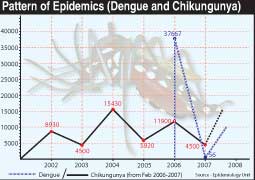
Health Ministry Epidemiology Unit Deputy Director Dr. Paba Palihawadane said minor outbreaks could be seen in many parts of the country and they may lead to epidemics.“There is a pattern of epidemics, in 2002, 2004, and in 2006, a huge caseload of cases was reported. In 2006, chikungunya spread mainly in Puttalam, Kalmunai, Colombo, Jaffna, Mannar, Batticaloa and Trincomalee. The number of cases was 37,667.We are trying our best to control it this year,” she said.
<table align="left" border="0" width="20%"> <tbody><tr> <td>
 </td> </tr> </tbody></table> According to the Epidemiology Unit, by yesterday five deaths and 1094 cases of dengue have been reported for this year. Meanwhile around 75 cases of chikungunya have been reported from Colombo and Ratnapura districts. Earlier this year 27 people from Anuradhapura were affected by dengue resulting in three deaths.
“We have recently added three districts to the high risk areas making a total of 15 high risk districts. The new districts are Vavuniya, Jaffna and Trincomalee. The already named high risk areas are Colombo, Gampaha, Kalutara, Kandy, Ratnapura, Kegalle, Kurunegala, Puttalam, Galle, Matara, Hambantota and Anuradhapura districts,” Dr. Palihawadane said.
The number of dengue and chikungunya patients is increasing especially in Colombo district. Only nine dengue cases were reported in February 2007 where as in February 2008 it has increased to 28 cases and the number is continuously increasing.
Dengue and chikungunya are transmitted by Aedes aegypti, a daytime mosquito. Aedes albopictus (the Asian tiger mosquito) also carries the infection to humans. These mosquitoes become infected when they feed on an infected person. Infected mosquitoes can then spread the virus to other humans when they bite.
The only way to avoid dengue and chikungunya fever is to prevent mosquito bites. Using mosquito repellents, coils, nets and wearing protective clothing are the best preventive measures.
Mosquito breeding areas/items like discarded tyres, plastic containers, coconut shells, blocked gutters, birdbaths and flowerpots where water could stagnate should be destroyed.
http://www.sundaytimes.lk/080224/News/news0026.html
By Nadia Fazlulhaq
With dengue and chikungunya cases reported from many parts of the country, health officials believe that 2008 could be a year of epidemics if sudden climate changes occur and immediate measures to prevent these diseases are not taken.
Health Ministry Epidemiology Unit Deputy Director Dr. Paba Palihawadane said minor outbreaks could be seen in many parts of the country and they may lead to epidemics.“There is a pattern of epidemics, in 2002, 2004, and in 2006, a huge caseload of cases was reported. In 2006, chikungunya spread mainly in Puttalam, Kalmunai, Colombo, Jaffna, Mannar, Batticaloa and Trincomalee. The number of cases was 37,667.We are trying our best to control it this year,” she said.
<table align="left" border="0" width="20%"> <tbody><tr> <td>
“We have recently added three districts to the high risk areas making a total of 15 high risk districts. The new districts are Vavuniya, Jaffna and Trincomalee. The already named high risk areas are Colombo, Gampaha, Kalutara, Kandy, Ratnapura, Kegalle, Kurunegala, Puttalam, Galle, Matara, Hambantota and Anuradhapura districts,” Dr. Palihawadane said.
The number of dengue and chikungunya patients is increasing especially in Colombo district. Only nine dengue cases were reported in February 2007 where as in February 2008 it has increased to 28 cases and the number is continuously increasing.
Dengue and chikungunya are transmitted by Aedes aegypti, a daytime mosquito. Aedes albopictus (the Asian tiger mosquito) also carries the infection to humans. These mosquitoes become infected when they feed on an infected person. Infected mosquitoes can then spread the virus to other humans when they bite.
The only way to avoid dengue and chikungunya fever is to prevent mosquito bites. Using mosquito repellents, coils, nets and wearing protective clothing are the best preventive measures.
Mosquito breeding areas/items like discarded tyres, plastic containers, coconut shells, blocked gutters, birdbaths and flowerpots where water could stagnate should be destroyed.
http://www.sundaytimes.lk/080224/News/news0026.html