Giuseppe
Emeritus
[Source: US Centers for Disease Control and Prevention, FluView, full page: (LINK). Edited.]
------
2011-2012 Influenza Season Week 37 ending September 15, 2012
All data are preliminary and may change as more reports are received.
U.S. Virologic Surveillance:
WHO and NREVSS collaborating laboratories located in all 50 states and Washington, D.C. report to CDC the number of respiratory specimens tested for influenza and the number positive by influenza type and subtype. Region specific data can be found at http://gis.cdc.gov/grasp/fluview/fluportaldashboard.html.
(…)
View National and Regional Level Graphs and Data
Novel Influenza A Virus:
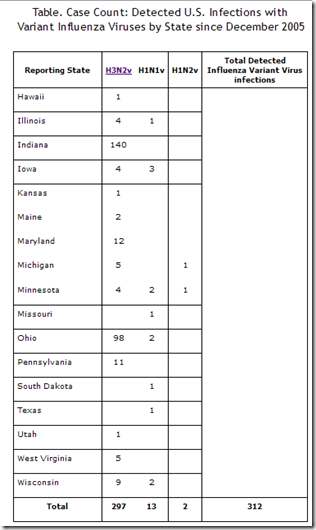
From July 12 through September 20, 2012, a total of 305 infections with influenza A (H3N2) variant (H3N2v) viruses have been reported from ten states.
No new cases have been reported since last week’s update.
Cumulative totals by state since July 15 are:
The vast majority of cases have occurred after prolonged swine exposure, though instances of likely human-to-human transmission have been identified.
At this time no ongoing human-to-human transmission has been identified.
Public health and agriculture officials are investigating the extent of disease among humans and swine, and additional cases are likely to be identified as the investigations continue.
Because of reporting schedules, state totals posted by CDC may not always be consistent with those reported by state health departments.
If there is a discrepancy between state and CDC case counts, data from the state health department should be used as the most accurate number.
As a result of enhanced surveillance activities for H3N2v, one infection with an influenza A (H1N1) variant (H1N1v) virus and three infections with influenza A (H1N2) variant (H1N2v) virus have been detected since July 2012, bringing the total number of variant influenza virus infections to 309.
Early identification and investigation of human infections with novel influenza A viruses is critical in order to evaluate the extent of the outbreak and possible human-to-human transmission. Additional information on influenza in swine, variant influenza infection in humans, and strategies to interact safely with livestock can be found at http://www.cdc.gov/flu/swineflu/h3n2v-outbreak.htm.
Pneumonia and Influenza (P&I) Mortality Surveillance:
During week 37, 6.3% of all deaths reported through the 122-Cities Mortality Reporting System were due to P&I. This percentage was below the epidemic threshold of 6.5% for week 37.
(…)
View Full Screen
Influenza-Associated Pediatric Mortality:
No influenza-associated pediatric deaths were reported to CDC during week 37. A total of 34 influenza-associated pediatric deaths have been reported during the 2011-2012 season. Additional data can be found at: http://gis.cdc.gov/GRASP/Fluview/PedFluDeath.html.
(…)
View Interactive Application
Influenza-Associated Hospitalizations:
The Influenza Hospitalization Surveillance Network (FluSurv-NET) conducts all age population-based surveillance for laboratory-confirmed influenza-related hospitalizations in select counties in the Emerging Infections Program (EIP) states and Influenza Hospitalization Surveillance Project (IHSP) states. Additional FluSurv-NET data can be found at: http://gis.cdc.gov/GRASP/Fluview/FluHospRates.html.
Outpatient Illness Surveillance:
Nationwide during week 37, 1.1% of patient visits reported through the U.S. Outpatient Influenza-like Illness Surveillance Network (ILINet) were due to influenza-like illness (ILI). This percentage is below the national baseline of 2.4%. (ILI is defined as fever (temperature of 100F [37.8C] or greater) and cough and/or sore throat.) Region specific data can be found at http://gis.cdc.gov/grasp/fluview/fluportaldashboard.html.
(…)
View National and Regional Level Graphs and Data
Additional National and International Influenza Surveillance Information
Google Flu Trends: Google Flu Trends uses aggregated Google search data in a model created in collaboration with CDC to estimate influenza activity in the United States. For more information and activity estimates from the U.S. and worldwide, see http://www.google.org/flutrends/
Europe: for the most recent influenza surveillance information from Europe, please see WHO/Europe at http://www.euroflu.org/index.php and visit the European Centre for Disease Prevention and Control at http://ecdc.europa.eu/en/publications/surveillance_reports/influenza/Pages/weekly_influenza_surveillance_overview.aspx
Public Health Agency of Canada: The most up-to-date influenza information from Canada is available at http://www.phac-aspc.gc.ca/fluwatch/
World Health Organization FluNet: Additional influenza surveillance information from participating WHO member nations is available at FluNet and the Global Epidemiology Reports
A description of surveillance methods is available at: http://www.cdc.gov/flu/weekly/overview.htm
-All data are preliminary and may change as more reports are received.
U.S. Virologic Surveillance:
WHO and NREVSS collaborating laboratories located in all 50 states and Washington, D.C. report to CDC the number of respiratory specimens tested for influenza and the number positive by influenza type and subtype. Region specific data can be found at http://gis.cdc.gov/grasp/fluview/fluportaldashboard.html.
(…)
View National and Regional Level Graphs and Data
Novel Influenza A Virus:
From July 12 through September 20, 2012, a total of 305 infections with influenza A (H3N2) variant (H3N2v) viruses have been reported from ten states.
No new cases have been reported since last week’s update.
Cumulative totals by state since July 15 are:
- Hawaii [1],
- Illinois [4],
- Indiana [138],
- Maryland [12],
- Michigan [6],
- Minnesota [4],
- Ohio [106],
- Pennsylvania [11],
- West Virginia [3], and
- Wisconsin [20].
The vast majority of cases have occurred after prolonged swine exposure, though instances of likely human-to-human transmission have been identified.
At this time no ongoing human-to-human transmission has been identified.
Public health and agriculture officials are investigating the extent of disease among humans and swine, and additional cases are likely to be identified as the investigations continue.
Because of reporting schedules, state totals posted by CDC may not always be consistent with those reported by state health departments.
If there is a discrepancy between state and CDC case counts, data from the state health department should be used as the most accurate number.
As a result of enhanced surveillance activities for H3N2v, one infection with an influenza A (H1N1) variant (H1N1v) virus and three infections with influenza A (H1N2) variant (H1N2v) virus have been detected since July 2012, bringing the total number of variant influenza virus infections to 309.
Early identification and investigation of human infections with novel influenza A viruses is critical in order to evaluate the extent of the outbreak and possible human-to-human transmission. Additional information on influenza in swine, variant influenza infection in humans, and strategies to interact safely with livestock can be found at http://www.cdc.gov/flu/swineflu/h3n2v-outbreak.htm.
Pneumonia and Influenza (P&I) Mortality Surveillance:
During week 37, 6.3% of all deaths reported through the 122-Cities Mortality Reporting System were due to P&I. This percentage was below the epidemic threshold of 6.5% for week 37.
(…)
View Full Screen
Influenza-Associated Pediatric Mortality:
No influenza-associated pediatric deaths were reported to CDC during week 37. A total of 34 influenza-associated pediatric deaths have been reported during the 2011-2012 season. Additional data can be found at: http://gis.cdc.gov/GRASP/Fluview/PedFluDeath.html.
(…)
View Interactive Application
Influenza-Associated Hospitalizations:
The Influenza Hospitalization Surveillance Network (FluSurv-NET) conducts all age population-based surveillance for laboratory-confirmed influenza-related hospitalizations in select counties in the Emerging Infections Program (EIP) states and Influenza Hospitalization Surveillance Project (IHSP) states. Additional FluSurv-NET data can be found at: http://gis.cdc.gov/GRASP/Fluview/FluHospRates.html.
Outpatient Illness Surveillance:
Nationwide during week 37, 1.1% of patient visits reported through the U.S. Outpatient Influenza-like Illness Surveillance Network (ILINet) were due to influenza-like illness (ILI). This percentage is below the national baseline of 2.4%. (ILI is defined as fever (temperature of 100F [37.8C] or greater) and cough and/or sore throat.) Region specific data can be found at http://gis.cdc.gov/grasp/fluview/fluportaldashboard.html.
(…)
View National and Regional Level Graphs and Data
Additional National and International Influenza Surveillance Information
Google Flu Trends: Google Flu Trends uses aggregated Google search data in a model created in collaboration with CDC to estimate influenza activity in the United States. For more information and activity estimates from the U.S. and worldwide, see http://www.google.org/flutrends/
Europe: for the most recent influenza surveillance information from Europe, please see WHO/Europe at http://www.euroflu.org/index.php
and visit the European Centre for Disease Prevention and Control at http://ecdc.europa.eu/en/publications/surveillance_reports/influenza/Pages/weekly_influenza_surveillance_overview.aspx Public Health Agency of Canada: The most up-to-date influenza information from Canada is available at http://www.phac-aspc.gc.ca/fluwatch/
World Health Organization FluNet: Additional influenza surveillance information from participating WHO member nations is available at FluNet
and the Global Epidemiology ReportsA description of surveillance methods is available at: http://www.cdc.gov/flu/weekly/overview.htm
------
Last edited by a moderator: