• FluTrackers.com Inc. does not provide medical advice. Information on this web site is collected from various internet resources, and the FluTrackers board of directors makes no warranty to the safety, efficacy, correctness or completeness of the information posted on this site by any author or poster. The information collated here is for instructional and/or discussion purposes only and is NOT intended to diagnose or treat any disease, illness, or other medical condition. Every individual reader or poster should seek advice from their personal physician/healthcare practitioner before considering or using any interventions that are discussed on this website. By continuing to access this website you agree to consult your personal physican before using any interventions posted on this website, and you agree to hold harmless FluTrackers.com Inc., the board of directors, the members, and all authors and posters for any effects from use of any medication, supplement, vitamin or other substance, device, intervention, etc. mentioned in posts on this website, or other internet venues referenced in posts on this website.
  • We are not asking for any donations. Do not donate to any entity who says they are raising funds for us.

US - Texas: 'Very little risk to the public': Dallas County resident being treated for monkeypox, officials say - ex-Nigeria - July 16, 2021

Shiloh

Editor, Senior Moderator
Source: https://www.wfaa.com/article/news/h...rson/287-f010d996-2c9f-4e16-b1ba-5119e568c0e3


'Very little risk to the public': Dallas County resident being treated for monkeypox, officials say
The person traveled from Nigeria to Dallas, arriving at Love Field on July 9. The person is in stable condition, officials said.
Author: Eline de Bruijn
Published: 7/16/2021 2:12:28 PM
Updated: 2:12 PM CDT July 16, 2021
Facebook Twitter

DALLAS COUNTY, Texas — A resident of Dallas County is being treated at a hospital for monkeypox, a rare disease, health officials said Friday. This is believed to be the first monkeypox virus infection in a Texas resident, but officials say there is little risk to the public.

The person traveled from Nigeria to Dallas, arriving at Love Field on July 9, according to a statement from Dallas County Health and Human Services. The person is in stable condition.

The Center for Disease Control and Prevention has been identifying close contacts, including airline passengers who may have been in contact. Face masks were required on the flights and at the airports, the county health department said in a statement...
 
Dallas County HHS
@DCHHS
·1h
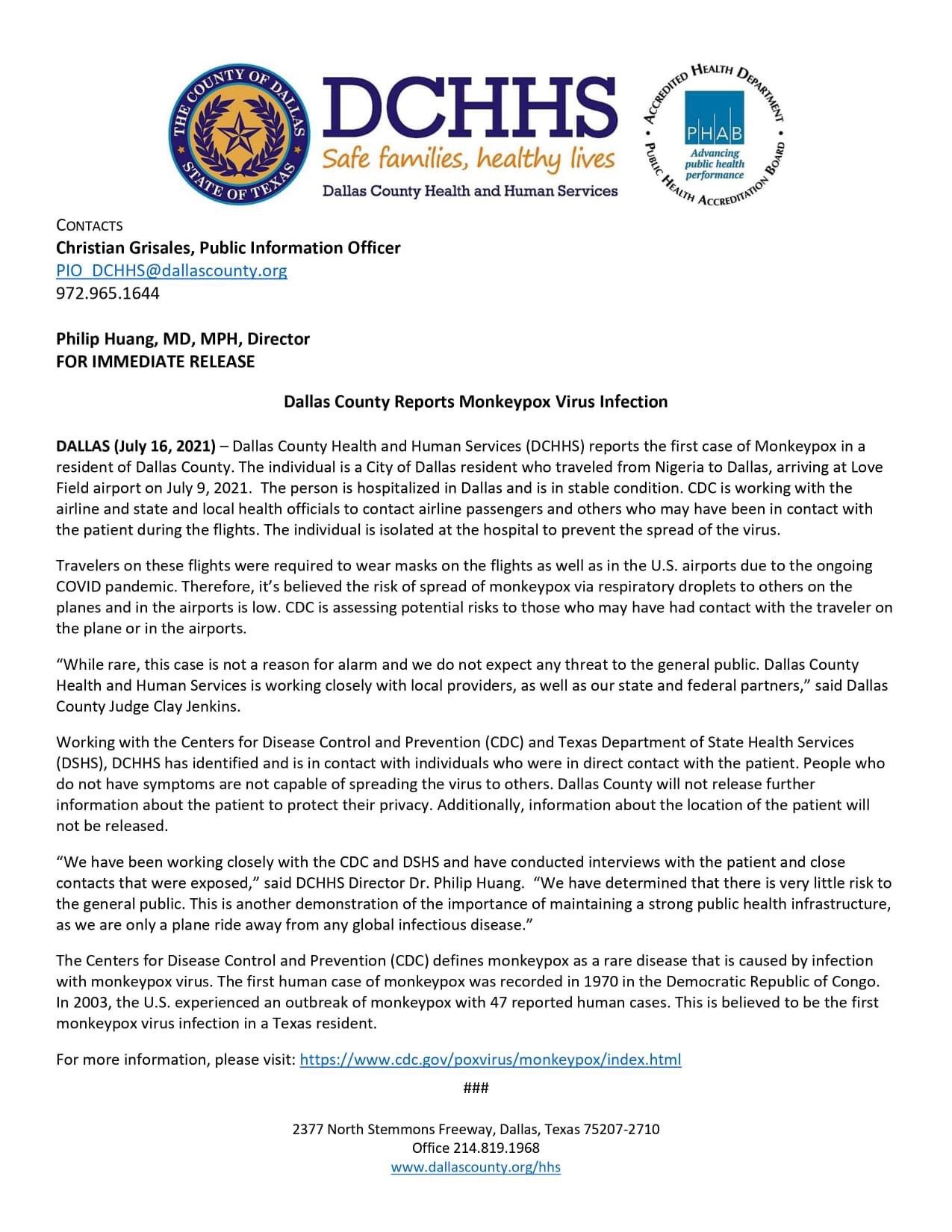
DCHHS reports the first case of Monkeypox.

“We have been working closely with the CDC & DSHS & have conducted interviews with the patient & close contacts that were exposed,” said Dr. Philip Huang. “We have determined that there is very little risk to the general public.”

E6cMwo_X0AQoXYu
 
CDC and Texas Confirm Monkeypox In U.S. Traveler

Media Statement
For Immediate Release: Friday, July 16, 2021
Contact: Media Relations
(404) 639-3286

The Centers for Disease Control and Prevention (CDC) and the Texas Department of State Health Services confirmed on July 15 a case of human monkeypox in a U.S. resident who recently traveled from Nigeria to the United States. The person is currently hospitalized in Dallas. CDC is working with the airline and state and local health officials to contact airline passengers and others who may have been in contact with the patient during two flights: Lagos, Nigeria, to Atlanta on July 8, with arrival on July 9; and Atlanta to Dallas on July 9.

Travelers on these flights were required to wear masks as well as in the U.S. airports due to the ongoing COVID-19 pandemic. Therefore, it’s believed the risk of spread of monkeypox via respiratory droplets to others on the planes and in the airports is low. Working with airline and state and local health partners, CDC is assessing potential risks to those who may have had close contact with the traveler on the plane and specific settings.

Monkeypox is a rare but potentially serious viral illness that typically begins with flu-like illness and swelling of the lymph nodes and progresses to a widespread rash on the face and body. Most infections last 2-4 weeks. Monkeypox is in the same family of viruses as smallpox but causes a milder infection. In this case, laboratory testing at CDC showed the patient is infected with a strain of monkeypox most commonly seen in parts of West Africa, including Nigeria. Infections with this strain of monkeypox are fatal in about 1 in 100 people. However, rates can be higher in people who have weakened immune systems.

Prior to the current case, there have been at least six reported monkeypox cases in travelers returning from Nigeria (including cases in the United Kingdom, Israel, and Singapore). This case is not related to any of these previous cases. In the United Kingdom, several additional monkeypox cases occurred in people who had contact with cases.

Background on monkeypox in Africa

Experts have yet to identify where monkeypox hides in nature, but it’s thought that African rodents and small mammals play a part in spreading the virus to people and other forest animals like monkeys. People can get monkeypox when they are bitten or scratched by an animal, prepare wild game, or have contact with an infected animal or possibly animal products. Monkeypox can also spread between people through respiratory droplets, or through contact with body fluids, monkeypox sores, or items that have been contaminated with fluids or sores (clothing, bedding, etc.) Human-to-human transmission is thought to occur primarily through large respiratory droplets. Respiratory droplets generally cannot travel more than a few feet, so prolonged face-to-face contact is required.

Most monkeypox outbreaks have occurred in Africa. In addition to Nigeria, outbreaks have also been reported in nine other countries in central and western Africa since 1970. Monkeypox also caused a large outbreak in people in the United States in 2003 after the virus spread from imported African rodents to pet prairie dogs.

CDC poxvirus experts have been supporting the investigation and response to Nigeria’s monkeypox flare-ups since 2017 when the disease re-emerged in Nigeria after a nearly 40-year stint with no reported cases. During 2017, CDC sent investigators to assist the Nigerian CDC and the National Veterinary Research Institute with tracing contacts of ill patients, providing diagnostic tests, training lab staff in country to safely test samples from suspect monkeypox cases, providing diagnostic tests and capturing small mammals to test for monkeypox (which would help identify which animals carry the disease in nature).

Scientists at CDC labs in Atlanta have also provided laboratory testing, including specialized tests to identify people who may have had monkeypox and recovered, sequencing to trace outbreaks and phylogenetics to determine if clusters of cases were related. CDC continues to train Nigerian partners in how to collect wildlife to test for which animals carry the virus in nature, helping to improve the country’s ability to track monkeypox cases in people and interview community members about their interactions with local wildlife. CDC is also running trials in Democratic Republic of Congo to assess whether the smallpox vaccine Jynneos may help protect healthcare workers from contracting undiagnosed monkeypox infections from their patients.

For more information about monkeypox, visit https://www.cdc.gov/poxvirus/monkeypox/index.html.

###
U.S. DEPARTMENT OF HEALTH AND HUMAN SERVICESexternal icon

CDC works 24/7 protecting America’s health, safety and security. Whether disease start at home or abroad, are curable or preventable, chronic or acute, or from human activity or deliberate attack, CDC responds to America’s most pressing health threats. CDC is headquartered in Atlanta and has experts located throughout the United States and the world.

Page last reviewed: July 16, 2021

https://www.cdc.gov/media/releases/2021/s0716-confirm-monkeypox.html
 
Potential Exposure to Person with Confirmed Human Monkeypox Infection — United States, 2021


HAN_badge_HEALTH_ADVISORY_320x125.png


Distributed via the CDC Health Alert Network
July 17, 2021, 5:00 PM ET
CDCHAN-00446

Summary
The Centers for Disease Control and Prevention (CDC), in collaboration with the Texas Department of State Health Services and Dallas County Health and Human Services, is investigating a single case of monkeypox virus infection in a U.S. citizen who resides in the United States and recently returned from travel to Nigeria. The patient traveled to Dallas from Lagos, Nigeria, via Atlanta on two separate flights during July 8-9, 2021. The patient presented to an emergency department in Dallas, Texas on July 13 for complaints of a rash that began on July 7, one day prior to travel. Testing at Dallas County and CDC confirmed the presence of monkeypox virus. CDC is working with the airlines to share information with state and local health officials to contact airline passengers and others who may have been in contact with the patient during two flights: Lagos, Nigeria, to Atlanta on July 8, with arrival on July 9; and Atlanta to Dallas on July 9. CDC is issuing this health advisory to ask clinicians to consider a diagnosis of monkeypox in people who present with a febrile prodrome followed by rash and who may have had direct or indirect contact with the patient.

Background
Monkeypox is endemic to several Central and West African nations. Recent cases outside of Africa either reported recent travel to one of these countries or contact with a person with confirmed monkeypox.

Symptoms of monkeypox most often begin with a prodrome of fever and other non-specific symptoms such as malaise, headache, and muscle aches following an average incubation period of 5-13 days. After the prodrome, which lasts approximately one to three days, a generalized rash appears. Nearly all patients with monkeypox have had fever early in illness onset and prior to the rash onset. Although lesions often begin on the face before spreading to other parts of the body, there has been at least one report of lesions beginning in the groin region. Lesions progress through specific stages—macules, papules, vesicles, and pustules—before scabbing and falling off[SUP]1[/SUP]. The rash appearance of monkeypox is very similar to that of smallpox, including a centrifugal distribution and lesions on the palms and soles. Monkeypox can occur concurrently with other rash illnesses, including varicella-zoster virus and herpes simplex virus infections. Case fatality ranges between 1 and 10%. Laboratory confirmation of monkeypox is performed using real-time polymerase chain reaction (PCR) on lesion material.

A person is considered infectious beginning five days prior to rash onset and is presumed to remain infectious until lesions have crusted, those crusts have separated, and a fresh layer of skin has formed underneath. Human-to-human transmission is thought to occur primarily through large respiratory droplets. Respiratory droplets generally cannot travel more than a few feet, so prolonged face-to-face contact is required. Transmission can also occur by direct contact with body fluids or lesion material. Indirect contact with lesion material through fomites has also been documented. Animal-to-human transmission may occur through a bite or scratch, preparation of wild game, and direct or indirect contact with body fluids or lesion material.

There is no specific treatment for monkeypox virus infection, although antivirals developed for use in patients with smallpox may prove beneficial[SUP]2[/SUP]. Persons with direct contact (i.e., exposure to the skin, crusts, bodily fluids, or other materials) or indirect contact (e.g., presence within a 6-foot radius in the absence of an N95 or filtering respiratory for ≥ 3 hours) with a monkeypox patient should be monitored by health departments; some persons may be candidates for post-exposure prophylaxis with smallpox vaccine after consultation with public health authorities.

Recommendations for Clinicians
  • If clinicians identify patients with a constellation of signs and symptoms that could be monkeypox, a travel history should be solicited. Monkeypox should be considered in patients with unexplained onset of fever, chills, new rash, or new lymphadenopathy, and a history of 1) air travel from Lagos Murtala Muhammed International Airport, Nigeria, to Hartsfield-Jackson Atlanta International Airport on July 8 with arrival on July 9, 2) air travel from Atlanta to Dallas Love Field Airport on July 9, or 3) presence in those airports on July 8-9.
  • Patients with suspected monkeypox should be isolated in a negative pressure room, and all personnel should wear personal protective equipment (PPE) in accordance with recommendations for standard, contact, and airborne precautions[SUP]3[/SUP]. All healthcare workers (e.g., clinical staff and environmental staff) caring for a patient with suspect or confirmed monkeypox should be communicated the importance of maintaining proper isolation precautions so that infection is not transmitted to them or others.
  • Clinicians should consult their state health department or CDC’s monkeypox call center through the CDC Emergency Operations Center (770-488-7100) as soon as monkeypox is suspected.
Recommendations for Health Departments
  • If monkeypox is suspected by the health department, then CDC should be consulted through the CDC Emergency Operations Center (770-488-7100).
    • After consultation with CDC, samples can be sent to CDC or an appropriate Laboratory Response Network for confirmatory testing by PCR[SUP]4[/SUP].
    • Send all specimens through the state/territorial public health department, unless authorized to send directly to CDC.
  • Ideal specimens for laboratory testing include lesion fluid, lesion roof, scabs, and crusts. Serum and whole blood can also be collected. Best practices are to collect multiple specimens from different locations on the body. Detailed specimen submission instructions are available at CDC’s monkeypox website[SUP]5[/SUP].
Recommendations for the Public
  • Individuals who have had contact with a suspect or confirmed monkeypox case should contact their health department for a risk assessment.
For More Information
  • Contact your local health department if you have any questions or suspect a patient may have monkeypox.
  • CDC
    • CDC-INFO or 1-800-232-4636
    • CDC 24/7 Emergency Operations Center (EOC): 770-488-7100
References
[SUP]1[/SUP] Clinical Recognition of Monkeypox
[SUP]2[/SUP] Antivirals
[SUP]3[/SUP] Infection Control Measures in Hospitals
[SUP]4[/SUP] U.S. Laboratory Response Network
[SUP]5[/SUP] Preparation and Collection of Specimens

The Centers for Disease Control and Prevention (CDC) protects people’s health and safety by preventing and controlling diseases and injuries; enhances health decisions by providing credible information on critical health issues; and promotes healthy living through strong partnerships with local, national and international organizations.
DEPARTMENT OF HEALTH AND HUMAN SERVICES

HAN Message Types
  • Health Alert: Conveys the highest level of importance; warrants immediate action or attention.
  • Health Advisory: Provides important information for a specific incident or situation; may not require immediate action.
  • Health Update: Provides updated information regarding an incident or situation; unlikely to require immediate action.
  • Info Service: Provides general information that is not necessarily considered to be of an emergent nature.
###
This message was distributed to state and local health officers, state and local epidemiologists, state and local laboratory directors, public information officers, HAN coordinators, and clinician organizations.
###

https://emergency.cdc.gov/han/2021/han00446.asp
 
Monkeypox ‘imported’ to US shows Nigeria’s need to focus on other diseases –Tomori

Agency Report
17 July 2021

A Professor of Virology, Oyewale Tomori, says COVID-19 is diverting the country’s need to increase surveillance on other diseases of public health concerns.

According to him, increased disease surveillance across board has become urgently necessary as the Texas U.S. health authorities detected a monkeypox case traceable to Nigeria.
...
Tomori said that the relevant agencies in the country should get in touch urgently with the U.S. officials for more details about the case, so that the country would know the locations, travel history of the case to assist in contact tracing and direct its response.

“Questions such as when was the case in Nigeria?, where did the case visit? who were the contacts among others should be asked,’’ he added.
...
He explained that monkeypox was a very contagious infection which spreads through physical contact with an infected person or animal.
...
The virologist said that monkeypox virus is a disease with symptoms similar to smallpox, noting that every one out of 10 persons affected by it could die, with most of the deaths occurring in the younger age group.

“After being hit by it, if the rashes on your body start turning into wounds and you feel more pain in it, then it should be understood that it can be risky for you.
...

https://punchng.com/monkeypox-imported-to-us-shows-nigerias-need-to-focus-on-other-diseases-tomori/
 
More than 200 people in U.S. being monitored for possible monkeypox exposure, CDC says

July 20, 2021

By Helen Branswell

More than 200 people in 27 states are being monitored for possible exposure to monkeypox after they had contact with an individual who contracted the disease in Nigeria before traveling to the United States this month, according to the Centers for Disease Control and Prevention. To date, no additional cases have been detected.

State and local health authorities are working with the CDC to identify and assess the individuals, and follow up with them daily until late this month, said Andrea McCollum, who leads the poxvirus epidemiology unit at the agency’s National Center for Emerging and Zoonotic Infectious Diseases.

... The people being monitored include a number who sat within 6 feet of the infected individual on the Lagos to Atlanta flight; others who used the mid-cabin bathroom on that flight; airline workers who cleaned the bathroom after the flight; flight attendants; and some family members who had contact with the individual in Dallas.

https://www.statnews.com/2021/07/20...red-for-possible-monkeypox-exposure-cdc-says/
 
Source: https://www.who.int/emergencies/disease-outbreak-news/item/monkeypox---the-united-states-of-america


Monkeypox - United States of America

27 July 2021


On 17 July 2021, the IHR National Focal Point of the United States of America (USA) notified PAHO/WHO of an imported case of human monkeypox in Dallas, Texas, USA. The case-patient travelled from the USA to Lagos State, Nigeria on 25 June and also stayed in Ibadan, Oyo State, from 29 June to 3 July. He developed self-reported fever, vomiting and mild cough on 30 June, and a painful genital rash on 7 July. The case-patient returned to the USA, departing Lagos on 8 July and arriving on 9 July. He developed a facial rash on the next day. On 13 July, the patient attended a local hospital; fever was documented, and he was immediately placed under isolation.
Sample of a skin lesion was taken, and on 14 July, an Orthopoxvirus was confirmed by reverse transcriptase polymerase chain reaction (RT-PCR) by Dallas County. On 15 July, the patient’s skin samples tested positive for the West African clade of monkeypoxvirus via RT-PCR conducted at the US Centers for Disease Control and Prevention (US CDC) Poxvirus and Rabies Branch Laboratory. The patient is currently hospitalized.
At this time, the source of infection for this case is unknown. Although monkeypox is considered a zoonotic disease, the wildlife reservoir has not been determined. During an outbreak of monkeypox in human in 2003 in the USA, exposure was traced to contact with pet prairie dogs that had been co-housed with monkeypoxvirus-infected African rodents, imported from Ghana. Contact with wild animals (including live animals, meat for consumption, and other products) are known potential risk factors in enzootic countries. Prolonged contact with an infected person can also result in person-to-person transmission.
An outbreak occurred in Nigeria from 2017 to 2019, with cases still being reported in 2021. In addition to Nigeria, outbreaks have also been reported in nine other countries in central and western Africa since 1970. In 2020, over 6200 suspected cases were reported in the Democratic Republic of the Congo. Sporadic outbreaks among humans have occurred in other countries such as Cameroon or the Central African Republic.
This is the first time that human monkeypox has been detected in a traveller to the USA, and the first case reported in the USA since the outbreak in 2003. Human monkeypox in travellers from Nigeria has been documented on seven previous occasions since 1978. The earliest documented travel-related case occurred in Benin in a patient who had contracted the infection in Oyo State, Nigeria. Since 2018, six cases have been reported and confirmed in non-endemic countries via travelers to Israel (2018), Singapore (2019), and the United Kingdom of Great Britain and Northern Ireland (two cases in 2018, one in 2019 and one in 2021). Lagos State and Oyo State in Nigeria continue to report and confirm sporadic cases. Additionally, cases have been reported in South Sudan which were likely imported from the Democratic Republic of the Congo.


Public health response

Public health measures are being taken, including isolation and treatment of the patient. The US CDC and state and local health departments are monitoring possible community and health care contacts who, during the infectious periods, had contact with the case-patient. The US CDC is working with the airline and state and local health officials to contact airline passengers who shared a common seating area with the patient during his travel from Nigeria and within the USA.
Travellers on these flights were required to wear masks due to the ongoing COVID-19 pandemic. While the risk of spread of monkeypox via respiratory droplets to others on the flights is therefore considered low, contamination of common use areas such as toilets may have occurred. Health personnel involved in the patient’s care have been wearing appropriate personal protective equipment. Post-exposure vaccination with a smallpox vaccine within 14 days from the most recent contact with the case-patient may be recommended for some contacts. As of 25 July, over 200 persons are being monitored in the USA and none have developed symptoms consistent with monkeypox.
The surveillance and public health response in Nigeria for the re-emergence of monkeypox since 2017 is ongoing across the country. Outbreak investigation related to this case is focused on Lagos and Oyo States and involves human and animal health specialists to identify possible sources of exposure and monitor persons who may have been in contact with the reported case.


WHO risk assessment

Monkeypox is a sylvatic zoonosis with incidental human infections that usually occur sporadically in forested parts of Central and West Africa. It is caused by the monkeypox virus (MPXV) that belongs to the Orthopoxvirus family. Genomic sequencing shows there are two monkeypox clades – Congo Basin and West African – consistent with observed differences in human pathogenicity and fatality in the two geographic areas. Both clades can be transmitted by contact and droplet exposure via exhaled large droplets, or via fomites such as bedding, and can be fatal in humans.
The incubation period for monkeypox is usually from 6 to 13 days but can range from 5 to 21 days. The disease is often self-limiting with symptoms usually resolving spontaneously within 14-21 days. Symptoms can be mild or severe, and lesions can be painful and become itchy. Although the West African clade of monkeypox virus infection generally causes mild disease, it may lead to severe illness in some individuals. The case fatality rate for the West African clade is around 1% while it may be as high as 10% for the Congo Basin clade. Immune deficiency appears to be a risk factors for severe disease. Children are also at higher risk and monkeypox during pregnancy may lead to complications, congenital monkeypox or stillbirth.
Milder cases of monkeypox may go undetected and represent a risk of person-to-person transmission. There is likely to be little immunity to the infection in those travelling and exposed as endemic disease is geographically limited to parts of West and Central Africa.
While a vaccine has been approved for prevention of monkeypox, and traditional smallpox vaccine also provides protection, these vaccines are not widely available and populations worldwide under the age of 40 or 50 years no longer benefit from the protection afforded by prior smallpox vaccination programmes. Increased susceptibility to monkeypox is in part related to waning immunity due to cessation of smallpox immunization.
The animal reservoir remains unknown, although is likely to be among small mammals. Contact with live and dead animals through hunting and consumption of wild game or bush meat are presumed drivers of human infection....

 
Back
Top