sharon sanders
Editor-in-Chief & President
Influenza Risk Assessment Tool (IRAT)
Public Health
May 9, 2024
Purpose
The Influenza Risk Assessment Tool (IRAT) is an evaluation tool developed by CDC and external influenza experts that assesses the potential pandemic risk posed by influenza A viruses that currently circulate in animals but not in humans.
IRAT: Assessing Pandemic Risk
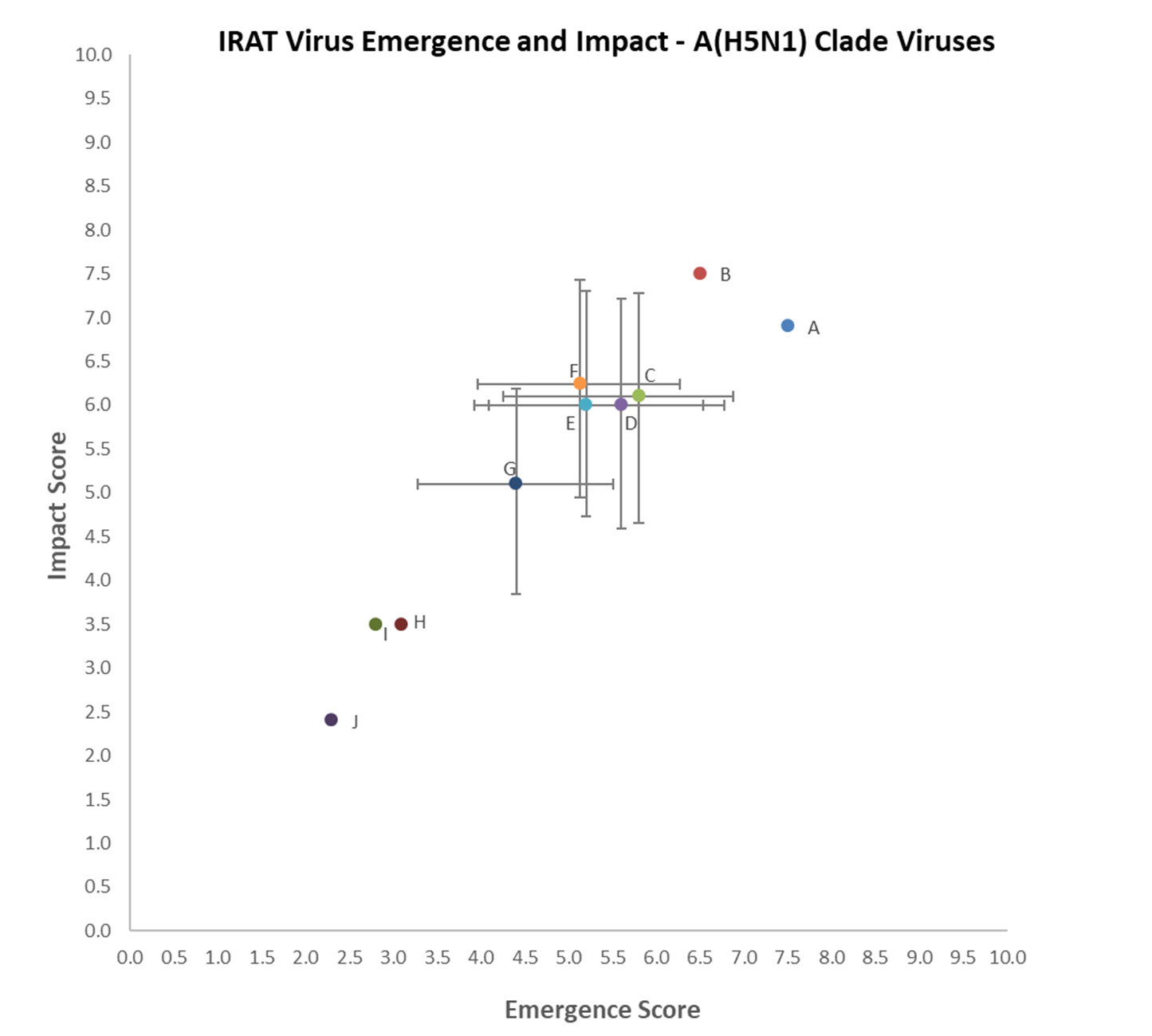
The IRAT assesses potential pandemic risk based on two questions: "emergence" and "public health impact."
These questions are listed as follows:
Public health impact refers to the potential severity of human disease caused by the virus (e.g., deaths and hospitalizations) as well as the burden on society (e.g., missed workdays, strain on hospital capacity and resources, and interruption of basic public services) if a novel influenza virus were to begin spreading efficiently and sustainably among people.
IRAT's 10 Risk Elements
The IRAT uses 10 risk elements to measure the potential pandemic risk associated with each of these questions. These 10 risk elements can be grouped into three overarching categories: "properties of the virus," "attributes of the population," and "ecology & epidemiology of the virus." Influenza subject matter experts evaluate novel influenza viruses based on each of these 10 risk elements.
Each of the 10 risk elements is then weighted statistically based on its significance to each of the two questions. A composite score for each virus is then calculated based on the given question. These composite scores provide a means to rank and compare influenza viruses to each other in terms of their potential pandemic risk for each of the two questions.
As we learn more about influenza A viruses, these 10 risk elements may change, other risk elements may be added, or some current risk elements may be dropped. The IRAT is designed to be flexible and responsive to current scientific advances.
IRAT's Key Objectives
The IRAT is intended to do the following:
The IRAT cannot predict the next pandemic and is not intended to do so. Additionally, the IRAT depends on subject matter experts to carefully analyze the 10 risk elements of the IRAT to determine pandemic risk and to rank the importance of the risk elements according to the specific risk question or situation.
The IRAT is not intended to provide a precise measurement of risk:
The IRAT consists of 10 risk elements grouped within three overarching categories. These categories and risk elements are described as follows:
Risk Elements: Ranked and Weighed
Influenza experts generate numerical values (point score) to estimate the pandemic risk associated with each of the 10 risk elements. The point scores fall into three general classifications of risk: low risk, moderate risk and high risk:
Each of the 10 risk elements is weighted according to its importance to each of the two questions on "emergence" and "public health impact."
Potential Emergence Risk (Column 3 in Table)
The first question is: "What is the risk that a novel virus has the potential for sustained human-to-human transmission?" The risk elements may be ranked and weighted as follows (with the first risk element receiving the highest rank and weight score, and the last risk element receiving the lowest rank and weight score).
The second question is: "If the virus were to achieve sustained human-to-human transmission, what is the risk that a novel virus has the potential for significant impact on public health?" The same risk elements could be ranked and weighted as follows (with the first risk element receiving the highest rank and weight score, and the last risk element receiving the lowest rank and weight score).
Mean-High and Mean-Low
Since the IRAT is qualitative in nature, its scores involve some degree of subjectivity. Subject matter experts provide a range of “acceptable” scores for each risk element by identifying a lower and upper bound they would consider acceptable from other experts scoring the same element. The mean of the lowest acceptable bound and the mean of the highest acceptable bound from each risk element are used in the weighted “emergence” or “public health impact” calculations to create the “mean-high” and “mean-low” acceptable score ranges.
Updating IRAT
The IRAT may be updated when new zoonotic or novel influenza viruses emerge or undergo a change in characteristics that prompts the need for a new assessment.
IRAT Virus Summaries
CDC has prepared a summary of Influenza Risk Assessment Tool (IRAT) results.
https://www.cdc.gov/pandemic-flu/php/national-strategy/influenza-risk-assessment-tool.html
Public Health
May 9, 2024
Purpose
The Influenza Risk Assessment Tool (IRAT) is an evaluation tool developed by CDC and external influenza experts that assesses the potential pandemic risk posed by influenza A viruses that currently circulate in animals but not in humans.
IRAT: Assessing Pandemic Risk
The IRAT assesses potential pandemic risk based on two questions: "emergence" and "public health impact."
These questions are listed as follows:
- Emergence asks the question: What is the risk that a virus not currently circulating in the human population has the potential for sustained human-to-human transmission?
- Public health impact asks the question: If the virus were to achieve sustained human-to-human transmission, what is the risk that a virus not currently circulating in the human population has the potential for significant impact on public health?
Public health impact refers to the potential severity of human disease caused by the virus (e.g., deaths and hospitalizations) as well as the burden on society (e.g., missed workdays, strain on hospital capacity and resources, and interruption of basic public services) if a novel influenza virus were to begin spreading efficiently and sustainably among people.
IRAT's 10 Risk Elements
The IRAT uses 10 risk elements to measure the potential pandemic risk associated with each of these questions. These 10 risk elements can be grouped into three overarching categories: "properties of the virus," "attributes of the population," and "ecology & epidemiology of the virus." Influenza subject matter experts evaluate novel influenza viruses based on each of these 10 risk elements.
Each of the 10 risk elements is then weighted statistically based on its significance to each of the two questions. A composite score for each virus is then calculated based on the given question. These composite scores provide a means to rank and compare influenza viruses to each other in terms of their potential pandemic risk for each of the two questions.
As we learn more about influenza A viruses, these 10 risk elements may change, other risk elements may be added, or some current risk elements may be dropped. The IRAT is designed to be flexible and responsive to current scientific advances.
IRAT's Key Objectives
The IRAT is intended to do the following:
- Prioritize and maximize investments in pandemic preparedness by helping to determine which novel (new) influenza viruses to develop vaccines against and capitalizing on surveillance efforts and in-country capacity-building activities;
- Identify key gaps in information and knowledge which can be the basis to prompt additional studies (for example, if information is not available for one of the 10 risk elements used by the IRAT additional studies could be done or resources allocated to provide the missing information);
- Document in a transparent manner the data and scientific process used to inform decisions associated with pandemic preparedness;
- Provide a flexible means to uniformly and regularly update the risk assessment of a novel influenza virus as new information becomes available;
- Be an effective evaluation tool for public health and medical professionals;
- Provide a means to weigh the 10 risk elements differently depending on whether the intent of the risk assessment is to:
- measure the ability of an influenza virus to "emerge" as a pandemic capable virus (i.e., become capable of efficient human-to-human spread) or "impact" the human population if it did emerge.
The IRAT cannot predict the next pandemic and is not intended to do so. Additionally, the IRAT depends on subject matter experts to carefully analyze the 10 risk elements of the IRAT to determine pandemic risk and to rank the importance of the risk elements according to the specific risk question or situation.
The IRAT is not intended to provide a precise measurement of risk:
- Many risk assessments generate a quantitative measure that describes the likelihood of exposure or disease risk. The IRAT focuses on the perceived pandemic potential of novel influenza viruses as estimated by subject matter experts using the IRAT risk elements and available data.
- The IRAT depends on data that are often scarce and/or preliminary (for example, typically, when the IRAT is run, there are a small number of cases of human infection which may not provide a reliable estimate of public health impact).
The IRAT consists of 10 risk elements grouped within three overarching categories. These categories and risk elements are described as follows:
- The "Properties of the Virus" category contains four of the 10 risk elements, including:
- Genomic analysis is a measure of the extent of genetic diversity or presence of known molecular signatures important for human infections and disease.
- Receptor binding refers to the host preference (e.g., animal or human) of an influenza virus as well as the types of tissues and cells the virus is best suited to infecting (e.g., nose tissue and cells vs. deep lung tissue and cells). Some influenza viruses are better adapted to infecting humans than animals.
- Transmission in animal models is a measure of the ability of an influenza virus to transmit efficiently in animals in laboratory studies. Some influenza viruses can transmit through the air via small infectious droplets expelled through coughs or sneezes. In contrast, other influenza viruses may only spread through direct contact with an infected host.
- Antiviral treatment options refers to the predicted effectiveness of influenza antiviral medications, such as oseltamivir, zanamivir, baloxavir, and M2 blockers.
- The "Attributes of the Population" category contains three of the 10 risk elements, including:
- Population immunity refers to whether the human population has any existing immune protection against the novel influenza virus being evaluated. Susceptibility to infection and severity of illness associated with specific influenza viruses may depend on age, geographic area, or genetic factors.
- Disease severity and pathogenesis measure the severity of illness caused by a particular influenza virus in people and/or animals.
- Antigenic relatedness is a measure of how similar an influenza virus not circulating in humans is to seasonal influenza vaccines, pre-pandemic candidate vaccine viruses, and stockpiled pre-pandemic vaccines.
- The "Ecology and Epidemiology" category contains the final risk elements, including:
- Global distribution in animals measures how widespread an influenza virus is in animals, the rate of spread over time, and any management factors that may affect the distributi.
- Infections in animals refers to what kinds of animals are impacted by the influenza virus and the likelihood of human contact with these animals. For example, are influenza infections occurring in wild birds or domestic birds?
- Human infections refers to evidence and frequency of human infections with an influenza virus not currently capable of sustained human-to-human transmission. If evidence exists, under what circumstances do human infections occur? For example, how frequently and easily does transmission occur after direct and prolonged contact between humans and infected animals?
Risk Elements: Ranked and Weighed
Influenza experts generate numerical values (point score) to estimate the pandemic risk associated with each of the 10 risk elements. The point scores fall into three general classifications of risk: low risk, moderate risk and high risk:
- Low risk is associated with a point score between 1.0 and 3.9;
- Moderate risk is associated with a point score between 4.0-7.9; and,
- High risk is associated with a point score between 8.0-10.0.
Each of the 10 risk elements is weighted according to its importance to each of the two questions on "emergence" and "public health impact."
Potential Emergence Risk (Column 3 in Table)
The first question is: "What is the risk that a novel virus has the potential for sustained human-to-human transmission?" The risk elements may be ranked and weighted as follows (with the first risk element receiving the highest rank and weight score, and the last risk element receiving the lowest rank and weight score).
- Human infections
- Transmission in animal models
- Receptor binding
- Population immunity
- Infections in animals
- Genomic analysis
- Antigenic relatedness
- Global distribution of animals
- Disease severity and pathogenesis
- Antiviral treatment options
The second question is: "If the virus were to achieve sustained human-to-human transmission, what is the risk that a novel virus has the potential for significant impact on public health?" The same risk elements could be ranked and weighted as follows (with the first risk element receiving the highest rank and weight score, and the last risk element receiving the lowest rank and weight score).
- Disease severity and pathogenesis
- Population immunity
- Human infections
- Antiviral treatment options
- Antigenic relatedness
- Receptor binding
- Genomic analysis
- Transmission in animal models
- Global distribution in animals
- Infections in animals
Mean-High and Mean-Low
Since the IRAT is qualitative in nature, its scores involve some degree of subjectivity. Subject matter experts provide a range of “acceptable” scores for each risk element by identifying a lower and upper bound they would consider acceptable from other experts scoring the same element. The mean of the lowest acceptable bound and the mean of the highest acceptable bound from each risk element are used in the weighted “emergence” or “public health impact” calculations to create the “mean-high” and “mean-low” acceptable score ranges.
Updating IRAT
The IRAT may be updated when new zoonotic or novel influenza viruses emerge or undergo a change in characteristics that prompts the need for a new assessment.
IRAT Virus Summaries
CDC has prepared a summary of Influenza Risk Assessment Tool (IRAT) results.
https://www.cdc.gov/pandemic-flu/php/national-strategy/influenza-risk-assessment-tool.html