

Michael Coston
Editor, Senior Moderator
TTD (Time to Detect): Revisited

Credit CDC
#18,112
As the CDC graphic above illustrates, for every infectious disease in the community, only a small percentage (the top of the pyramid) are likely to be confirmed by public health officials. It doesn't matter whether we are talking about seasonal flu, COVID, Lyme Disease, Mpox, West Nile Virus, Dengue, or even novel H5 influenza.
People who experience mild, or even moderate symptoms, are unlikely seek medical care. Most who visit their GP with `flu-like' symptoms won't be tested, or at best, will be given a RIDT (Rapid Influenza Diagnostic Test) which (in most cases) doesn't identify the subtype.
Those who are hospitalized will generally have more detailed tests performed, but even then there can be delays of weeks before final results are known.
This week the WHO reported on two novel H5Nx infections - one in Australia (apparently imported from India), and one in Mexico City - and in both cases it took more than a month for the results of their tests to be confirmed to be novel H5.
This isn't a slam on the doctors who treated them. Viral illnesses can present with an array of similar symptoms, and the tests that are often available at the hospital level do not discriminate between influenza A subtypes.
In both of these cases, samples were taken and forwarded to a central lab, but since both Australia and Mexico have never reported an H5 case, they were included in larger, non-prioritized batches for processing.
As a result . . .
But the virus wasn't sent out for sequencing until May 8th - 2 weeks later - and final results weren't returned until the third week of May.
As a result, all contact tracing and testing occurred more than a month after the index patient's death. And as one might expect after that much time, all tested negative, although serology tests are reportedly pending.
Similarly, delays in diagnosing the child with H5N1 in Australia meant that India - the likely origin of the girl's infection - wasn't notified until May 21st, 7 weeks after the child left the country.
The FDA lists nearly 90 Influenza Diagnostic Tests approved for use in the United States - and while all should be able to identify novel H5 as influenza A (with varying degrees of sensitivity) - only 19 discriminate between Influenza A/H1/H1pdm09/H3 seasonal subtypes, and only 1 is designed to identify H5.
Between a limited testing `window' for influenza, a plethora of non-subtype-specific influenza A tests, and sensitivities for antigen tests running between 50%-70%, there are a lot of opportunities for a novel H5 virus to escape detection.
We've seen numerous studies over the years suggesting that the majority of novel flu infections likely go undetected, even here in the United States.
The UK TTD charts below assume a fairly aggressive R0 (pronounced R-naught) or Basic Reproductive Number, yet detection could take anywhere from 3 weeks to > 2 months and require anywhere from a few dozen to more than 1,100 cases.
 https://afludiary.blogspot.com/2024/06/ttd-time-to-detect-revisited.html

Our ability to detect H5 cases in the community depends not only on a bit luck, but also on how hard we are actually looking. And based on some media reports and official statements, it appears that some states aren't as invested in finding cases as others.
Two days ago, the Pennsylvania Department of Health released the following HAN, urging that:
`. . .clinicians continue to test for influenza in patients with respiratory illness throughout the summer, particularly in individuals who are severely ill, or individuals with influenza-like illness with or without a fever or conjunctivitis, particularly in persons with relevant exposures (e.g., dairy cows, raw milk, wild birds, poultry, agricultural fair attendance).

(Page 1 of 3)
Intensive testing becomes all the more critical since over the next few months hundreds of state and country fairs will be held, with most featuring well attended agricultural exhibits featuring a variety of livestock, including cattle, pigs, and goats. [TABLE="cellpadding: 0, cellspacing: 0"]
[TR]
[TD]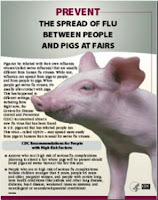 [/TD]
[/TD]
[/TR]
[TR]
[TD]PDF[/TD]
[/TR]
[/TABLE]
Each year we see anywhere from a handful to dozens of human novel swine variant infections linked to these exhibits, and any spread of the H5 virus in pigs would be viewed as a serious escalation of the threat.
This scheme obviously won't capture every human infection, but it greatly increases the chances for early detection.
And that matters since every human infection - no matter how mild - provides the virus with another opportunity to further adapt to human physiology, or even reassort with a more `humanized' flu virus.
Neither of which bode well for society.
https://afludiary.blogspot.com/2024/06/ttd-time-to-detect-revisited.html
Credit CDC
#18,112
As the CDC graphic above illustrates, for every infectious disease in the community, only a small percentage (the top of the pyramid) are likely to be confirmed by public health officials. It doesn't matter whether we are talking about seasonal flu, COVID, Lyme Disease, Mpox, West Nile Virus, Dengue, or even novel H5 influenza.
People who experience mild, or even moderate symptoms, are unlikely seek medical care. Most who visit their GP with `flu-like' symptoms won't be tested, or at best, will be given a RIDT (Rapid Influenza Diagnostic Test) which (in most cases) doesn't identify the subtype.
Those who are hospitalized will generally have more detailed tests performed, but even then there can be delays of weeks before final results are known.
This week the WHO reported on two novel H5Nx infections - one in Australia (apparently imported from India), and one in Mexico City - and in both cases it took more than a month for the results of their tests to be confirmed to be novel H5.
This isn't a slam on the doctors who treated them. Viral illnesses can present with an array of similar symptoms, and the tests that are often available at the hospital level do not discriminate between influenza A subtypes.
In both of these cases, samples were taken and forwarded to a central lab, but since both Australia and Mexico have never reported an H5 case, they were included in larger, non-prioritized batches for processing.
As a result . . .
- The 59 y.o. patient with multiple comorbidities who died in Mexico City on April 24th wasn't identified as a novel H5N2 infection until May 22nd. His complex medical history, and death on the day of his admission to the hospital, no doubt contributed to the delay.
- And the toddler in Australia, who was hospitalized on March 2nd, and released 2.5 weeks later - was only identified by retrospective testing by a WHO lab sometime in May.
But the virus wasn't sent out for sequencing until May 8th - 2 weeks later - and final results weren't returned until the third week of May.
As a result, all contact tracing and testing occurred more than a month after the index patient's death. And as one might expect after that much time, all tested negative, although serology tests are reportedly pending.
Similarly, delays in diagnosing the child with H5N1 in Australia meant that India - the likely origin of the girl's infection - wasn't notified until May 21st, 7 weeks after the child left the country.
The FDA lists nearly 90 Influenza Diagnostic Tests approved for use in the United States - and while all should be able to identify novel H5 as influenza A (with varying degrees of sensitivity) - only 19 discriminate between Influenza A/H1/H1pdm09/H3 seasonal subtypes, and only 1 is designed to identify H5.
Between a limited testing `window' for influenza, a plethora of non-subtype-specific influenza A tests, and sensitivities for antigen tests running between 50%-70%, there are a lot of opportunities for a novel H5 virus to escape detection.
We've seen numerous studies over the years suggesting that the majority of novel flu infections likely go undetected, even here in the United States.
- A study published in 2013 (see CID Journal: Estimates Of Human Infection From H3N2v (Jul 2011-Apr 2012) - estimated that during a time when only 13 cases of novel flu were reported by the CDC - that the actual number of infections was likely 200 times (or more) higher.
- Although the 2009 Swine flu pandemic was first reported in Southern California in late April of 2009, we now know the virus had been circulating - unnoticed - for at least 2 months in Mexico (seeEarly Outbreak of 2009 Influenza A (H1N1) in Mexico Prior to Identification of pH1N1 Virus).
- During the opening weeks of China's H7N9 outbreak in 2013, in Lancet: Clinical Severity Of Human H7N9 Infection, we saw estimates that the number of `symptomatic' cases was likely anywhere between 10 and 200 times higher than reported.
The UK TTD charts below assume a fairly aggressive R0 (pronounced R-naught) or Basic Reproductive Number, yet detection could take anywhere from 3 weeks to > 2 months and require anywhere from a few dozen to more than 1,100 cases.
https://afludiary.blogspot.com/2024/06/ttd-time-to-detect-revisited.htmlOur ability to detect H5 cases in the community depends not only on a bit luck, but also on how hard we are actually looking. And based on some media reports and official statements, it appears that some states aren't as invested in finding cases as others.
Two days ago, the Pennsylvania Department of Health released the following HAN, urging that:
`. . .clinicians continue to test for influenza in patients with respiratory illness throughout the summer, particularly in individuals who are severely ill, or individuals with influenza-like illness with or without a fever or conjunctivitis, particularly in persons with relevant exposures (e.g., dairy cows, raw milk, wild birds, poultry, agricultural fair attendance).
(Page 1 of 3)
Intensive testing becomes all the more critical since over the next few months hundreds of state and country fairs will be held, with most featuring well attended agricultural exhibits featuring a variety of livestock, including cattle, pigs, and goats. [TABLE="cellpadding: 0, cellspacing: 0"]
[TR]
[TD]
[/TD][/TR]
[TR]
[TD]PDF[/TD]
[/TR]
[/TABLE]
Each year we see anywhere from a handful to dozens of human novel swine variant infections linked to these exhibits, and any spread of the H5 virus in pigs would be viewed as a serious escalation of the threat.
This scheme obviously won't capture every human infection, but it greatly increases the chances for early detection.
And that matters since every human infection - no matter how mild - provides the virus with another opportunity to further adapt to human physiology, or even reassort with a more `humanized' flu virus.
Neither of which bode well for society.
https://afludiary.blogspot.com/2024/06/ttd-time-to-detect-revisited.html