• FluTrackers.com Inc. does not provide medical advice. Information on this web site is collected from various internet resources, and the FluTrackers board of directors makes no warranty to the safety, efficacy, correctness or completeness of the information posted on this site by any author or poster. The information collated here is for instructional and/or discussion purposes only and is NOT intended to diagnose or treat any disease, illness, or other medical condition. Every individual reader or poster should seek advice from their personal physician/healthcare practitioner before considering or using any interventions that are discussed on this website. By continuing to access this website you agree to consult your personal physican before using any interventions posted on this website, and you agree to hold harmless FluTrackers.com Inc., the board of directors, the members, and all authors and posters for any effects from use of any medication, supplement, vitamin or other substance, device, intervention, etc. mentioned in posts on this website, or other internet venues referenced in posts on this website.
  • We are not asking for any donations. Do not donate to any entity who says they are raising funds for us.

Study: Migratory birds not to blame for spread of avian flu

Re: Study: Migratory birds not to blame for spread of avian flu

that was estimating that 50% of negatives could be false negatives, AFAIR.
would like to hear others' estimates on that one too.

But better: how much % of migratory birds in Europe or Africa do you estimate
carry at least one live H5N1 - virius ?
OK, I guesstimate 0.1%

zero birds was what was measured, you suggest the actual number
is different.

I also sent email to Nicolas Gaidet who did the Africa-testing.Would be interesting
to hear his estimate too.

and yours and canagica's , please.
 
counting the dead bird samples

counting the dead bird samples

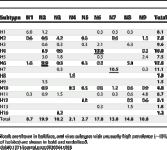
I read the table again:

4 H5N1 positive bird tests were hunter killed
1 H5N1 positive test was the environment (water???) of mallard ducks
1 H5N1 positive test was an alive bird

C, How can you tell how many birds they tested?

I am SO SICK of the migratory bird debate that I cannot even look at
official reports properly.

Migratory birds carry H5N1---and lots of other avian influenza viruses.

YEARS OF H5N1 TESTING----wild bird, cat, chicken, human---have been unreliable, slow, minimal, secretive, contradictory, and subject to error.

There has not been much of an effort to improve this H5N1 testing situation over the years------and we will never know the truth about past H5N1 activity.

We don't have a testing lab, and no one will care and demand more testing until birds fall dead out of the sky all over the country----- like they did in Austin, TX.

I can empathize with you, Johnny Yuma-I am also sick of the debate, as it often seems like we are debating things that are the least helpful in increasing our understanding of the epidemiology of H5N1.

In terms of getting a number for how many birds were tested, I used the totals at the bottom of the HEDDS 2006 AI surveillance table for the total number of morbid/mortaliy samples (~7400). I then looked at the USGS Quarterly Reports for 2006 and totalled the number of birds listed as being reported in mortality morbidity events (roughly 66K). These events are reported from a variety of state, federeal and regional cooperatives that represent as comprehensive a sample as we are going to get.

Dividing the first by the second gets a rough estimate of 11% of the birds reported in mortality/morbidity sampling were tested. One caveat to the morbidity/mortality numbers is that, until the first quarter of 2007 is reported, they don't match up perfectly to the AI surveillance season (which runs 1 April-31 March). But they give us somewhere to start from in order to assess how minimally morbid/mortality birds were tested.

As for your question about the environmental sample, I believe that it came from fecal samples. Multiple fecal samples were collected (I think the protocol said something like 5 per vessel?) and then tested together, which makes it difficult to tell how many birds may have been infected (i.e. the environmental samples only tell us presence/absence rather than a frequency of infection). I was stunned to hear some folks from APHIS speaking as though the 50K environmental samples gathered last year equalled another 50K birds sampled

It just underscores the misunderstandings possible even at the level of the people running the surveillance. A little light could be shed on the issue of whether or not we "should" be finding more LPAI H5N1 in North America if we had a document summarizing all of the AI testing done in various studies in North America over the last 50 years that would have had the ability to detect it. From there we could get some sort of a frequency estimate that would help us put the current numbers into context.
 
AI rapid screening test question

AI rapid screening test question

However, even with samples that were H5N1 positive, H5N1 was only isolated six times. Nothing was isolated in 7 of the collections, and 4 collections yeilded serotypes other than H5N1 (H5N2, H6N2, H1N1, H4N1).

These data are well into the abysmal category, where low path H5N1 could not be isolates from samples that were H5N1 positive, and presumably gave sequences which were used to declare the samples low path.

The abysmal record on detecting or isolating H5N1 low path shows why no high path was found.

Dr.Niman-

Given your knowledge about the AI tests, do you know whether the PCR tests that are being given by the US testing effort (their "rapid screening tests" that have a high false positive rate) are the same as the ones being used by the Eurasian/African studies?

Thanks.
 
Re: AI rapid screening test question

Re: AI rapid screening test question

Dr.Niman-

Given your knowledge about the AI tests, do you know whether the PCR tests that are being given by the US testing effort (their "rapid screening tests" that have a high false positive rate) are the same as the ones being used by the Eurasian/African studies?

Thanks.
I haven't seen any data that remotely suggests that there are any false positives.
 
Re: AI rapid screening test question

Re: AI rapid screening test question

I haven't seen any data that remotely suggests that there are any false positives.

Sorry-I should have been more clear. Some studies have shown that the AI RT-PCR tests generate more positive results than viral isolations of the same virus (e.g., Dybkaer et al. 2003, Spackman et al. 2002), and while the VI method has remained the "gold standard", each of these studies suggests that the RT-PCR test is more sensitive and is perhaps a better test than VI. These studies also suggest that they are between 85-98% accurate. The way they are characterized on the HEDDS site describes them (as I stated in an earlier post) as having an issue with positives that are not isolated in subsequent VIs.

But after rereading these RT-PCR papers, it just occurred to me that these aren't necessarily false positives. But it raises another question of why we are using VIs as the gold standard if the RT-PCRs are more sensitive to the virus? By framing the tests as overly sensitive it makes it easier to dismiss the positives when the VIs come up empty.
 
Re: AI rapid screening test question

Re: AI rapid screening test question

Sorry-I should have been more clear. Some studies have shown that the AI RT-PCR tests generate more positive results than viral isolations of the same virus (e.g., Dybkaer et al. 2003, Spackman et al. 2002), and while the VI method has remained the "gold standard", each of these studies suggests that the RT-PCR test is more sensitive and is perhaps a better test than VI. These studies also suggest that they are between 85-98% accurate. The way they are characterized on the HEDDS site describes them (as I stated in an earlier post) as having an issue with positives that are not isolated in subsequent VIs.

But after rereading these RT-PCR papers, it just occurred to me that these aren't necessarily false positives. But it raises another question of why we are using VIs as the gold standard if the RT-PCRs are more sensitive to the virus? By framing the tests as overly sensitive it makes it easier to dismiss the positives when the VIs come up empty.
The testing in the US was abysmal. In Canada in 2005, as much as 24% of the birds tested were H5 PCR positive (in British Columbia). so any credible claims of false postives would require postives north of some double digit number (i.e. over 15,000 positives). The number of positives in the US was much lower, although only H5N1 data was released. 17 H5N1 PCR postives out of 150,000 tested would hardly suggest there were any false positives.
 
Re: Study: Migratory birds not to blame for spread of avian flu

here is a new study from Europe, 36000 birds, full text freely available

http://pathogens.plosjournals.org/perlserv/?request=get-document&doi=10.1371/journal.ppat.0030061


Canagica and niman, please discuss !
(I haven't read the whole study, I'm occupied with the Taubenberger,Morens,Fauci - paper...)

euwild.gif
 
Last edited by a moderator:
Back
Top