• FluTrackers.com Inc. does not provide medical advice. Information on this web site is collected from various internet resources, and the FluTrackers board of directors makes no warranty to the safety, efficacy, correctness or completeness of the information posted on this site by any author or poster. The information collated here is for instructional and/or discussion purposes only and is NOT intended to diagnose or treat any disease, illness, or other medical condition. Every individual reader or poster should seek advice from their personal physician/healthcare practitioner before considering or using any interventions that are discussed on this website. By continuing to access this website you agree to consult your personal physican before using any interventions posted on this website, and you agree to hold harmless FluTrackers.com Inc., the board of directors, the members, and all authors and posters for any effects from use of any medication, supplement, vitamin or other substance, device, intervention, etc. mentioned in posts on this website, or other internet venues referenced in posts on this website.
  • We are not asking for any donations. Do not donate to any entity who says they are raising funds for us.

Saudi Arabia Increases Its Coronavirus Case Count to 688 including 282 deaths - June 3, 2014

sharon sanders

Editor-in-Chief & President
Update in Statistics: Ministry of Health Institutes New Standards for Reporting of MERS-CoV
6/3/2014

Last month the Ministry of Health’s Command & Control Center launched a rigorous examination of data related to MERS-CoV patients from 2012 onwards. The main objective of that review was to ensure a more complete and accurate understanding of the MERS-CoV outbreak in the Kingdom. The review has already enhanced the Ministry’s policy development process and improved measures taken to address the situation.

Following the review, the new total number of cases recorded in the Kingdom between 2012 and today, is 688. Of that total, 282 of the cases were fatalities, 53 are currently receiving treatment, 353 have recovered.

Based on the findings of the review, the Ministry has already put in place a number of measures to ensure that best practices of data gathering, reporting, transparency are being strictly observed, and that the necessary systems and processes have been put in place to ensure that from now on, case information will be accurate, reliable and timely.

Dr Tariq Madani, Head of the Scientific Advisory Board within the Ministry’s Command and Control Center said: “The Ministry is committed to fully understanding MERS-CoV and putting in place the policies needed to protect public health and safety. To do this the Ministry has reviewed historical cases of MERS-CoV to give a more comprehensive understanding of the facts. While the review has resulted in higher total number of previously unreported cases, we still see a decline in the number of new cases reported over the past few weeks.”

Measures that have been taken to ensure the reliability of information and speed of reporting include the development of an electronic case reporting system, and improving reporting mechanisms on new cases to MoH Command & Control Center.

Additionally, the capacity, efficiency and quality of the standardized labs and testing facilities was upgraded through a series of measures that included:

Authorization of additional labs to perform standard testing.
Standardization of testing kits across all labs and implementation of quality assurance processes.
Development and implementation of guidelines for the proper labeling and storage of samples in hospitals and labs.
Development and implementation of efficient specimen transport protocols to guarantee the integrity of samples during transport and ensure accuracy.
Improving access to authorized MoH labs through implementation of a robust countrywide courier transportation system for rapid transfer of specimens to regional labs.

Dr. Madani added: “This review has informed the Ministry’s policies, and it took stringent action to combat MER-CoV, announcing the new Command and Control Center to increase the level of preparedness for future public health challenges, issuing infection control protocols to contain the spread of the virus, and directly engaging the public with an awareness campaign.”


http://www.moh.gov.sa/en/CCC/PressReleases/Pages/mediastatement-2014-06-03-001.aspx
 
Re: Saudi Arabia Increases Its Coronavirus Case Count to 688 including 282 deaths - June 3, 2014

Our totals are:

Total global case count = 812

Total Saudi count including 11 exports = 699


---------------------------------

on our case list:


#700-812 - Undefined Saudi cases. Please note: On June 3rd the Saudi MoH increased their count from 575 to 688. This is an increase of 113. We also add the 11 exported cases for a new Saudi total of 699.


***Total case count is 807 ***


Our case list shows a count that is 5 more than the count announced by The WHO because 4 cases originally announced by the Ministries of Health, and, therefore, included on our list, were not later confirmed by the WHO....And - on May 28, 2014 the US CDC announced that a man, previously identified as a MERS case of a confirmed contact, was, in fact, a negative case.


http://www.flutrackers.com/forum/showthread.php?t=205075
 
Re: Saudi Arabia Increases Its Coronavirus Case Count to 688 including 282 deaths - June 3, 2014

hat tip Michael Coston

Tuesday, June 03, 2014

A Closer Look At The New MERS Numbers


Credit Saudi MOH


# 8702


Today?s announcement from the Saudi MOH ? adding 113 new cases and 92 deaths ? to their previous MERS totals was perhaps less surprising than it was vexing. I think everyone had pretty much assumed that the `official numbers? were likely a subset of a larger, unquantified, population of cases.

Anywhere you go, and with any disease you care to mention, cases are always undercounted (see The Fog Of MERS).

So this isn?t a uniquely Saudi problem, although diligence and willingness to report are always factors in the accuracy of case counts.

Frankly, we?ve seen estimates that the `real? number could be 5 to 10 times higher than the official count (see Transmission Estimates Of MERS-CoV ? Lancet Infectious Disease), although the `real? number is anyone?s guess.

Still, it?s a common (albeit cynical) reaction often heard in Flublogia when each day?s tally is announced that, ` you?d better add another zero to it . . .?.
While today?s new and improved case count may be closer to the truth, we won?t really have a decent handle on how pervasive this virus is in the community until some broad based, and comprehensive, seroprevalence studies are conducted. And that may be months, even years, away.

Although the total number of cases jumped by just under 20%, the number of fatalities announced leapt by nearly 50% (from 190 to 282).

While we don?t know how many of the 53 cases currently under treatment will survive - if we exclude them - and simply look at those with an already determined outcome (353 recovered, 282 died for a total of 635 cases) , we find that 44.4% of those have died.

Pretty much negating the `happy news? recently promulgated in the Arabic press that the fatality rate has been steadily dropping.

Admittedly, the real mortality rate is probably considerably lower, but until we get those seroprevalence studies (hint . . .hint) , that?s pretty much intuition, not science.

For those trying to keep track of individual cases and epidemiological trends (see FluTracker?s MERS Case List, and science blogger-analysts like Dr. Ian Mackay and Maia Majumder) there are now sizable, and vexing gaps in the data. We literally know nothing about these 113 new cases; not gender, not age, or even location.

Hopefully that information, along with more detailed info on all of the Saudi cases will be made publically available sooner rather than later. It is going to be a nightmare to try to `catch-up? these lists, assuming it is ever possible.
The Saudi MOH has unveiled what they call their Command And Control Center, where they promise a new openness and efficiency in the fight against the MERS Coronavirus.


With Ramadan, and the influx of hundreds of thousands of visitors to Saudi Arabia less than a month away, one hopes they really mean it.

Posted by Michael Coston at <a class="timestamp-link" href="http://afludiary.blogspot.ca/2014/06/a-closer-look-at-new-mers-numbers.html" rel="bookmark" title="permanent link"><abbr class="published" itemprop="datePublished" title="2014-06-03T15:02:00-04:00">3:02 PM</abbr>
 
Re: Saudi Arabia Increases Its Coronavirus Case Count to 688 including 282 deaths - June 3, 2014

I've had suspicions that there were many more cases than were being reported. Let's hope the new Health Minister does a better job. This outbreak continues to be worrisome. It seems even with the lax prevention practices in the KSA hospitals there should be more of a decline in cases. Is this bug more contagious than we thought?
 
Re: Saudi Arabia Increases Its Coronavirus Case Count to 688 including 282 deaths - June 3, 2014

From: WorldHealthOrganizationNews@who.int
To: undisclosed-recipients@null, null@null
Subject: WHO Disease Outbreak News: Middle East respiratory syndrome coronavirus (MERS-CoV) – update
Date: Jun 26, 2014 9:37 AM
Disease Outbreak News
26 June 2014


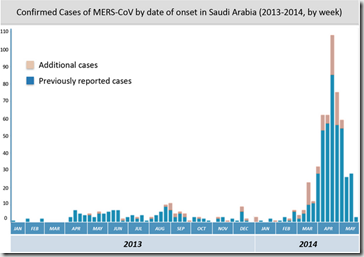
On 3 June 2014, the National IHR Focal Point of Saudi Arabia reported 113 laboratory-confirmed cases of infection with Middle East Respiratory Syndrome Coronavirus (MERS-CoV), including 34 deaths. These cases and deaths were identified through retrospective review of hospital records, dating between 5 May 2013 and 6 May 2014.

The majority of the cases (84) occurred after 1 March 2014; and the rest of cases (29) occurred between 5 May 2013 and 28 February 2014.

The 113 cases are residents of the following regions: 49 from Makkah (including 44 from the city of Jeddah, 2 from the city of Makkah, 2 from Taif and 1 from Shamyah), 47 from Riyadh (including 21 from the city of Riyadh, 12 from Kharj, 9 from Delam, 2 from Wadi Addawaseer, 2 from Aflaj and 1 from Hanakia ), 9 from Medina (including 8 from the city Medinah and 1 from Yanbu), 4 cases from Ash Sharqiyah (including 2 from the city of Hassa, 1 from Dammam and 1 from Hafr Al Batin) 2 from Asir(including 1 from the city of Khamis Mshet and 1 from Bisha), 1 case from Tabuk (Tabuk city) and 1 case from Jawf (Jawf city).

Of the 113 cases, 69 are Saudi nationals, while 44 are non-Saudi nationals.

The median age of the cases is 41 years (ranging from 3 months to 89 years) and 57% (64) are males.
Information on the symptoms was reported for 111 of the 113 cases. Of these, 32 cases had no symptoms of illness (asymptomatic), while 79 were reported to have symptoms. Of the cases with symptoms, 70 were reported to have been hospitalized. No information was provided on existing underlying medical conditions.

Information on the final outcome was provided for 113 cases as follow: 76 recovered, 3 were still hospitalized and 34 died.


Information on possible source of infection was reported for 72 out of the 113 cases. Of these 18 cases acquired infection from a non-human source at the community level and 54 cases acquired infection from another person. Of the infections acquired from another person: health care acquired infection was reported for 41 cases and household infection was reported for 13 cases.

Thirty-seven percent (42 out of 113 cases) are health care workers. Among these, 19 were reported as asymptomatic and 23 were reported to have symptoms. Information on the severity of these symptoms was not reported. The final outcome for the health care workers was provided as follow: 39 recovered, 1 still hospitalized and 2 died.

The characteristics of the 113 cases are similar to those previously reported. The pattern and dynamic of the epidemic and the risk assessment remain unchanged.

Globally, 820 laboratory-confirmed cases of infection with MERS-CoV including at least 286 related deaths have officially been reported to WHO. This global total includes all the cases in this update.

WHO advice
Based on the current situation and available information, WHO encourages all Member States to continue their surveillance for acute respiratory infections and to carefully review any unusual patterns.

Infection prevention and control measures are critical to prevent the possible spread of MERS-CoV in health care facilities. It is not always possible to identify patients with MERS-CoV early because like other respiratory infections, the early symptoms of MERS-CoV are non-specific. Therefore, health-care workers should always apply standard precautions consistently with all patients, regardless of their diagnosis. Droplet precautions should be added to the standard precautions when providing care to patients with symptoms of acute respiratory infection; contact precautions and eye protection should be added when caring for probable or confirmed cases of MERS-CoV infection; airborne precautions should be applied when performing aerosol generating procedures.

Until more is understood about MERS-CoV, people with diabetes, renal failure, chronic lung disease, and immunocompromised persons are considered to be at high risk of severe disease from MERS‐CoV infection. Therefore, these people should avoid close contact with animals, particularly camels, when visiting farms, markets, or barn areas where the virus is known to be potentially circulating. General hygiene measures such as regular hand washing before and after touching animals and avoiding contact with sick animals, should be adhered to.

Food hygiene practices should be observed. People should avoid drinking raw camel milk or camel urine, or eating meat that has not been properly cooked.

WHO does not advise special screening at points of entry with regard to this event nor does it currently recommend the application of any travel or trade restrictions.

http://www.who.int/csr/don/2014_06_26/en/
 
Last edited:
Back
Top Bottom