

sharon sanders
Editor-in-Chief & President
Sunday, October 18, 2015
Saudi MOH Reports A New Primary MERS Case In Hofuf
# 10,636
Between mid-April and the first half of July, the Hofoof (aka `Hofuf’) / Al-Ahsa region was the epicenter for most of Saudi Arabia’s MERS cases, as they were battling a prolonged nosocomial outbreak across several hospitals. The index case was described by the April 29th WHO DON as:
Nearly 6 weeks later (Aug 26th), a solitary MERS case was reported once again from Hofuf involving a 65 year old male, described later by the WHO as having `a history of frequent contact with camels and consumption of their raw milk.’ Luckily, this time we did not see a repeat cluster of cases.
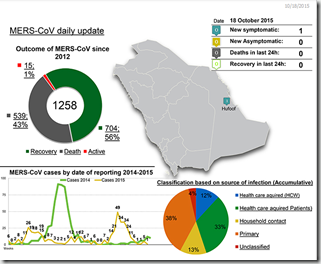
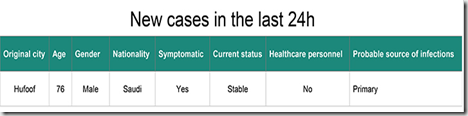
Fast forward seven more weeks, and today the Saudi MOH is reportinganother `primary’ MERS case – again involving an elderly Saudi male – from Hofuf. The circumstances of his exposure are not provided.
For whatever reason (and camel exposure is a distinct possibility), Hofuf seems to be one of the hotspots for primary MERS cases in 2015.
If it seems as if we keep hearing of cases from the same short list of Saudi cities, you’re right. Partly because in2014 KSAassigned 17 MERS-CoV specialist hospitals across the Kingdom, along with three centers of excellence for complex cases in :
Still, there does appear to be a bit of a `MERS Belt’ in KSA (see graphic below), one which crosses the center of the country from the Southwest to the Northeast, and accounts for the vast majority of cases. We’ve seen relatively few cases from the extreme north or south of the country.

Modified from WHO EMRO MERS update Graphic
Whether this geographic pattern is due to some greater risk of contracting MERS in this central region, or a laxity in surveillance, testing, or reporting from other regions - or some other cause - is unknown. It is curious however.
This is just one of many `MERS mysteries’ that after three years, we seem still far from understanding. Others include:
Saudi MOH Reports A New Primary MERS Case In Hofuf
# 10,636
Between mid-April and the first half of July, the Hofoof (aka `Hofuf’) / Al-Ahsa region was the epicenter for most of Saudi Arabia’s MERS cases, as they were battling a prolonged nosocomial outbreak across several hospitals. The index case was described by the April 29th WHO DON as:
A 61-year-old male from Hafouf city developed symptoms on 16 April and was admitted to hospital on 18 April. The patient has comorbidities and a history of frequent contact with camels and sheep as well as consumption of raw camel milk.
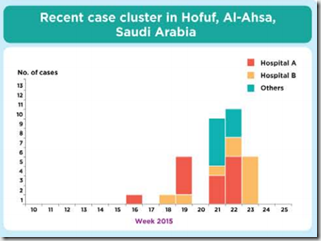
Over the next couple of weeks several additional family members were infected and hospitalized, which led to an even larger nosocomial outbreak. The graphic below (from the June 15th EMRO MERS report) illustrates this cluster, which eventually exceeded 40 cases before tapering off in mid-July.Nearly 6 weeks later (Aug 26th), a solitary MERS case was reported once again from Hofuf involving a 65 year old male, described later by the WHO as having `a history of frequent contact with camels and consumption of their raw milk.’ Luckily, this time we did not see a repeat cluster of cases.
Fast forward seven more weeks, and today the Saudi MOH is reportinganother `primary’ MERS case – again involving an elderly Saudi male – from Hofuf. The circumstances of his exposure are not provided.
For whatever reason (and camel exposure is a distinct possibility), Hofuf seems to be one of the hotspots for primary MERS cases in 2015.
If it seems as if we keep hearing of cases from the same short list of Saudi cities, you’re right. Partly because in2014 KSAassigned 17 MERS-CoV specialist hospitals across the Kingdom, along with three centers of excellence for complex cases in :
- Western Province – King Fahad Hospital, Jeddah.
- Central Province – Prince Mohammad bin Abdulaziz Hospital, Riyadh.
- Eastern Province – Dammam Medical Complex.
Still, there does appear to be a bit of a `MERS Belt’ in KSA (see graphic below), one which crosses the center of the country from the Southwest to the Northeast, and accounts for the vast majority of cases. We’ve seen relatively few cases from the extreme north or south of the country.
Modified from WHO EMRO MERS update Graphic
Whether this geographic pattern is due to some greater risk of contracting MERS in this central region, or a laxity in surveillance, testing, or reporting from other regions - or some other cause - is unknown. It is curious however.
This is just one of many `MERS mysteries’ that after three years, we seem still far from understanding. Others include:
- The incidence and impact of mild or asymptomatic infections on the spread of the virus
- The skewing of cases towards older males
- The remarkably low number of children and adolescents infected to date
- The source(s) of primary cases – which account for more than 40% of known cases – in the community