A Curious Coronavirus `Mutation' Report From Russia
#15,565
Over the years we've seen a number of curious, highly suspect, and often never verified `
official reports' on infectious diseases come out of Russian state media - or actually published on Federal agency websites - that haven't exactly helped their credibility.
- In 2006 Dimitri Lvov predicted 1 billion deaths from an expected H5N1 pandemic (see From Russia, With Lvov (Again)). While Russia’s Chief Health Officer Gennady Onishchenko, all but predicted a Bird Flu pandemic would hit Russia later that same summer.
In each case, these events either didn't happen or were never verified.
Add in a tabloid press, eager to publish `
juicy' stories, and it pays to take unverified reports coming out of Russia with a very large gain of salt. But of course, not
everything can be assumed to be click bait or rumor.
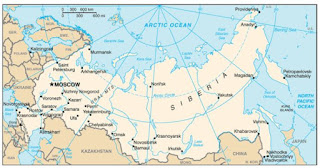
Keeping these substantial caveats in mind, overnight the Russian media has exploded with reports of the discovery - reportedly announced by Anna Popova - of a `mutated coronavirus' spreading in Siberia.
Mutations are common in all viruses, and hundreds have already been identified in SARS-CoV-2. Most are either benign or prove detrimental to the virus's `
fitness'. Only rarely does a mutation have a serious impact on a virus's virulence, host range, replication, or transmissibility.
Details on this reported
`mutation' in Siberia are -
not surprisingly - scant, but so far authorities have not found any evidence that this
`new variant' is anymore dangerous than its parental strain. It may well be that these reports - assuming they are true - merely highlight
a distinction without a difference.
The primary significance I can find to these early reports is that genetic analysis indicates recent virus isolates are all of European - not Chinese - origin, and that it apparently impacts the Spike (S) Protein.
Nevertheless, since this story is likely to make banner headlines around the world today, it is worth our noting. Our first stop, this English language report in
TASS. At the same time, the head of Rospotrebnadzor clarified that the identified mutations do not make the virus more dangerous and do not affect the epidemic situation.
(Continue . . . )
And this English Language report from the
Moscow Times.
Mutating Coronavirus Discovered in Siberia
A mutated version of the coronavirus strain that causes Covid-19 has been discovered in Siberia, the head of Russia’s consumer safety watchdog said Tuesday.
“We’re seeing certain changes in the proteins, and these changes detected in Siberia allow us to assume that this region is forming its own version [of coronavirus] with certain mutations,” Rospotrebnadzor head Anna Popova said at a scientific symposium, according to Interfax
And finally this (translated) report from
Izvestia.
This article alludes to changes in the S-protein that raises the possibility (
like with the Danish Mink mutation) that it
might impact vaccine efficiency or individual immunity against older strains. Unless and until sequences are deposited in GenBank? and analysed by other scientists, this is all pretty much uncorroborated.
Rospotrebnadzor revealed a mutation of coronavirus in Siberia
17 November 2020, 13:56
New mutations of the coronavirus are forming in the Siberian Federal District. On November 17, speaking at the virtual symposium "Pandemic COVID-19: a challenge to modern science," said the head of Rospotrebnadzor Anna Popova.
“We see certain changes in the S-protein, and this substitution, identified in the Siberian region, suggests that its own variant (of the coronavirus) with certain mutations is being formed there,” she said.
Speaking about the differences in the types of the virus, Popova noted that the mutated virus is characterized by a lower sensitivity to recovalescent serum, which contains antibodies to coronavirus. Moreover, this feature is not observed in biological materials taken in other regions of the country.
(Continue . . . )
While it may have absolutely nothing to do with this
`Siberian mutation', The Moscow Times reported nearly two weeks ago that Russian mink farms continue to process and sell pelts (see
Russian Mink Farmers Unfazed by Coronavirus Mutations), claiming that (
unlike Denmark, The Netherlands, Sweden, Spain, Italy and the United States) that animals and staff working on their farms have not shown any signs of infection.
Like so many other bombastic reports out of Russia, this one may fade away without explanation. Or, perhaps, it will prove to be important down the road. Time will tell.
Stay tuned.
https://afludiary.blogspot.com/2020/...on-report.html