

Michael Coston
Editor, Senior Moderator
Preprint: Human Cell adaptation of the Swine Acute Diarrhea Syndrome Coronavirus Spike Protein

#18,229
Although many were taken by surprise in 2020 when a novel coronavirus - now dubbed SARS-CoV-2 - emerged from Wuhan, China sparking the worst pandemic in more than a century, the reality is we'd been following a number of coronaviruses with pandemic potential since the early 2000's.
Until the original SARS virus emerged from China in 2002 (see SARS and Remembrance), only four coronaviruses (Alpha coronaviruses 229E and NL63, and Beta coronaviruses OC43 & HKU1) were known to infect humans.
These human coronaviruses generally produced only mild upper respiratory illnesses and were thought responsible for 15%-30% of the `common colds’ around the world, Only rarely did they migrate to the lower respiratory tract (cite).
But SARS-CoV was a wake-up call, as it unexpectedly had a 10% fatality rate. This alarm increased in 2012, when the MERS-CoV virus emerged from camels in the Middle East, causing severe, often fatal respiratory illness in humans (see 2017's A Pandemic Risk Assessment Of MERS-CoV In Saudi Arabia).
Over the past 2 decades we've looked at a number of other coronaviruses with zoonotic potential, detected in bats, pigs, and other mammals around the globe. A few include:

A classic serial passage experiment showing Host adaptation
While further work is needed, their results hint at human cell adaptation of the virus after 10 passages. I've only reproduced the abstract and a brief excerpt, so you'll want to follow the link to read it in its entirety. I'll have a bit more after the break.
Human cell adaptation of the swine acute diarrhea syndrome coronavirus spike protein
Clàudia Soriano-Tordera, Rafael Sanjuán, Jérémy Dufloo
doi: https://doi.org/10.1101/2024.07.29.605615
Preview PDF
Swine acute diarrhea syndrome coronavirus (SADS-CoV) is a recently identified highly pathogenic swine coronavirus. In vitro, SADS-CoV can infect cell lines from many different species, including humans, highlighting its high zoonotic potential. Coronavirus spike glycoproteins play a critical role in viral entry and are involved in determining viral host range and cellular tropism.
Here, we used experimental evolution to investigate how the SADS-CoV spike protein adapts to human cells and to identify potential variants with increased infectivity. We evolved a recombinant vesicular stomatitis virus expressing the SADS-CoV spike (rVSV-SADS) in three human cell lines.
After ten passages, increased viral replication was observed, and spike mutations were identified by sequencing. Mutations were functionally characterized in terms of viral fitness, spike processing and fusogenicity. Our results thus identify potential human-adaptive mutations in the SADS-CoV spike that may further enhance its zoonotic potential.
Importance
Coronavirus transmission from animals represents a serious threat to humans. Pigs are of particular concern because of their proximity to humans and the several coronaviruses they harbor. In particular, the swine acute diarrhea syndrome coronavirus (SADS-CoV) is a recently identified highly pathogenic porcine coronavirus that has a very broad tropism in vitro, highlighting its high zoonotic risk.
The coronavirus spike protein is a strong determinant of species tropism, and spike mutations may facilitate cross-species transmission. Here, to identify potential variants with increased ability to enter human cells, we used an experimental evolution approach to study how the SADS-CoV spike adapts to different human cell lines. These mutations, should they occur in nature, could potentially increase the zoonotic potential of SADS-CoV.
(Continue . . . )
Until SARS-CoV began its limited world tour in 2002-2003, novel influenza viruses were considered the most serious pandemic threat. SARS, followed by MERS-CoV, gradually changed that perception, but SARS-CoV-2 confirmed the truth of it.
Today, in addition to the growing list of new coronaviruses being discovered around the world, we also have the spillover of COVID into scores of non-human species, where it continues to evolve. (see Nature: Comparative Susceptibility of SARS-CoV-2, SARS-CoV, and MERS-CoV Across Mammals).
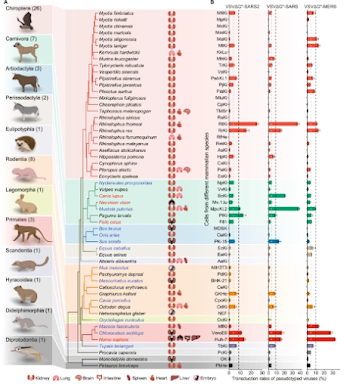
Since COVID is already exquisitely adapted to mammals (including humans), it may be capable of sparking even more frequent pandemics going forward than is novel influenza.
Time will tell.
The uncomfortable truth is we now live in a new age where the the number, frequency, and intensity of pandemics are only expected to increase over the next few decades.
BMJ Global: Historical Trends Demonstrate a Pattern of Increasingly Frequent & Severe Zoonotic Spillover Events
PNAS Research: Intensity and Frequency of Extreme Novel Epidemics
We can either take that information, and act on it, or wait for it to overwhelm us.
https://afludiary.blogspot.com/2024/08/preprint-human-cell-adaptation-of-swine.html

#18,229
Although many were taken by surprise in 2020 when a novel coronavirus - now dubbed SARS-CoV-2 - emerged from Wuhan, China sparking the worst pandemic in more than a century, the reality is we'd been following a number of coronaviruses with pandemic potential since the early 2000's.
Until the original SARS virus emerged from China in 2002 (see SARS and Remembrance), only four coronaviruses (Alpha coronaviruses 229E and NL63, and Beta coronaviruses OC43 & HKU1) were known to infect humans.
These human coronaviruses generally produced only mild upper respiratory illnesses and were thought responsible for 15%-30% of the `common colds’ around the world, Only rarely did they migrate to the lower respiratory tract (cite).
But SARS-CoV was a wake-up call, as it unexpectedly had a 10% fatality rate. This alarm increased in 2012, when the MERS-CoV virus emerged from camels in the Middle East, causing severe, often fatal respiratory illness in humans (see 2017's A Pandemic Risk Assessment Of MERS-CoV In Saudi Arabia).
Over the past 2 decades we've looked at a number of other coronaviruses with zoonotic potential, detected in bats, pigs, and other mammals around the globe. A few include:
- In 2014, in SECD: Another Emerging Coronavirus Threat - in the wake of several newly discovered coronaviruses detected in North American swine - we looked at growing concerns that some porcine-adapted coronaviruses might have zoonotic potential, given the similar physiology between our two species.
- In 2016, we looked at a coronavirus isolated from Chinese horseshoe bats PNAS: SARS-like WIV1-CoV Poised For Human Emergence which could could bind to the same receptors as SARS-CoV.
- In the summer of 2017 we looked at paper published in the EID Journal: A New Bat-HKU2–like Coronavirus in Swine, China, 2017, on the recent discovery of a new HKU2-like coronavirus in Chinese pigs showing symptoms of PED (Porcine Epidemic Diarrhea), which they tentatively named porcine enteric alphacoronavirus (PEAV).
- In a follow up in 2020, in PNAS: Swine Coronavirus Replicates In Human Cells, we saw additional evidence to suggest that swine coronaviruses might have the `right stuff' to spill over into humans.
- Last summer, in a letter published in the Journal of Medical Virology, Chinese scientists made a case for the case for the zoonotic potential of two classes of swine coronaviruses (PDCoV and SADS-CoV) (see J. Med. Virology: Potential Cross-Species Transmission Risks of Emerging Swine Enteric Coronavirus to Human Beings).
A classic serial passage experiment showing Host adaptation
While further work is needed, their results hint at human cell adaptation of the virus after 10 passages. I've only reproduced the abstract and a brief excerpt, so you'll want to follow the link to read it in its entirety. I'll have a bit more after the break.
Human cell adaptation of the swine acute diarrhea syndrome coronavirus spike protein
Clàudia Soriano-Tordera, Rafael Sanjuán, Jérémy Dufloo
doi: https://doi.org/10.1101/2024.07.29.605615
Preview PDF
Abstract
Swine acute diarrhea syndrome coronavirus (SADS-CoV) is a recently identified highly pathogenic swine coronavirus. In vitro, SADS-CoV can infect cell lines from many different species, including humans, highlighting its high zoonotic potential. Coronavirus spike glycoproteins play a critical role in viral entry and are involved in determining viral host range and cellular tropism.
Here, we used experimental evolution to investigate how the SADS-CoV spike protein adapts to human cells and to identify potential variants with increased infectivity. We evolved a recombinant vesicular stomatitis virus expressing the SADS-CoV spike (rVSV-SADS) in three human cell lines.
After ten passages, increased viral replication was observed, and spike mutations were identified by sequencing. Mutations were functionally characterized in terms of viral fitness, spike processing and fusogenicity. Our results thus identify potential human-adaptive mutations in the SADS-CoV spike that may further enhance its zoonotic potential.
Importance
Coronavirus transmission from animals represents a serious threat to humans. Pigs are of particular concern because of their proximity to humans and the several coronaviruses they harbor. In particular, the swine acute diarrhea syndrome coronavirus (SADS-CoV) is a recently identified highly pathogenic porcine coronavirus that has a very broad tropism in vitro, highlighting its high zoonotic risk.
The coronavirus spike protein is a strong determinant of species tropism, and spike mutations may facilitate cross-species transmission. Here, to identify potential variants with increased ability to enter human cells, we used an experimental evolution approach to study how the SADS-CoV spike adapts to different human cell lines. These mutations, should they occur in nature, could potentially increase the zoonotic potential of SADS-CoV.
(Continue . . . )
Until SARS-CoV began its limited world tour in 2002-2003, novel influenza viruses were considered the most serious pandemic threat. SARS, followed by MERS-CoV, gradually changed that perception, but SARS-CoV-2 confirmed the truth of it.
Today, in addition to the growing list of new coronaviruses being discovered around the world, we also have the spillover of COVID into scores of non-human species, where it continues to evolve. (see Nature: Comparative Susceptibility of SARS-CoV-2, SARS-CoV, and MERS-CoV Across Mammals).
Since COVID is already exquisitely adapted to mammals (including humans), it may be capable of sparking even more frequent pandemics going forward than is novel influenza.
Time will tell.
The uncomfortable truth is we now live in a new age where the the number, frequency, and intensity of pandemics are only expected to increase over the next few decades.
BMJ Global: Historical Trends Demonstrate a Pattern of Increasingly Frequent & Severe Zoonotic Spillover Events
PNAS Research: Intensity and Frequency of Extreme Novel Epidemics
We can either take that information, and act on it, or wait for it to overwhelm us.
https://afludiary.blogspot.com/2024/08/preprint-human-cell-adaptation-of-swine.html