

Michael Coston
Editor, Senior Moderator
PAHO: Public Health Risk Assessment Related to Outbreaks of HPAI H5N1 in Animal Species
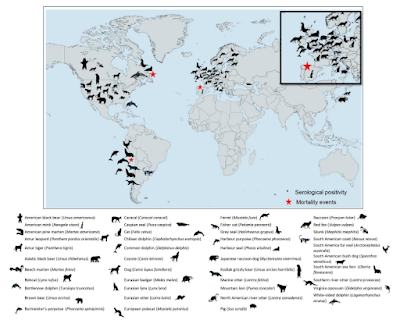
Credit ECDC
#17,687
While H5N1 clade 2.3.4.4b continues to spread aggressively around the world, and has greatly increased its host range (both in birds and mammals) over the past couple of years, it has yet to demonstrate the ability to easily infect, and efficiently transmit between, humans.
Unless, and until that occurs, HPAI H5Nx poses a relatively low public health threat. Not zero, of course.
We've seen a handful of human infections from this clade, but not nearly as many as were seeing a decade ago or two ago (with earlier clades). The virus is continually evolving, and so what we can say today about the virus - and the risks its poses - could easily change tomorrow.
Despite the attention it gets (primarily due to its high mortality rate in humans), H5Nx is only one of many viral contenders for igniting the next influenza pandemic. A few non-H5 credible threats include:
While expected to be less severe, H1, H2, and H3 viruses have caused all of the known flu pandemics going back 130 years, and appear to have an easier time adapting to humans than H5 and H7 avian viruses (see Are Influenza Pandemic Viruses Members Of An Exclusive Club?).
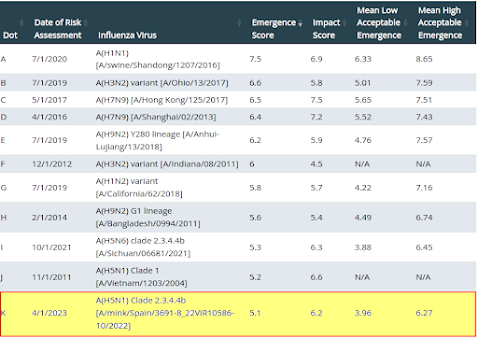
This `longshot' status for H5N1 is illustrated in the following CDC IRAT chart, placing our current H5N1 virus in 11th place (emergence score) among their top 24 zoonotic influenza viruses with pandemic potential. EA A(H1N1) `G4' - in Chinese pigs - is ranked #1.
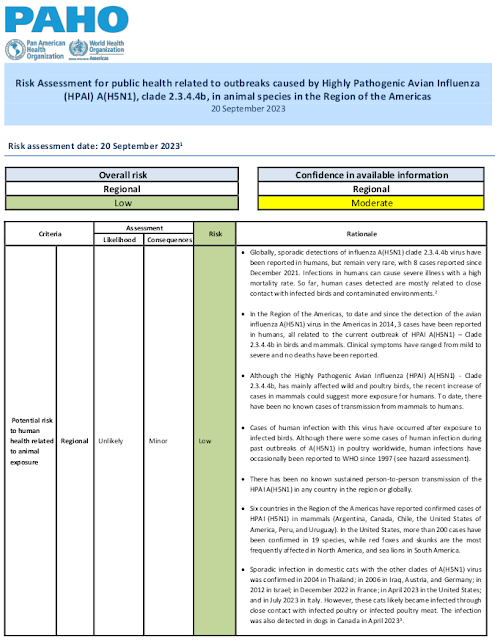
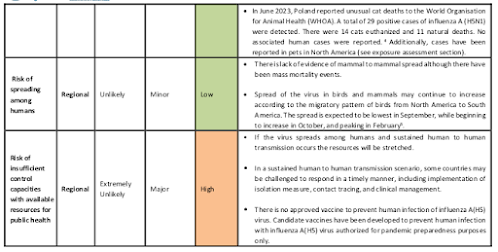
All of which serves as prelude to a recently published Risk Assessment from PAHO (Pan American Health Organization) that finds - despite the alarming spillover of H5N1 into tens of thousands of marine and terrestrial animals in South America - the risks of infection remain low for the general public.
Due to its length, I've only posted the summary below. Follow the link to read the report (and their rationale) in its entirety. I'll have a brief postscript when you return.
(Continue . . . )
The quandary for governments, public health organizations, and yes - even bloggers - around the world is how much weight to give a long-shot like H5N1 when discussing public health threats.
There are some who seem absolutely convinced that H5N1 is the heir apparent, while others dismiss the possibility entirely.
The reality is, our track record in predicting the next pandemic has been abysmal, and we generally don't recognize a pandemic virus until it has been circulating efficiently for weeks or even months.
Risk assessments are valuable because they tell us where we are (or at least were, a few weeks ago), but can't tell us much about where we are going.
Which is why we need to be preparing for a wide range of scenarios.
https://afludiary.blogspot.com/2023/09/paho-public-health-risk-assessment.html
Credit ECDC
#17,687
While H5N1 clade 2.3.4.4b continues to spread aggressively around the world, and has greatly increased its host range (both in birds and mammals) over the past couple of years, it has yet to demonstrate the ability to easily infect, and efficiently transmit between, humans.
Unless, and until that occurs, HPAI H5Nx poses a relatively low public health threat. Not zero, of course.
We've seen a handful of human infections from this clade, but not nearly as many as were seeing a decade ago or two ago (with earlier clades). The virus is continually evolving, and so what we can say today about the virus - and the risks its poses - could easily change tomorrow.
Despite the attention it gets (primarily due to its high mortality rate in humans), H5Nx is only one of many viral contenders for igniting the next influenza pandemic. A few non-H5 credible threats include:
While expected to be less severe, H1, H2, and H3 viruses have caused all of the known flu pandemics going back 130 years, and appear to have an easier time adapting to humans than H5 and H7 avian viruses (see Are Influenza Pandemic Viruses Members Of An Exclusive Club?).
This `longshot' status for H5N1 is illustrated in the following CDC IRAT chart, placing our current H5N1 virus in 11th place (emergence score) among their top 24 zoonotic influenza viruses with pandemic potential. EA A(H1N1) `G4' - in Chinese pigs - is ranked #1.
All of which serves as prelude to a recently published Risk Assessment from PAHO (Pan American Health Organization) that finds - despite the alarming spillover of H5N1 into tens of thousands of marine and terrestrial animals in South America - the risks of infection remain low for the general public.
Due to its length, I've only posted the summary below. Follow the link to read the report (and their rationale) in its entirety. I'll have a brief postscript when you return.
(Continue . . . )
The quandary for governments, public health organizations, and yes - even bloggers - around the world is how much weight to give a long-shot like H5N1 when discussing public health threats.
There are some who seem absolutely convinced that H5N1 is the heir apparent, while others dismiss the possibility entirely.
The reality is, our track record in predicting the next pandemic has been abysmal, and we generally don't recognize a pandemic virus until it has been circulating efficiently for weeks or even months.
Risk assessments are valuable because they tell us where we are (or at least were, a few weeks ago), but can't tell us much about where we are going.
Which is why we need to be preparing for a wide range of scenarios.
https://afludiary.blogspot.com/2023/09/paho-public-health-risk-assessment.html