• FluTrackers.com Inc. does not provide medical advice. Information on this web site is collected from various internet resources, and the FluTrackers board of directors makes no warranty to the safety, efficacy, correctness or completeness of the information posted on this site by any author or poster. The information collated here is for instructional and/or discussion purposes only and is NOT intended to diagnose or treat any disease, illness, or other medical condition. Every individual reader or poster should seek advice from their personal physician/healthcare practitioner before considering or using any interventions that are discussed on this website. By continuing to access this website you agree to consult your personal physican before using any interventions posted on this website, and you agree to hold harmless FluTrackers.com Inc., the board of directors, the members, and all authors and posters for any effects from use of any medication, supplement, vitamin or other substance, device, intervention, etc. mentioned in posts on this website, or other internet venues referenced in posts on this website.
  • We are not asking for any donations. Do not donate to any entity who says they are raising funds for us.

New small earthquakes in Yellowstone Park - known to occur after major quake elsewhere

AlaskaDenise

In Memoriam
2.7 2010/01/18 00:02:56 44.563 -110.970 11.3 YELLOWSTONE NATIONAL PARK, WYOMING
2.5 2010/01/17 22:43:34 44.565 -110.972 6.5 YELLOWSTONE NATIONAL PARK, WYOMING
2.6 2010/01/17 21:55:56 44.554 -110.970 0.9 YELLOWSTONE NATIONAL PARK, WYOMING
2.7 2010/01/17 21:04:07 44.562 -110.967 9.7 YELLOWSTONE NATIONAL PARK, WYOMING

Swarms of earthquakes and disruptions in the geysers have been known to occur after major quakes thousands of miles away. If this swarm continues, we may be seeing the impact from the January 12th Haiti earthquake.

Article below is about similar events after 2002 Alaska 7.9 earthquake, as well as other earthquakes in California, etc.


November 4, 2002 -- A major, magnitude-7.9 earthquake that rocked Alaska on Sunday apparently triggered scores of earthquakes some 2,000 miles away at Yellowstone National Park in Wyoming.

By 8:30 a.m. MST Monday Nov. 4 - about 17 hours after the Alaskan quake - more than 200 small earthquakes had been detected occurring in clusters throughout the Yellowstone area. The quakes were recorded by the Yellowstone seismic network operated by the University of Utah Seismograph Stations.

The smallest events were of magnitude less than 0 and the largest of about magnitude 2.5. National Park Service rangers at Old Faithful and Canyon Village reported feeling some of the earthquakes.

While the data are preliminary, they suggest that the Yellowstone earthquakes may have been triggered by the passage of large seismic waves generated by the Alaskan earthquake more than 3,200 kilometers (almost 2,000 miles) from the park. The apparent triggering is suggested by the fact the Yellowstone activity began within a half hour of the Alaska earthquake, which hit at 3:12 p.m. MST Nov. 3 (1:12 p.m. local time in Alaska).

There also are preliminary reports the Alaska quake may have triggered smaller tremors at The Geysers geothermal area in northern California.

Scientists once believed that an earthquake at one location could not trigger earthquakes at distant sites. But that belief was shattered in 1992 when the magnitude-7.3 Landers earthquake in California's Mojave Desert triggered a swarm of quakes more than 800 miles away at Yellowstone, as well as other jolts near Mammoth Lakes, Calif., and Yucca Mountain, Nev.

The apparent triggering of the Yellowstone tremors by the Alaska quake "confirms what we are beginning to see worldwide - that earthquakes can be triggered by other earthquakes at great distances, more so than we had thought before," said Robert. B. Smith, a University of Utah professor of geology and geophysics and coordinating scientist for the Yellowstone Volcano Observatory.

Clusters of small earthquakes in time and space are common in Yellowstone. However, the clusters of Yellowstone earthquakes following the Alaskan mainshock extended across much of the park and were not concentrated in a single location.

The small Yellowstone quakes are not considered to pose a threat to the public, but are of great interest to scientists who want to confirm if they were triggered and understand how. Investigation is ongoing and may take some time to complete, said Sue Nava, seismograph network manager at the University of Utah Seismograph Stations.

There has been some suggestion that seismic waves from a large, distant quake may jostle the ground at Yellowstone, triggering small quakes by moving the hydrothermal fluids responsible for Yellowstone geysers and hot springs.
http://www.scienceblog.com/cms/alaska_quake_seems_to_trigger_yellowstone_jolts
 
Re: New small earthquakes in Yellowstone Park - known to occur after major quake elsewhere

That's very interesting about that pattern. There is a fault that got active in Oklahoma recently and they had a 4.0 on the 15th. It felt strong since it was pretty shallow.

http://www.koco.com/news/22250896/detail.html

The New Madrid fault has been quiet lately, and there's a theory that the energy from that could have moved to another fault.

http://www.sciencedaily.com/releases/2009/03/090313145956.htm
" ?If other faults in the central and eastern U.S. have been active recently, geologically speaking, they could potentially be activated again in the future,? he said. ?We need to develop a new paradigm for how earthquakes happen at faults that are inside continents.?

Calais and Stein are exploring possible explanations for the behavior of faults like the New Madrid. One possibility is that earthquakes in these areas occur in clusters and then migrate to a nearby fault."
 
Re: New small earthquakes in Yellowstone Park - known to occur after major quake elsewhere

I noticed that Oklaholma one.

There was another in NE Arkansas.

I think the 5.6 way off Mexico, near the Clipperton Islands with no fault nearby is interesting.....partly because Clipperton Island is an old volcano. There's an internal separate lagoon that is very deep and very acidic - sulfuric acid coming from the bottom.

.
 
Re: New small earthquakes in Yellowstone Park - known to occur after major quake elsewhere

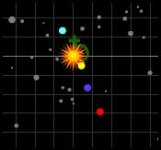
It may be interesting to consider the positions of the inner planets on 12 jan at 5PM:

planets.JPG

Starting with the upper left: the bright blue spot is Venus, then coming toward center is the sun, then the yellow spot is Mercury, the purple is earth, and the pink is Mars. The overshadow of the Saturn symbol is an overlay of a different viewpoint. (source: http://www.davidcolarusso.com/astro/#geo) The site has a heliocentric animation that you can run or stop frame at a particular date.

And the moon was facing mercury within that same lineup.

Interesting coincidence, eh?

.
 
Re: New small earthquakes in Yellowstone Park - known to occur after major quake elsewhere

That is interesting, too, about the one in Mexico with no fault involved. Was that really recent?

ETA:just saw the next post...I'll have a look at that.
 
Last edited:
Re: New small earthquakes in Yellowstone Park - known to occur after major quake elsewhere

Updates from the Yellowstone Volcanic Observatory regarding the recent cluster of earthquakes:

(most recent first)

Press Release

University of Utah Seismograph Stations

Released: January 21, 2010 2:00 PM MST

This release is a continuation of information updates building upon our two previous press releases on the ongoing earthquake swarm on the west side of Yellowstone National Park. The University of Utah Seismograph Stations reports that a pair of earthquakes of magnitude 3.7 and 3.8 occurred in the evening of January 20, 2010 in Yellowstone National Park.

The first event of magnitude 3.7 occurred at 11:01 PM and was shortly followed by a magnitude 3.8 event at 11:16 PM. Both shocks were located around 9 miles to the southeast of West Yellowstone, MT and about 10 miles to the northwest of Old Faithful, WY. Both events were felt throughout the park and in surrounding communities in Wyoming, Montana, and Idaho.

These two earthquakes are part of an ongoing swarm in Yellowstone National Park that began January 17, 2010 (1:00 PM MST). The largest earthquake in the swarm as of 12 PM, January 21, 2010, was a magnitude 3.8. There have been 901 located earthquakes in the swarm of magnitude 0.5 to 3.8. This includes 8 events of magnitude larger than 3, with 68 events of magnitude 2 to 3, and 825 events of magnitude less than 2. There have been multiple personal reports of ground shaking from observations inside the Park and in surrounding areas for some of the larger events (for felt reports, please visit http://earthquake.usgs.gov/eqcenter/dyfi/). Earthquake swarms are relatively common in Yellowstone.

The swarm earthquakes are likely the result of slip on pre-existing faults rather than underground movement of magma. Currently there is no indication of premonitory volcanic or hydrothermal activity, but ongoing observations and analyses will continue to evaluate these different sources.

Seismic information on the earthquake can be viewed at the University of Utah Seismograph Stations: http://www.seis.utah.edu/.

Seismograph recordings from stations of the Yellowstone seismograph network can be viewed online at: http://quake.utah.edu/helicorder/yell_webi.htm.

Anyone who has felt earthquakes in the swarm are encouraged to fill out a form on the USGS Community Felt reports web site: http://earthquake.usgs.gov/eqcenter/dyfi/.

This press release was prepared by the Yellowstone Volcano Observatory partners of the U.S. Geol. Survey, the University of Utah, and the National Park Service: http://volcanoes.usgs.gov/yvo/


Press Release
University of Utah Seismograph Stations

Released: January 19, 2010 3:00 PM MST

The University of Utah Seismograph Stations reports an update of information on an ongoing earthquake swarm in Yellowstone National Park that began January 17, 2010 (1:00 PM MST). The swarm is located about 10 miles northwest of Old Faithful, WY and 9 miles southeast of West Yellowstone, MT. The largest earthquake in the swarm as of 3 PM, January 19, 2010, was a magnitude 3.7 event that occurred at 2:31 PM, MST, January 19, 2010. and there have been 469 located earthquakes in the swarm of magnitudes 0.5 to 3.7. This includes 5 events of magnitude larger than 3, with 34 events of magnitude 2 to 3, and 430 events of magnitude less than 2. There have been multiple personal reports of ground shaking from observations inside Yellowstone National Park and in neighboring communities in Montana and Idaho for some of the larger events. Earthquake swarms of this nature are relatively common in Yellowstone National Park.

At this time the Yellowstone Volcano Observatory does not consider the swarm to be unusual and the earthquakes are likely related to tectonic fault sources. Also there is no indication of premonitory volcanic or hydrothermal activity, but ongoing analyses will evaluate these different sources.


Information on earthquake can be viewed at the University of Utah Seismograph Stations: http://www.seis.utah.edu/.

Seismographic recordings from Yellowstone seismograph stations can be viewed online at: http://www.quake.utah.edu/helicorder/yell_webi.htm.

Persons who felt any of the earthquakes are encouraged to fill out a survey form on the USGS "Did You Feel It?" web site: http://earthquake.usgs.gov/eqcenter/dyfi/.

Press Release
University of Utah Seismograph Stations

Released: January 18, 2010 09:30 AM MST

The University of Utah reports that a notable swarm of small earthquakes large as magnitude 2.7 has occurred throughout the evening of January 17 and morning of January 18, 2010, in Yellowstone National Park. The swarm is located about 10 miles northwest of Old Faithful, Wyoming and 9 miles southeast of West Yellowstone, MT. There were a total of 206 located earthquakes in the swarm of magnitude 2.7 to 0.5 as of 9AM Monday morning, and there has been one report of one of the larger earthquakes being felt in Yellowstone National Park.

Swarms of this nature are relatively common in this part of Yellowstone National Park. At this time we consider this swarm normal for tectonic related sources in the volcanic setting of Yellowstone and not an indication of premonitory volcanic or hydrothermal activity, but ongoing analyses will evaluate these different sources.

Information on earthquake can be viewed at the University of Utah Seismograph Stations: http://www.seis.utah.edu/.

Seismographic recordings from Yellowstone seismograph stations can be viewed online at: http://quake.utah.edu/helicorder/yell_webi.htm.

Persons who felt any of the earthquakes are encouraged to fill out a survey form on the USGS "Did You Feel It?" web site: http://earthquake.usgs.gov/eqcenter/dyfi/.

http://www.seis.utah.edu/EQCENTER/PRESS/yell_press.htm#20100118

.
 
Re: New small earthquakes in Yellowstone Park - known to occur after major quake elsewhere

Replying to post #4:
(I like that website!)
It does make me wonder about gravitational forces with that lineup, and it was near new moon event. The end of this month will have Mars in opposition close to a full moon perigee.

http://www.smv.org/Starcharts/JanuaryStarChart.pdf
January 12: Venus at superior conjunction, on the opposite side of the Sun as seen from Earth.
January 15: Annular solar eclipse visible eastern Africa, southern India, and the Far East.
January 24: Waxing Gibbous Moon less than 1° north of Pleiades star cluster.
January 27: Mars at closest approach to Earth, 61,350,833 miles.
January 27: Mercury reaches greatest elongation; the point in its orbit where it is farthest from the Sun as seen from Earth; 25° west of the Sun.
January 30: Full Moon coincides with Moon’s perigee, its closest point to Earth, 221,577 miles. The Full Moon will look larger than average, and
coastal residents will experience large tides. This will be the largest apparent Full Moon of 2010. The Moon will rise at 5:06 p.m., and set at 7:21 a.m.
(January 31)
 
Last edited:
Re: New small earthquakes in Yellowstone Park - known to occur after major quake elsewhere

Source: http://www.missoulian.com/news/state-and-regional/article_9db5e032-0a22-11df-95bc-001cc4c002e0.html

More than 1,200 tiny quakes hit Yellowstone Park, but jitters are few

By MEAD GRUVER Associated Press | Posted: Monday, January 25, 2010 7:25 pm

CHEYENNE, Wyo. - Yellowstone National Park is shaking again, but jitters seem few so far.

Over eight days, more than 1,270 mostly tiny earthquakes have struck between Old Faithful and West Yellowstone. The strongest dozen or so have ranged between magnitudes 3.0 and 3.8.

That's strong enough to feel - barely. The vast majority have been too weak to be felt even nearby.

Likewise, online chatter about an imminent volcanic eruption in Yellowstone hasn't really picked up compared with the attention that a similar quake swarm drew just over a year ago.

"Perhaps we have done a better job in the past year or so helping the public understand that earthquake swarms are not unusual in Yellowstone," park spokesman Al Nash said Monday.

The largest quakes in the current swarm have included two of magnitude 3.1 and one of magnitude 3.0 late Sunday and early Monday, according to the University of Utah, which helps monitor seismic activity in Yellowstone.

Those who've felt some of the recent quakes include Tim Townsend, a law enforcement ranger at Old Faithful. Most haven't been alarming, he said, although one last week "had me running to cover, for sure."

One of the world's largest volcanoes slumbers at the core of Yellowstone.

The volcano last had a caldera-forming eruption 640,000 years ago and last spewed lava 70,000 years ago. Geologists say Yellowstone could erupt again, although the probability of an eruption within anyone's lifetime is extremely low.

That hasn't discouraged speculation. One Web site during last year's swarm carried a "Yellowstone Warning" urging everyone to flee the Yellowstone area, saying there was a risk of poisonous volcanic gases venting from the earth.

Others have tied the Yellowstone volcano to the end of the world in 2012, as some people fancifully interpret the ancient Mayan calendar to predict.

Relatively mundane fault slippage is believed to be causing the latest quakes, said Jamie Farrell, a researcher at the University of Utah in Salt Lake City.

Not that the swarm isn't interesting to geologists - quite the opposite.

"It gives us an opportunity to maybe get a better idea of what the processes are that are causing the earthquakes we're seeing," Farrell said. "Hopefully, each time we get one of these, we can get maybe a little better idea of what's going on down there."
 
Back
Top Bottom