
• FluTrackers.com Inc. does not provide medical advice. Information on this web site is collected from various internet resources, and the FluTrackers board of directors makes no warranty to the safety, efficacy, correctness or completeness of the information posted on this site by any author or poster. The information collated here is for instructional and/or discussion purposes only and is NOT intended to diagnose or treat any disease, illness, or other medical condition. Every individual reader or poster should seek advice from their personal physician/healthcare practitioner before considering or using any interventions that are discussed on this website. By continuing to access this website you agree to consult your personal physican before using any interventions posted on this website, and you agree to hold harmless FluTrackers.com Inc., the board of directors, the members, and all authors and posters for any effects from use of any medication, supplement, vitamin or other substance, device, intervention, etc. mentioned in posts on this website, or other internet venues referenced in posts on this website.
  • We are not asking for any donations. Do not donate to any entity who says they are raising funds for us.

Nature reserve on bird flu alert

AlaskaDenise

In Memoriam
http://www.shanghaidaily.com/art/2006/12/13/299721/Nature_reserve_on_bird_flu_alert.htm

2006-12-13
<!--Beijing Time -->ZHALONG State Nature Reserve for Red-Crowned Cranes, the largest artificial breeding center for red-crowned cranes in the country, is on high alert for bird flu following reports of an outbreak of bird flu in the Republic of Korea.

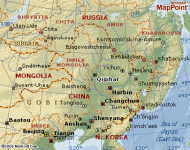
Zhalong, situated south of Qiqihar, a city in western Heilongjiang Province, is on the flight route of migratory birds, exposing the reserve to the possibility of a bird flu outbreak, said Wang Wenfeng, deputy head of Administration for Zhalong State-Level Nature Reserve.

...........(reminder of article is unrealted stories).

.
 
Re: Nature reserve on bird flu alert

The location is bird heaven - lots of wetlands & many lakes. NOte it is not far north of Harbin....
Qiqihar, China 2006.gif
 
Re: Nature reserve on bird flu alert

hawkeye said:
Is the "Republic of Korea" considered all of Korea?
South Korea


Highly pathogenic avian influenza in the Republic of Korea (diagnosis confirmation)​
(Date of previous outbreak of highly pathogenic avian influenza in the Republic of Korea reported to the OIE: 2004).
Information received on 26 November 2006 from Dr Chang-Seob Kim, Chief Veterinary Officer, Animal Health Division, Ministry of Agriculture and Forestry (MAF), Gwacheon:
Report date:
26 November 2006.
Reason for immediate notification: re-occurrence of a listed disease or infection in a country or zone/compartment following a report declaring the outbreak(s) ended.
Identification of agent: highly pathogenic avian influenza virus subtype H5N1.
Date of first confirmation of the event: 22 November 2006.
Nature of diagnosis: clinical, post-mortem and laboratory.
Location of the outbreak: Iksan city (Jeollabuk-do province).
Number of animals in the outbreak: 6,500 cases, 13,300 susceptible animals, 6,500 deaths and 6,800 animals destroyed.
Description of affected population: a parent stock farm for broiler chickens (45 weeks old).
Laboratory where diagnostic tests were performed: National Veterinary Research and Quarantine Service, Anyang, Kyonggi.
Diagnostic tests used:
<DIR>
- PCR<SUP>(1)</SUP>,
- haemagglutination inhibition test,
- sequence analysis: amino acid sequence at cleavage site reveals a HPAI profile,
- cytopathic effect on cell culture,
- neuraminidase inhibition test.
</DIR>Source of outbreak or origin of infection: unknown or inconclusive.
Control measures undertaken:
<DIR>
- control of wildlife reservoirs;
- stamping out (all poultry in the affected farm);
- quarantine (removal of feed, manure and egg plates out of the farms within a 3-km radius zone around the outbreak is prohibited);
- movement control inside the country (a 10-km radius zone around the infected holding);
- screening;
- zoning;
- burial of dead and destroyed poultry as well as of feed, manure and egg plates in the affected farm;
- disinfection and surveillance intensified in the poultry holdings.
</DIR>Control measure to be undertaken: stamping out (all poultry within a 0.5-km radius zone around the outbreak).
(1) PCR: polymerase chain reaction
**********************
OIE Animal Health Information Department
information.dept@oie.int
 
Re: Nature reserve on bird flu alert

AD, If your map is correct, the article doesn't make sense. Why is Zhalong on "high alert" and concerned about migratory birds from S. Korea? Spring, yes. But, why now? :confused:
 
Re: Nature reserve on bird flu alert

I didn't interpret the article to mean that the migratory birds will come from South Korea, only that they could suffer an impact similar to South Korea.

Different species take different paths and travel at different times.

Also, last year in Turkey, there was about a 3-6 week delay between the first dead wild birds and the first dead poultry flocks. There may also have been a further population in that cycle - local birds. So the sequence would be migratory>local wild>poultry flocks. So, if South Korean flocks were infected by migratory birds, it may have been from birds migrating through at least 3-6 weeks weeks earlier.

South Korean poultry could have been infected by birds migrating down the coast, where Zhalong may be infected by birds traveling from Siberia toward the SE Asian coast.

Another factor is that many species migratory schedule varies by sex. The females & sometimes young, leave first; while many males leave at the last possible moment.

Our scientists here have speculated that the most likely time to find H5N1 would be in the fall, after their parenting duties end & the young are learning to fly. This is when they interact more with nearby birds. Remember that birds are on a tight schedule when in their breeding areas.

It would make sense to me that the late departing males would be most likely to carry newly adapted H5N1 - they had time to mingle viral RNA prior to the journey south. Their actual departure time can be dictated by weather, fat reserves, and expected total distance to summer grounds.

.
 
Re: Nature reserve on bird flu alert

Thank you AD. I obviously didn't consider the points you raised nor do I have the knowledge of migratory patterns you do. I was looking at it in simple fall/spring migration terms. Not so simple, is it?

BTW, I wasn't really questioning your map - I knew you were right before I checked :D
 
Re: Nature reserve on bird flu alert

I aslo suspect, it depends on weather.
When it suddenly becomes colder, they start to migrate.
We saw this with the Whooper-swans in Europe in February
and in Mongolia some months ago.


you can follow the weather , e.g.:
http://www.weatheronline.co.uk/Asia.htm
click on :
East
China
Qiqihar
history
8 weeks, min.temperatur
go


you see a sudden decrease in temperature ~Nov.9th
add 2 weeks and you have the date of the Korea outbreak.
In Europe there was a cold period 25th Jan. and the outbreaks
followed 2 weeks later.
 
Re: Nature reserve on bird flu alert

gsgs said:
I aslo suspect, it depends on weather.
When it suddenly becomes colder, they start to migrate.
We saw this with the Whooper-swans in Europe in February
and in Mongolia some months ago.


you can follow the weather , e.g.:
http://www.weatheronline.co.uk/Asia.htm
click on :
East
China
Qiqihar
history
8 weeks, min.temperatur
go


you see a sudden decrease in temperature ~Nov.9th
add 2 weeks and you have the date of the Korea outbreak.
In Europe there was a cold period 25th Jan. and the outbreaks
followed 2 weeks later.

gsgs do you have a table showing the outbreaks: location, species, date, and temperature drop

Assuming:
The swans migration was triggered by a sudden decrease in temperature.

Could this cause an increase in interaction between the swans and local birds leading to an out break that occurs 2 weeks after the sudden decrease in temperature?
 
Re: Nature reserve on bird flu alert

What triggers bird migration

http://www.madsci.org/posts/archives/jun99/928783781.Zo.r.html

There are two primary theories to explain why birds migrate based on physical change.

Both theories assume that each annual cycle is divided into seasonal halves

? The winter feeding phase

? The reproductive phase

The Wallace theory postulates that they were originally coincident but gradually diverged with geological and climatic changes. The breeding grounds representing their original ranges while the winter grounds representing the diversification to areas with milder conditions.

The Brooks theory, which is a biological theory, postulates that the winter grounds represent the original range. The breeding grounds, representing a range expansion in search of safer and more suitable locations.

In either condition an impulse to migrate would be the beginning of one part of the circannual cycle. The recognition of which maybe

? Hormonal changes.

? Changes in day night length.
 
Re: Nature reserve on bird flu alert

AnneZ said:
gsgs do you have a table showing the outbreaks: location, species, date, and temperature drop

Assuming:
The swans migration was triggered by a sudden decrease in temperature.

Could this cause an increase in interaction between the swans and local birds leading to an out break that occurs 2 weeks after the sudden decrease in temperature?


AnneZ, I posted this earlier. Probably at another forum.
The sudden drop in temperature all over middle and Eastern Europe
somewhere between Jan20-25 can still be verified from my link above.
Outbreak on Ruegen was Febr.14, on some European locations (Greece,Italy,Austria?)
1-2 weeks earlier.

The idea is that the Whooper Swans start to migrate on cold weather
and at some resting centers like Ruegen they contact the mute-swans
or other species. Fecal-oral or Freyana Anserina or whatever.
 
Re: Nature reserve on bird flu alert

Thank you gsgs.

I have trouble getting my head around your seasons, they are all the wrong way round.

The temperature drop is in late winter. Is that correct?
 
Re: Nature reserve on bird flu alert

yes, typically. But I'm talking about short-term fluctuations with
periods of some days only, which supposedly trigger long-range
migrations over a few days.
So, when the temperature goes down 10 degrees from one day to the next then probably the swans start to migrate some hundred kilometers
south (northern hemisphere).
And they won't go back, when the temperature raises again
the next week.
But better consult an ornitologist ...
 
Re: Nature reserve on bird flu alert

The Brooks theory, which is a biological theory, postulates that the winter grounds represent the original range. The breeding grounds, representing a range expansion in search of safer and more suitable locations.

I'll lean toward the above theory, speaking about the birds of the extreme north. They come far north for abundant food and safety. They have abundant food because: no competition from local birds, arctic has abundance of insects (wet climate & fewer animals feeding on them), & parents can hunt for food 24 hours/day - remember it never gets dark. They are safer because there are few predators who have adapted to withstand the winters.

The territory expansion is partly related to the retreat of the ice sheets - leaving areas free from a local bird population, abundant in food, & also with fewer predators. There are some birds that have a seemingly illogical migration pattern that is related to when & where the ice sheets melted, opening up new food sources.

There is a small population of birds that formerly were joined to their southern relatives, but got "stuck" north of the ice sheets during the ice ages. They occupied the ice-free areas of the extreme north & consequently have different habit patterns.

Migratory birds must #1 at adaptation - they do it so well and for so long.
It's no wonder their immune systems cope well with disease.

.
 
Re: Nature reserve on bird flu alert

gsgs:

I remember last winter that when the White Fronted Goose that normally occupies the few open water bodies in E. Europe (e.g., Russian atomic plant water ponds) were frozen out, & they went further west - it was not long after that there were outbreaks in Europe.

.
 
Back
Top