• FluTrackers.com Inc. does not provide medical advice. Information on this web site is collected from various internet resources, and the FluTrackers board of directors makes no warranty to the safety, efficacy, correctness or completeness of the information posted on this site by any author or poster. The information collated here is for instructional and/or discussion purposes only and is NOT intended to diagnose or treat any disease, illness, or other medical condition. Every individual reader or poster should seek advice from their personal physician/healthcare practitioner before considering or using any interventions that are discussed on this website. By continuing to access this website you agree to consult your personal physican before using any interventions posted on this website, and you agree to hold harmless FluTrackers.com Inc., the board of directors, the members, and all authors and posters for any effects from use of any medication, supplement, vitamin or other substance, device, intervention, etc. mentioned in posts on this website, or other internet venues referenced in posts on this website.
  • We are not asking for any donations. Do not donate to any entity who says they are raising funds for us.

Ministry fears spread of H5N1 virus, bans transport of water fowl

Ronan Kelly

Retired 2020
Wednesday, Sep 19, 2012, Posted at: 14:57(GMT+7)
Ministry fears spread of virus, bans transport of water fowl
The Ministry of Agriculture and Rural Development has decided to stop transport of live water-fowl from North and Central Vietnam to the South, in an effort to curb spread of the new highly toxic strain of avian flu virus.


Pham Van Dong, deputy director of the Department of Animal Health, stated this at a meeting held yesterday in Hanoi by the National Steering Committee for Avian Flu Prevention and Control.

The new strain, 2.3.2.1 C, which has been detected, is highly toxic and therefore extremely deadly.

The virus strain has recently spread to Vietnam and is now present in affected areas in the northern and central provinces of Hai Phong, Ha Tinh, Ninh Binh, Nam Dinh, Bac Kan, Thanh Hoa and Quang Ngai.

Fearing the virus may spread to South Vietnam, the Department of Animal Health was asked to isolate the virus and ban transport of live water-fowl from infected areas.
...
http://www.saigon-gpdaily.com.vn/Health/2012/9/102772/
 
Re: Ministry fears spread of H5N1 virus, bans transport of water fowl

Virulent bird flu strain emerges
HA NOI (VNS)? A highly-virulent, newly-mutated bird flu H5N1 strain is feared to spreading from North Viet Nam to the South at a menacing pace, warned deputy head of Animal Health Department Pham Van Dong.
Speaking in Ha Noi yesterday, Dong, whose department comes under the Ministry of Agriculture and Rural Development, said the outbreak of this strain started in July and has so far attacked seven northern provinces plus the central province of Quang Ngai.
To prevent further spreading south, the ministry has ordered provinces to strengthen inspection and control activities.
In the meantime, live poultry due to be carried from North to South will not pass through the central provinces of Quang Ngai or Kon Tum until the outbreak is completely under control.
...
http://vietnamnews.vnagency.com.vn/social-issues/230295/virulent-bird-flu-strain-emerges.html
 
Re: Ministry fears spread of H5N1 virus, bans transport of water fowl

hat tip Michael Coston

Vietnam: Ministry Bans Transport Of Waterfowl Over H5N1 Fears


image_thumb%25255B2%25255D.png

Photo Credit ? FAO

# 6564


Over the past few weeks we?ve seen a growing number of reports out of Vietnam regarding a newly emerging sub-clade of the H5N1 virus (see Vietnam Reports A Possible Change In The H5N1 Virus).

While the origin of this virus is in dispute (see V Said, C Said), what is clear is the concern being expressed by officials over this new threat.
This new sub-clade has been dubbed 2.3.2.1 C, and is the third variation of the 2.3.2.1 clade that has been circulating for several years in South East Asia and China. Just over a year ago (see FAO Warns On Bird Flu) concerns were raised over this clade, as the poultry vaccine currently in use was ineffective against it.

The myriad of H5N1 viruses we have today have all essentially evolved from clade 0, first identified in 1996. You can see the history of the virus in the chart below. H5N1 ? like all flu strains ? is a constantly moving target, continually evolving, looking for an evolutionary advantage.

Some less successful clades have died out along the way, but many co-circulate around the globe today.
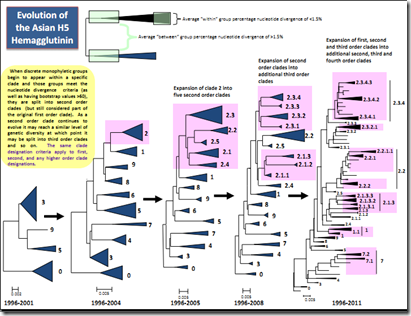

(click to load larger image)

All of which means we are not watching just one H5N1 virus strain, we are watching at least 20 genetically separate clades of the virus, with many minor variants of each clade thrown in the mix.

Which brings us to today?s report from the SGGP (S?i G?n Giải Ph?ng), the official newspaper of the Vietnamese government.


Ministry fears spread of virus, bans transport of water fowl
Wednesday, Sep 19, 2012

The Ministry of Agriculture and Rural Development has decided to stop transport of live water-fowl from North and Central Vietnam to the South, in an effort to curb spread of the new highly toxic strain of avian flu virus.

Pham Van Dong, deputy director of the Department of Animal Health, stated this at a meeting held yesterday in Hanoi by the National Steering Committee for Avian Flu Prevention and Control.

The new strain, 2.3.2.1 C, which has been detected, is highly toxic and therefore extremely deadly.

The virus strain has recently spread to Vietnam and is now present in affected areas in the northern and central provinces of Hai Phong, Ha Tinh, Ninh Binh, Nam Dinh, Bac Kan, Thanh Hoa and Quang Ngai.

Fearing the virus may spread to South Vietnam, the Department of Animal Health was asked to isolate the virus and ban transport of live water-fowl from infected areas.

Dong said that slaughterhouses practicing good hygiene should be mentioned to localities from the central province of Thua Thien-Hue to Ho Chi Minh City.

Because the new strain is different from the earlier A/H5N1 virus, the ministry has urged for experiments and tests to confirm whether the vaccine used to combat A/H5N1 is also effective against the new strain. If the existing vaccine is ineffective, studies on new vaccines should be conducted soon.

The Central Veterinary Diagnosis Center has been asked to study the new strain to help find a specific medication to fight the virus.

Although the above story describes this new strain (2.3.2.1 C) as `highly toxic and therefore extremely deadly? this would appear to be referring mainly to its effect on poultry.

Vietnam has reported only 4 human infections this year (2 fatal), and none have been reported since last March (see WHO Update Avian influenza ? situation in Viet Nam ? update).

Thus far, we have scant hard data on the threat this new clade poses to humans.

While we continue to see isolated human infections around the world, H5N1 remains largely an avian-adapted virus, and for now primarily a threat to poultry.

The concern, of course, is that with continual changes to the virus, one of these days it may adapt to human or mammalian physiology.
And so the world remains at Pre-pandemic Phase III on the H5N1 virus, and we continue to watch for signs that the virus is moving towards becoming a bigger threat.

Posted by Michael Coston at <a class="timestamp-link" href="http://afludiary.blogspot.com/2012/09/vietnam-ministry-bans-transport-of.html" rel="bookmark" title="permanent link"><abbr class="published" title="2012-09-19T08:14:00-04:00">8:14 AM</abbr>

 
Re: Ministry fears spread of H5N1 virus, bans transport of water fowl

Vietnam’s new strain of bird flu spreading fast

Last Updated: Friday, September 21, 2012

Local authorities worry that it took just one month to spread from north to central Vietnam, but international experts do not predict a worse scenario than in previous years.

A new strain of the H5N1 virus known as bird flu has appeared in Vietnam, but the Food and Agriculture Organization (FAO) says there is no reason to believe it is any more virulent than previous strains.

“In the past, the occurrence of variations in the virus has resulted in limited upsurges of outbreaks and the FAO expects this situation will be the same,” the UN agency said in a statement to Vietweek.

According to the Vietnamese Department of Animal Health, bird flu outbreaks have been detected in the northern and central provinces of Ha Tinh, Ninh Binh, Nam Dinh, Bac Kan, Quang Ngai, Hoa Binh and Tuyen Quang, where more than 180,000 chickens and ducks have been culled so far.

“There is a new strain of the H5N1 virus that is spreading fast with a high capacity to kill humans,” Diep Kinh Tan, deputy minister of Agriculture and Rural Development, said at a recent meeting of the National Committee for Avian Influenza Disease Control and Prevention.

“The central government is very concerned,” he said.

.....

“There is currently no evidence to suggest that this present strain of the H5N1 virus will have an increased risk to human health,” the UN agency said.

Tanhnien News
 
Back
Top Bottom