
Mary Wilson
Well-known member
OCTOBER 25, 2024
By Amy Maxmen
... Hundreds of emails from state and local health departments, obtained in records requests from KFF Health News, help reveal why. Despite health officials’ arduous efforts to track human infections, surveillance is marred by delays, inconsistencies, and blind spots.
Several documents reflect a breakdown in communication with a subset of farm owners who don’t want themselves or their employees monitored for signs of bird flu.
For instance, a terse July 29 email from the Weld County Department of Public Health and Environment in Colorado said, “Currently attempting to monitor 26 dairies. 9 have refused.”
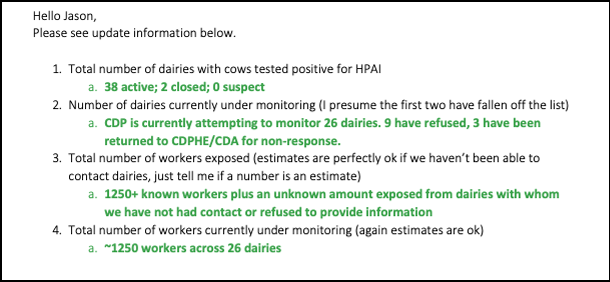 A July 29 email reflects the absence of information when some farm owners don’t wish to correspond with public health departments about potential cases of bird flu, also called HPAI, for “highly pathogenic avian influenza.” This email was obtained through Freedom of Information Act records requests from KFF Health News to the Weld County Department of Public Health and Environment in Colorado.(SCREENSHOT BY KFF HEALTH NEWS)
The email tallied the people on farms in the state who were supposed to be monitored: “1250+ known workers plus an unknown amount exposed from dairies with whom we have not had contact or refused to provide information.”
Other emails hint that cases on dairy farms were missed. And an exchange between health officials in Michigan suggested that people connected to dairy farms had spread the bird flu virus to pet cats. But there hadn’t been enough testing to really know. ...
Cat Clues
And then there were the pet cats. Unlike dozens of feral cats found dead on farms with outbreaks, these domestic cats didn’t roam around herds, lapping up milk that teemed with virus.
In emails, Mid-Michigan health officials hypothesized that the cats acquired the virus from droplets, known as fomites, on their owners’ hands or clothing. “If we only could have gotten testing on the [REDACTED] household members, their clothing if possible, and their workplaces, we may have been able to prove human->fomite->cat transmission,” said a July 22 email.
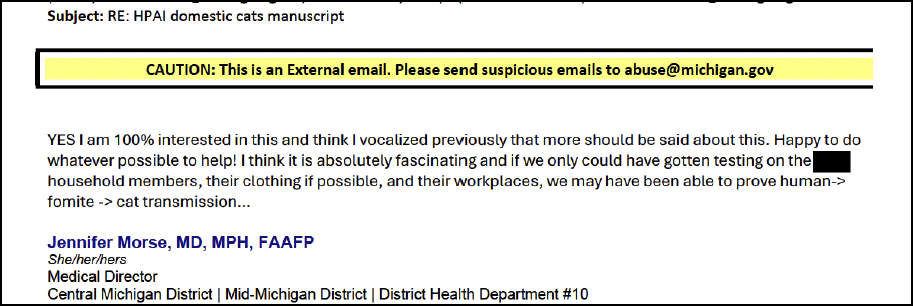 A July 22 email suggests that people might have infected their domestic cats with the bird flu, also called HPAI, for “highly pathogenic avian influenza,” but epidemiologists couldn’t determine how it happened because the animals’ owners had not been tested. This email was obtained through Freedom of Information Act records requests from KFF Health News to the Mid-Michigan District Health Department. (SCREENSHOT BY KFF HEALTH NEWS)
Her colleague suggested they publish a report on the cat cases “to inform others about the potential for indirect transmission to companion animals.”
Thijs Kuiken, a bird flu researcher in the Netherlands, at the Erasmus Medical Center in Rotterdam, said person-to-cat infections wouldn’t be surprising since felines are so susceptible to the virus. Fomites may have been the cause or, he suggested, an infected — but untested — owner might have passed it on.
Hints of missed cases add to mounting evidence of undetected bird flu infections. Health officials said they’re aware of the problem but that it’s not due only to farm owners’ objections. ...
https://kffhealthnews.org/news/arti...ls-tracking-human-cases-obstacles-california/
__________________________________________________ ______________________
JANUARY 30, 2025
By Amy Maxmen
... Like farmworkers, livestock veterinarians are at risk of bird flu infections. The study results could help protect them. And having fewer infections would lessen the chance of the H5N1 bird flu virus evolving within a person to spread efficiently between people — the gateway to a bird flu pandemic.
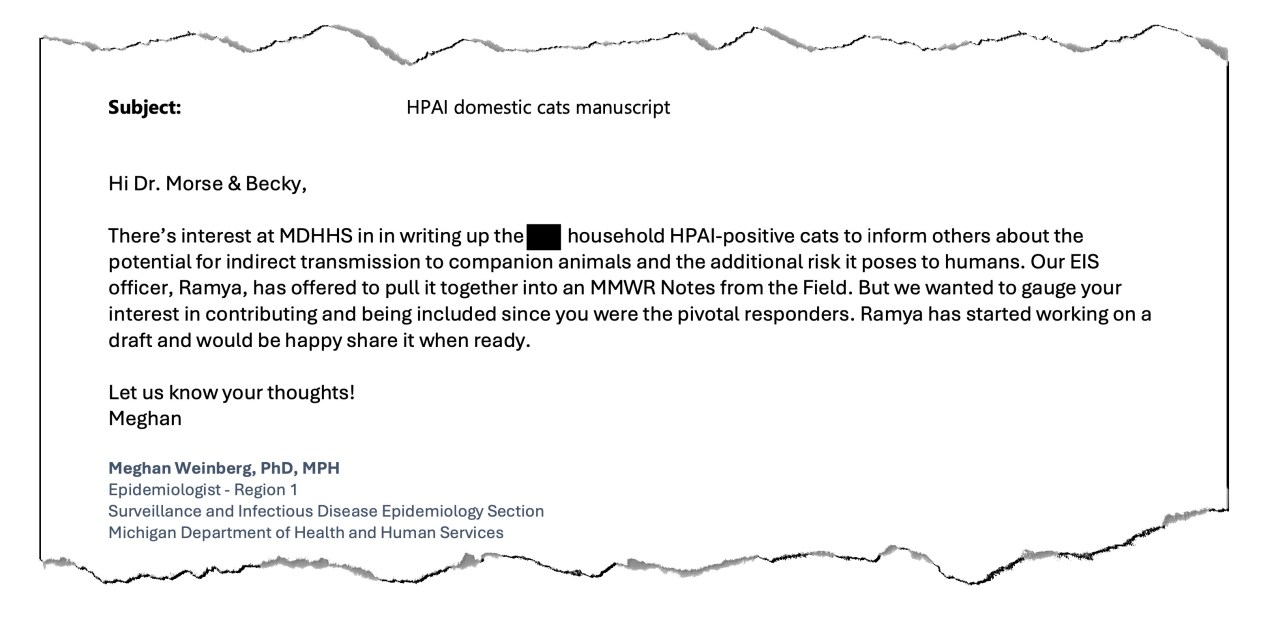 In a July 22 email obtained by KFF Health News, an epidemiologist at the Michigan health department suggests publishing a report about people who potentially spread the bird flu virus to their pet cats. The paper was accepted by the journal of the Centers for Disease Control and Prevention. But its publication is on hold because of a Trump administration order to pause communications. (Screenshot by KFF Health News)
At least 67 people have tested positive for the bird flu in the U.S., with the majority getting the virus from cows or poultry. But studies and reporting suggest many cases have gone undetected, because testing has been patchy. ...
https://kffhealthnews.org/news/article/cdc-trump-mmwr-bird-flu-studies-blocked-meddling/
By Amy Maxmen
... Hundreds of emails from state and local health departments, obtained in records requests from KFF Health News, help reveal why. Despite health officials’ arduous efforts to track human infections, surveillance is marred by delays, inconsistencies, and blind spots.
Several documents reflect a breakdown in communication with a subset of farm owners who don’t want themselves or their employees monitored for signs of bird flu.
For instance, a terse July 29 email from the Weld County Department of Public Health and Environment in Colorado said, “Currently attempting to monitor 26 dairies. 9 have refused.”
The email tallied the people on farms in the state who were supposed to be monitored: “1250+ known workers plus an unknown amount exposed from dairies with whom we have not had contact or refused to provide information.”
Other emails hint that cases on dairy farms were missed. And an exchange between health officials in Michigan suggested that people connected to dairy farms had spread the bird flu virus to pet cats. But there hadn’t been enough testing to really know. ...
Cat Clues
And then there were the pet cats. Unlike dozens of feral cats found dead on farms with outbreaks, these domestic cats didn’t roam around herds, lapping up milk that teemed with virus.
In emails, Mid-Michigan health officials hypothesized that the cats acquired the virus from droplets, known as fomites, on their owners’ hands or clothing. “If we only could have gotten testing on the [REDACTED] household members, their clothing if possible, and their workplaces, we may have been able to prove human->fomite->cat transmission,” said a July 22 email.
Her colleague suggested they publish a report on the cat cases “to inform others about the potential for indirect transmission to companion animals.”
Thijs Kuiken, a bird flu researcher in the Netherlands, at the Erasmus Medical Center in Rotterdam, said person-to-cat infections wouldn’t be surprising since felines are so susceptible to the virus. Fomites may have been the cause or, he suggested, an infected — but untested — owner might have passed it on.
Hints of missed cases add to mounting evidence of undetected bird flu infections. Health officials said they’re aware of the problem but that it’s not due only to farm owners’ objections. ...
https://kffhealthnews.org/news/arti...ls-tracking-human-cases-obstacles-california/
__________________________________________________ ______________________
JANUARY 30, 2025
By Amy Maxmen
... Like farmworkers, livestock veterinarians are at risk of bird flu infections. The study results could help protect them. And having fewer infections would lessen the chance of the H5N1 bird flu virus evolving within a person to spread efficiently between people — the gateway to a bird flu pandemic.
At least 67 people have tested positive for the bird flu in the U.S., with the majority getting the virus from cows or poultry. But studies and reporting suggest many cases have gone undetected, because testing has been patchy. ...
https://kffhealthnews.org/news/article/cdc-trump-mmwr-bird-flu-studies-blocked-meddling/
