Michael Coston
Editor, Senior Moderator
Kent County MI Health Department Bulletin on Swine Flu (in pigs) at Local Fair

Credit Wikipedia
#19,289
We've seen an unusually quiet year of reporting on Swine Variant Influenza, with only 2 H1N2v (human) cases reported since October 1st of 2025; a far cry from the average of 36 human infections per year since tracking began in 2011 (n=581).

The CDC describes swine influenza viruses as:
H1N2 variant [A/California/62/2018] Jul 2019 5.8 5.7 Moderate
H3N2 variant [A/Ohio/13/2017] Jul 2019 6.6 5.8 Moderate
While no additional cases have been confirmed, this week the Kent County Health Department announced the closure of their county fair's swine barn after the sudden death of a pig, and `several other pigs developed signs of illness'.
KCHD is reportedly investigating reports of `influenza-like' illness among individuals who had contact with pigs at the fair, but no confirmed human infections have been reported at this time.
They are urging the public:
“Anyone who develops flu-like symptoms after having contact with pigs at the fair should contact the Kent County Health Department and let their health care provider know about their exposure.”
So far, we've no indication of the subtype involved or the severity of the human `influenza-like' illnesses they are investigating. Typically, swine variant infections are mild or moderate in humans, with only a couple of deaths reported since 2011.
The bulletin advises that the Kent County Fair has ended, but attendees who had contact with pigs at the fair should monitor for flu-like symptoms for 10 days. They then go on to list the precautions other fair-goers in Michigan should take when attending agricultural events.
First, the Health Department announcement, after which I'll have a bit more.
Health Officials Raise Awareness Following Swine Flu Detection in Pigs at the Kent County Youth Fair
GRAND RAPIDS, MI. (August 10, 2026) — The Kent County Health Department (KCHD), in partnership with the Michigan Department of Health and Human Services (MDHHS) and the Michigan Department of Agriculture and Rural Development (MDARD), is advising people who may have had contact with pigs at the Kent County Youth Fair to monitor for influenza-like symptoms due to a detection of swine influenza.
On Friday, August 7, a pig at the Kent County Youth Fair died suddenly, and several other pigs developed signs of illness. The sick pigs were isolated, and the swine barn was immediately closed to the public. However, as a precaution, the KCHD is investigating reports of influenza-like illness among individuals who had contact with pigs at the fair.
“While we do not have confirmation of human infection at this time, we are taking this situation seriously and want people who may have been exposed to know what symptoms to watch for and what to do next,” said Kent County Health Department Health Officer Dr. Adam London.
This isn't just an American problem, as there is much diversity among swine flu viruses around the globe, with China's EA H1N1 `G4' virus often cited as the biggest pandemic threat. We've also followed repeated spillovers in Brazil, and last year the Eurasian 1C Swine Influenza A Virus was labeled a `high pandemic risk'.
The reality is, surveillance and testing for swine influenza A viruses is notoriously sub-optimal, and many strains circulate under the radar.
For more on the risks of exposure to influenza infected pigs, you may wish to revisit:
Preprint: Occupationally Exposed & General Population Antibody Profiles to Influenza A Viruses Circulating in Swine as an Indication of Zoonotic Risk
.
https://afludiary.blogspot.com/2026/08/kent-county-mi-health-department.html
Credit Wikipedia
#19,289
We've seen an unusually quiet year of reporting on Swine Variant Influenza, with only 2 H1N2v (human) cases reported since October 1st of 2025; a far cry from the average of 36 human infections per year since tracking began in 2011 (n=581).
The CDC describes swine influenza viruses as:
- Swine influenza is a respiratory disease of pigs caused by type A influenza viruses that regularly cause outbreaks of influenza in pigs.
- Influenza viruses that commonly circulate in swine are called “swine influenza viruses” or “swine flu viruses.”
- Like human influenza viruses, there are different subtypes and strains of swine influenza viruses.
- The main swine influenza viruses circulating in U.S. pigs in recent years have been, swine triple reassortant (tr) H1N1 influenza virus, trH3N2 virus, and trH1N2 virus.
H1N2 variant [A/California/62/2018] Jul 2019 5.8 5.7 Moderate
H3N2 variant [A/Ohio/13/2017] Jul 2019 6.6 5.8 Moderate
H3N2 variant [A/Indiana/08/2011] Dec 2012 6.0 4.5 Moderate
While no additional cases have been confirmed, this week the Kent County Health Department announced the closure of their county fair's swine barn after the sudden death of a pig, and `several other pigs developed signs of illness'.
KCHD is reportedly investigating reports of `influenza-like' illness among individuals who had contact with pigs at the fair, but no confirmed human infections have been reported at this time.
They are urging the public:
“Anyone who develops flu-like symptoms after having contact with pigs at the fair should contact the Kent County Health Department and let their health care provider know about their exposure.”
So far, we've no indication of the subtype involved or the severity of the human `influenza-like' illnesses they are investigating. Typically, swine variant infections are mild or moderate in humans, with only a couple of deaths reported since 2011.
The bulletin advises that the Kent County Fair has ended, but attendees who had contact with pigs at the fair should monitor for flu-like symptoms for 10 days. They then go on to list the precautions other fair-goers in Michigan should take when attending agricultural events.
First, the Health Department announcement, after which I'll have a bit more.
Health Officials Raise Awareness Following Swine Flu Detection in Pigs at the Kent County Youth Fair
GRAND RAPIDS, MI. (August 10, 2026) — The Kent County Health Department (KCHD), in partnership with the Michigan Department of Health and Human Services (MDHHS) and the Michigan Department of Agriculture and Rural Development (MDARD), is advising people who may have had contact with pigs at the Kent County Youth Fair to monitor for influenza-like symptoms due to a detection of swine influenza.
On Friday, August 7, a pig at the Kent County Youth Fair died suddenly, and several other pigs developed signs of illness. The sick pigs were isolated, and the swine barn was immediately closed to the public. However, as a precaution, the KCHD is investigating reports of influenza-like illness among individuals who had contact with pigs at the fair.
“While we do not have confirmation of human infection at this time, we are taking this situation seriously and want people who may have been exposed to know what symptoms to watch for and what to do next,” said Kent County Health Department Health Officer Dr. Adam London.
“Anyone who develops flu-like symptoms after having contact with pigs at the fair should contact the Kent County Health Department and let their health care provider know about their exposure.”
Signs and Symptoms in Humans
Signs and Symptoms in Humans
Symptoms of swine flu can be similar to the seasonal flu and may include:
Protecting Animal and Human Health at the Fair
- Fever
- Lethargy (tiredness)
- Lack of appetite
- Coughing
- Runny nose
- Sore throat
- Eye irritation
- Nausea
- Vomiting
- Diarrhea
Protecting Animal and Human Health at the Fair
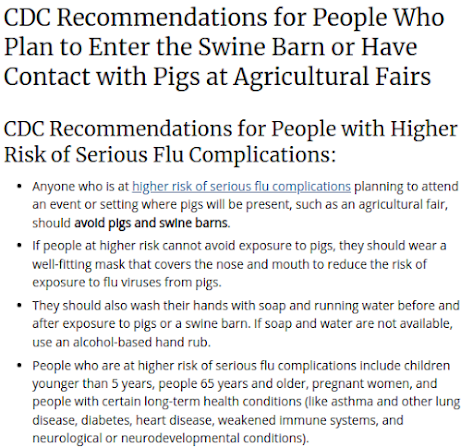
While the Kent County Youth Fair has ended, people who plan to attend other agricultural fairs or have contact with animals should take the following precautions to reduce the risk of influenza and other diseases that can spread between animals and people:
- Avoid interacting, touching, or petting animals if you have an increased risk for severe influenza complications.
- Don't eat, drink, or put anything in your mouth in areas with animals.
- Don't take toys, pacifiers, cups, baby bottles, strollers, or similar items into areas with animals.
- Wash your hands with soap and water before and after exposure to pigs or other animals, using hand-sanitizer if water and soap are not available.
- Change and wash clothing and clean footwear or equipment after visiting animal areas, particularly if you have livestock at home.
- Avoid close contact with animals that appear sick, including animals showing loss of appetite, fever, tiredness, eye redness, discomfort, coughing, or a runny nose.
- If you must come in contact with animals that may be ill, then wear personal protective equipment (PPE). This includes protective clothing, gloves, and a well-fitting mask that covers your mouth and nose and immediately contact the fair veterinarian. Parents and caregivers should review considerations for specific groups of people when selecting a respirator or mask for children.
- Stay home and away from others, including animals, if you are experiencing flu-like symptoms
Swine flu in pigs is not a food safety concern, and people cannot contract influenza by eating properly handled and cooked pork or pork products. Consumers should continue to follow standard food-safety practices when handling and preparing pork.
For more information about preventing swine flu, please visit the Centers for Disease Control and Prevention (CDC) website.
For more information about preventing swine flu, please visit the Centers for Disease Control and Prevention (CDC) website.
This isn't just an American problem, as there is much diversity among swine flu viruses around the globe, with China's EA H1N1 `G4' virus often cited as the biggest pandemic threat. We've also followed repeated spillovers in Brazil, and last year the Eurasian 1C Swine Influenza A Virus was labeled a `high pandemic risk'.
The reality is, surveillance and testing for swine influenza A viruses is notoriously sub-optimal, and many strains circulate under the radar.
For more on the risks of exposure to influenza infected pigs, you may wish to revisit:
Preprint: Occupationally Exposed & General Population Antibody Profiles to Influenza A Viruses Circulating in Swine as an Indication of Zoonotic Risk
.
https://afludiary.blogspot.com/2026/08/kent-county-mi-health-department.html
Last edited: