AlaskaDenise
In Memoriam
Global warming causes glaciers to retreat in India, prompting ingenuity from mountain farmers to conserve water for crops.
By Ben Arnoldy | Staff writer of The Christian Science Monitor
Stakmo, India
Chhewang Norphel makes artificial glaciers. The reason: The real ones have rapidly receded up the Himalayan slopes in his home district of Ladakh in northernmost India.
Himalayan communities like Ladakh rely on glacial runoff to grow food, making them ? along with tiny island nations ? among the first to feel an existential threat from climate change. Mr. Norphel's artificial glaciers represent one of the earliest human efforts at adaptation.
"At the moment, except for this, there is no other solution," says Norphel. But he feels time running out, since even his idea requires runoff from real glaciers. "Everything is melting very, very quickly because of global warming."
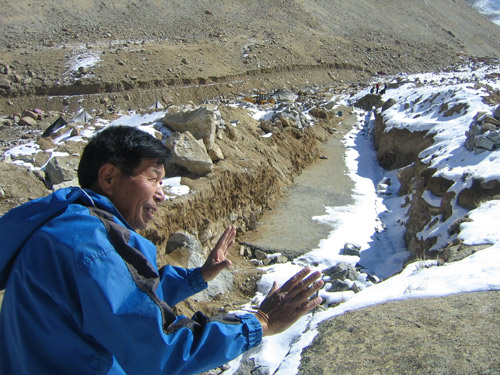
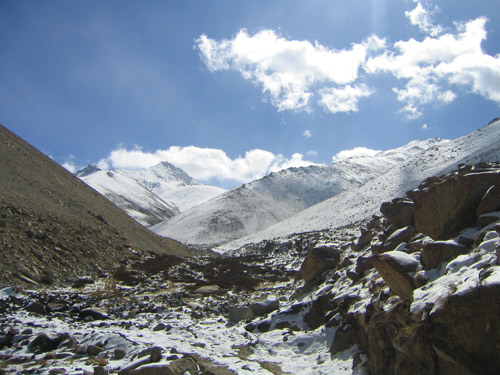
The septuagenarian nimbly hops from stone to stone to cross a stream. Below, on an otherwise boulder-strewn high desert, lies the small village of Stakmo in a patch of green fields famous for barley.
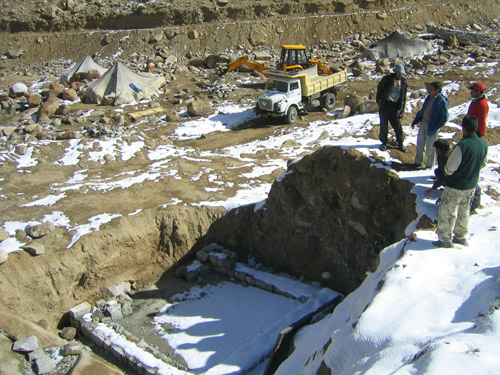
Here, Norphel is using what is abundant ? stone ? to conserve what is precious ? water. The idea is simple: Divert the unneeded autumn and winter runoff into a series of large, rock-lined holding ponds. As the days grow colder, the ponds freeze and interconnect into a growing glacier.
Less snow to moisten spring soil
He has built 10 glaciers across the region. His largest stretched more than a mile before an unusual week of rain wiped it out in 2006.
The artificial glaciers melt early enough to rescue farmers from the catastrophe of a dry spring. In recent years, farmers have been planting later and later because the natural glaciers are now too high to melt early, and the valleys no longer get a covering of snow to moisten springtime soil.
"The fields used to be full of snow, now they aren't at all," says Tashi Tondup, a farmer in Stakmo. Some 80 percent of Ladakhi farmers like Mr. Tondup depend on snow and glacial melt for irrigation, according to Norphel.
"We have a saying: If we sow our fields after the 21st of June, they will never grow. But this year, due to late arrival of water, we sowed our fields on the 28th of June. So we still don't know what we are going to get," says Tondup.
Norphel says his glaciers will melt in April or May.
In Sabo, manmade glacier lost to Mother Nature
Tondup hopes the effort will work. But Tsering Wangchuk knows it will. His village of Sabo had been suffering years of springtime water shortages because of declining snowfalls. So they turned to Norphel.
"After getting the glacier, [farmers] had sufficient water to do what they were doing originally ? a bad situation went to normal," says Mr. Wangchuk. But the 2006 floods wiped out the glacier and earthworks.
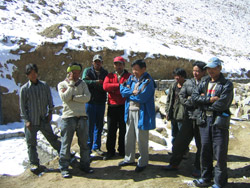
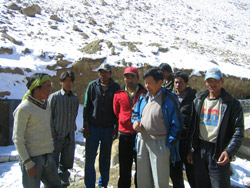
Now Wangchuk has come to Stakmo to learn from Norphel how to rebuild a better glacier.
Norphel himself is experimenting with three different designs in Stakmo ? tweaking variables such as using shadier north slopes and varying the 5-ft. to 7-ft. depths of the holding pools. He then plans to train as many villagers as possible on the most effective design.
It will take 20 people with shovels and a backhoe to build the more than 900 feet of rock walls to finish the Stakmo project. The materials are simple: dirt, pipes, rocks ? and runoff from real glaciers high above.
"There needs to be some source of water," says Norphel. "When all the glaciers [are] finished, it will be very difficult to solve this problem."
A new glacier: $50,000
Norphel says a good artificial glacier costs $50,000. He gets only partial support ? about $20,000 a glacier over a five-year window ? from the central government's Watershed Redevelopment Program. If the money doesn't materialize, he might have to scale back either the scope of the project or its upkeep. No one else has stepped forward to help with funding, and while journalists have chronicled his work, no scientists have come to study the technique. That doesn't seem to bother him: He says simply that he is more interested in training local villagers than in passing his knowledge on to academics.
He is starting to get attention from environmental groups, however, and he now has a PowerPoint presentation that he gave most recently this September at a climate change conference in Ladakh's capital of Leh.
"I think Ladakh is the first victim of climate change," says Padma Tashi, who runs a local nongovernmental organization (NGO) and organized the conference. And "we, the people of Ladakh, are looking for some kind of climate justice."
By "climate justice," Mr. Tashi means reparations in the form of payments from developed countries that have produced most of the world's greenhouse gases. That money could then be used to fund adaptation projects like Norphel's glaciers, or rebuild villages following climatic disasters like the 2006 flood.
Flush toilets and daily showers drain water supply
While India was one of the early victims of developed countries' pollution, Ladakhis are also responsible for their environment's degradation. The district has welcomed an explosion of tourists ? from 18,000 in 2000 to 74,000 last year. They have brought profligate attitudes about water usage, including daily bathing and flush toilets. As a result, natural glacier-fed springs that three years ago supplied enough water for the capital have dried up. To compensate, Ladakhis have started drilling bore holes and taking more water out of the head-waters of the Indus River.
For the most part, the district government has done little to enforce conservation beyond talking about a development plan and restricting private well drilling. Otherwise, the government is focused entirely on increasing supply, rather than curbing demand.
"Demand you cannot restrict," says Ravinder Kumar Koaul, executive engineer of Leh's water department. "Now, every house is having these flushing latrines," he says, adding that it is up to NGOs to promote conservation.
To meet summer demand, Mr. Koaul needs to increase the water supply from 700,000 gallons of water a day to 1.6 million gallons ? with most of the new water coming from the Indus. "Once the river dries up, what will happen?" Koaul muses. "I don't know."
Every drop taken out by Ladakhis also equals less water for India's archrival, Pakistan, whose agriculture depends on the river. When asked about how Pakistan might feel about this, a visiting water developer replied, "Why should we care?"
For Tashi, the focus ought to be on sustainable adaptations to climate change, like Norphel's glaciers and a renewed focus on traditional conservation values for residents and tourists alike ? not short-term fixes like raiding the Indus. He urges leaders to think of the thathugu, or "the generation to come."
"If the situation continues like we are facing now, and we are not going to do anything, [then] the people of Ladakh will not be in a position to hand over land to the next generation," says Tashi. "If there is no water, within 10 to 15 years, many villages and Ladakhis will have to pick up and go somewhere."
http://www.csmonitor.com/2009/1021/p11s01-wogn.html
By Ben Arnoldy | Staff writer of The Christian Science Monitor
Stakmo, India
Chhewang Norphel makes artificial glaciers. The reason: The real ones have rapidly receded up the Himalayan slopes in his home district of Ladakh in northernmost India.
Himalayan communities like Ladakh rely on glacial runoff to grow food, making them ? along with tiny island nations ? among the first to feel an existential threat from climate change. Mr. Norphel's artificial glaciers represent one of the earliest human efforts at adaptation.
"At the moment, except for this, there is no other solution," says Norphel. But he feels time running out, since even his idea requires runoff from real glaciers. "Everything is melting very, very quickly because of global warming."
The septuagenarian nimbly hops from stone to stone to cross a stream. Below, on an otherwise boulder-strewn high desert, lies the small village of Stakmo in a patch of green fields famous for barley.
Here, Norphel is using what is abundant ? stone ? to conserve what is precious ? water. The idea is simple: Divert the unneeded autumn and winter runoff into a series of large, rock-lined holding ponds. As the days grow colder, the ponds freeze and interconnect into a growing glacier.
Less snow to moisten spring soil
He has built 10 glaciers across the region. His largest stretched more than a mile before an unusual week of rain wiped it out in 2006.
The artificial glaciers melt early enough to rescue farmers from the catastrophe of a dry spring. In recent years, farmers have been planting later and later because the natural glaciers are now too high to melt early, and the valleys no longer get a covering of snow to moisten springtime soil.
"The fields used to be full of snow, now they aren't at all," says Tashi Tondup, a farmer in Stakmo. Some 80 percent of Ladakhi farmers like Mr. Tondup depend on snow and glacial melt for irrigation, according to Norphel.
"We have a saying: If we sow our fields after the 21st of June, they will never grow. But this year, due to late arrival of water, we sowed our fields on the 28th of June. So we still don't know what we are going to get," says Tondup.
Norphel says his glaciers will melt in April or May.
In Sabo, manmade glacier lost to Mother Nature
Tondup hopes the effort will work. But Tsering Wangchuk knows it will. His village of Sabo had been suffering years of springtime water shortages because of declining snowfalls. So they turned to Norphel.
"After getting the glacier, [farmers] had sufficient water to do what they were doing originally ? a bad situation went to normal," says Mr. Wangchuk. But the 2006 floods wiped out the glacier and earthworks.
Now Wangchuk has come to Stakmo to learn from Norphel how to rebuild a better glacier.
Norphel himself is experimenting with three different designs in Stakmo ? tweaking variables such as using shadier north slopes and varying the 5-ft. to 7-ft. depths of the holding pools. He then plans to train as many villagers as possible on the most effective design.
It will take 20 people with shovels and a backhoe to build the more than 900 feet of rock walls to finish the Stakmo project. The materials are simple: dirt, pipes, rocks ? and runoff from real glaciers high above.
"There needs to be some source of water," says Norphel. "When all the glaciers [are] finished, it will be very difficult to solve this problem."
A new glacier: $50,000
Norphel says a good artificial glacier costs $50,000. He gets only partial support ? about $20,000 a glacier over a five-year window ? from the central government's Watershed Redevelopment Program. If the money doesn't materialize, he might have to scale back either the scope of the project or its upkeep. No one else has stepped forward to help with funding, and while journalists have chronicled his work, no scientists have come to study the technique. That doesn't seem to bother him: He says simply that he is more interested in training local villagers than in passing his knowledge on to academics.
He is starting to get attention from environmental groups, however, and he now has a PowerPoint presentation that he gave most recently this September at a climate change conference in Ladakh's capital of Leh.
"I think Ladakh is the first victim of climate change," says Padma Tashi, who runs a local nongovernmental organization (NGO) and organized the conference. And "we, the people of Ladakh, are looking for some kind of climate justice."
By "climate justice," Mr. Tashi means reparations in the form of payments from developed countries that have produced most of the world's greenhouse gases. That money could then be used to fund adaptation projects like Norphel's glaciers, or rebuild villages following climatic disasters like the 2006 flood.
Flush toilets and daily showers drain water supply
While India was one of the early victims of developed countries' pollution, Ladakhis are also responsible for their environment's degradation. The district has welcomed an explosion of tourists ? from 18,000 in 2000 to 74,000 last year. They have brought profligate attitudes about water usage, including daily bathing and flush toilets. As a result, natural glacier-fed springs that three years ago supplied enough water for the capital have dried up. To compensate, Ladakhis have started drilling bore holes and taking more water out of the head-waters of the Indus River.
For the most part, the district government has done little to enforce conservation beyond talking about a development plan and restricting private well drilling. Otherwise, the government is focused entirely on increasing supply, rather than curbing demand.
"Demand you cannot restrict," says Ravinder Kumar Koaul, executive engineer of Leh's water department. "Now, every house is having these flushing latrines," he says, adding that it is up to NGOs to promote conservation.
To meet summer demand, Mr. Koaul needs to increase the water supply from 700,000 gallons of water a day to 1.6 million gallons ? with most of the new water coming from the Indus. "Once the river dries up, what will happen?" Koaul muses. "I don't know."
Every drop taken out by Ladakhis also equals less water for India's archrival, Pakistan, whose agriculture depends on the river. When asked about how Pakistan might feel about this, a visiting water developer replied, "Why should we care?"
For Tashi, the focus ought to be on sustainable adaptations to climate change, like Norphel's glaciers and a renewed focus on traditional conservation values for residents and tourists alike ? not short-term fixes like raiding the Indus. He urges leaders to think of the thathugu, or "the generation to come."
"If the situation continues like we are facing now, and we are not going to do anything, [then] the people of Ladakh will not be in a position to hand over land to the next generation," says Tashi. "If there is no water, within 10 to 15 years, many villages and Ladakhis will have to pick up and go somewhere."
http://www.csmonitor.com/2009/1021/p11s01-wogn.html