

Michael Coston
Editor, Senior Moderator
Hurricane Preparedness Week 2017 (May 7th - May 13th)
#12,438
As a native Floridian who has spent much of his life either living aboard boats, or very near the coast, I take my yearly hurricane preps seriously. I've been lucky enough to avoid the intense core of the worst of these storms, but what I've ridden through (on land, and on the water) has made me a believer.
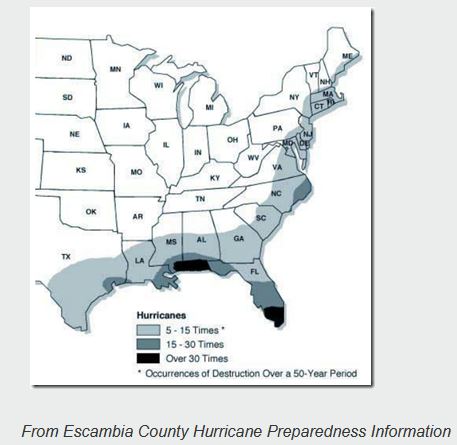
Every year I give hurricane preparedness a prominent place in this blog because for more than 50 million Americans living in coastal areas (and millions more in other countries), hurricanes and their byproducts (flooding, tornadoes, lightning) are probably their greatest natural disaster threat. While South Florida and the northern Gulf coast are at highest risk of direct hurricane impact, even those areas not shaded in – even hundreds of miles inland – can still feel the effects of a hurricanes.
Chances are, on the night of June 19th, 1972, no one sitting at home in New York state or Pennsylvania gave much thought to a weak early season hurricane named Agnes that was making landfall on the Florida panhandle more than a thousand miles to their south.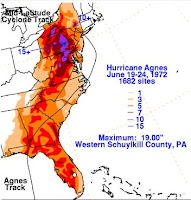
But a week later Agnes would end up being the costliest hurricane in U.S. history up until that date. Of the 122 deaths associated with this storm, only 9 occurred in Florida where Agnes made landfall. The rest - 113 fatalities - were caused by inland fresh water flooding, with New York and Pennsylvania suffering the highest loses.
While we tend to concern ourselves most with the rare CATEGORY 5 storm (like Andrew in 1992 or Camille in 1969), it is often the slow moving minimal hurricane or tropical storm that produces extensive damage hundreds . . . sometimes more than 1000 miles inland.
Some storms with far-reaching impact include:
On this first day of Hurricane Preparedness week the National Weather Service asks you to determine your risks, and those can extend far from the point of landfall.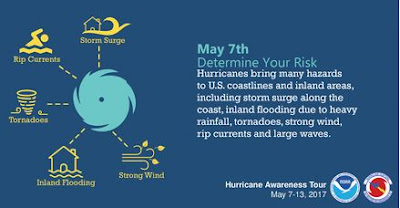 We'll be looking in on various hurricane prep issues over the coming week, and on tropical climatology as the summer progresses. If a storm threatens, I'll cover it, but by all means your primary source of information should always be the National Hurricane Center in Miami, Florida.
http://afludiary.blogspot.com/2017/0...-2017-may.html
#12,438
As a native Floridian who has spent much of his life either living aboard boats, or very near the coast, I take my yearly hurricane preps seriously. I've been lucky enough to avoid the intense core of the worst of these storms, but what I've ridden through (on land, and on the water) has made me a believer.
Every year I give hurricane preparedness a prominent place in this blog because for more than 50 million Americans living in coastal areas (and millions more in other countries), hurricanes and their byproducts (flooding, tornadoes, lightning) are probably their greatest natural disaster threat.
Chances are, on the night of June 19th, 1972, no one sitting at home in New York state or Pennsylvania gave much thought to a weak early season hurricane named Agnes that was making landfall on the Florida panhandle more than a thousand miles to their south.

But a week later Agnes would end up being the costliest hurricane in U.S. history up until that date. Of the 122 deaths associated with this storm, only 9 occurred in Florida where Agnes made landfall. The rest - 113 fatalities - were caused by inland fresh water flooding, with New York and Pennsylvania suffering the highest loses.
While we tend to concern ourselves most with the rare CATEGORY 5 storm (like Andrew in 1992 or Camille in 1969), it is often the slow moving minimal hurricane or tropical storm that produces extensive damage hundreds . . . sometimes more than 1000 miles inland.
Some storms with far-reaching impact include:
- Hurricane Hazel, which had already devastated Haiti (400-1000 deaths) came ashore on the North-South Carolina border in August of 1954. She claimed 95 lives in the United States and was responsible for as many as 100 deaths in Canada.
- The CAT 5 monster Camille, which claimed 143 lives along the Gulf coast also killed 113 people in associated flooding in Virginia.
- And Audrey, the horrific `surprise’ gulf coast CAT 4 storm of 1957 -that claimed more than 550 lives - at least 15 of those victims were in Canada.
On this first day of Hurricane Preparedness week the National Weather Service asks you to determine your risks, and those can extend far from the point of landfall.
Weather-Ready Nation
National Program
Determine your risk
Sunday, May 7th
Find out today what types of wind and water hazards could happen where you live, and then start preparing now for how to handle them. Hurricanes are not just a coastal problem. Their impacts can be felt hundreds of miles inland. It’s easy to forget what a hurricane is capable of doing.
The U.S. has not been directly impacted by a major hurricane (Category 3 or higher) in more than a decade. However, hurricanes such as Ike, Sandy and Isaac reminded us that significant impacts can occur without it being a major hurricane. Many people are suffering from hurricane amnesia in the forms of complacency, denial and inexperience. This remarkable hurricane streak is going to end, and we have to be ready for it to happen this season.
National Program
Determine your risk
Sunday, May 7th
Find out today what types of wind and water hazards could happen where you live, and then start preparing now for how to handle them. Hurricanes are not just a coastal problem. Their impacts can be felt hundreds of miles inland. It’s easy to forget what a hurricane is capable of doing.
The U.S. has not been directly impacted by a major hurricane (Category 3 or higher) in more than a decade. However, hurricanes such as Ike, Sandy and Isaac reminded us that significant impacts can occur without it being a major hurricane. Many people are suffering from hurricane amnesia in the forms of complacency, denial and inexperience. This remarkable hurricane streak is going to end, and we have to be ready for it to happen this season.
These are the real experts, and the only ones you should rely on to track and forecast the storm.
If you are on Twitter, you should also follow @FEMA, @NHC_Atlantic, @NHC_Pacific and @ReadyGov.http://afludiary.blogspot.com/2017/0...-2017-may.html