

Michael Coston
Editor, Senior Moderator
How Not To Swelter In Place

#18,066
Two days ago a derecho with straight-line winds of greater than 100 mph struck metro Houston, Texas leaving 7 dead, and a million people without power. Today, > 500,000 are reportedly still without power in Harris County, alone, and some may go weeks before power is restored.
Between tornado outbreaks, derechos, and landfalling hurricanes we see this scenario repeated nearly every year; large regional power outages that can last days, weeks, or sometimes months.
Invariably, we see deaths associated with extreme heat or cold, or fromcarbon monoxide poisoning from using generators, in the days or weeks that follow (see NEJM Mortality in Puerto Rico after Hurricane Maria).
As a Floridian, I've gone through this more than a few times, and even when it isn't life-threatening, going without electricity for days - particularly during the summer - can be miserable.
With Hurricane season starting in a couple of weeks, and the fact that severe weather, earthquakes, and even solar storms can happen at any time, now seems like a good time to review some preparedness options for when the grid goes down.
Generators are an obvious solution, but they are expensive, loud, emit deadly fumes, and consume fuel at a voracious rate. Keeping enough gas on hand to run more than a day or two is impractical for many, and getting more fuel when the power is off can be nearly impossible.
Those with tens of thousands of dollars to spend can have a whole-house Solar system - one capable of running freezers, refrigerators, and air conditioners - when the grid goes down.
But on far less of a budget during my last hurricane outage (2022) I had lights, fans, radios, phone and iPad charging capability, and even a mini-DVD player for my entertainment.
Believe me, under those conditions, having fans was as luxury.
I detailed my previous solar power system upgrade 3 years ago, in My New (And Improved) Solar Battery Project (for CPAP).
It relied upon a pair of 40 watt solar panels I bought in the early 1990s, and a couple of small (35 amp/hr) lead acid batteries. The panels still work, but are approaching the end of their life, and lead-acid batteries - while cheap - are heavy, have a short (2-4 year life), and can only be discharged about 50% without damage.
Since they are still serviceable, I haven't replaced them, but a little over a year ago I augmented them with a third (50 amp/hr) LiFePo battery (light, long lasting, and able to discharge > 80%), and a new 100 watt solar panel.
This new single battery/panel will charge faster, and deliver more power, than the two other batteries combined. And I did it for roughly $300.
I'm not going to give a step-by-step tutorial on how to build a system, since there are scores of videos on YouTube that can do that. Instead, I'm going to give an overview of my system, and why I've made the choices I've made.
If you are at all handy, and comfortable working with 12 volt DC systems, you should be able to cobble together your own system.
Disclaimer: lead acid batteries can offgas Hydrogen, which can be explosive, and should be kept in a ventilated are. A dead short across the terminals of a 12 volt battery can cause a fire or explosion. Reversing the polarity of your connections can fry components. If you are unsure of how to safely deal with batteries or DC voltage, have someone who knows how assist you.
Admittedly, for many people the best solution may be dropping $500-$1000 on a solar generator (really, a battery-inverter), and $150-$400 on a matching solar panel. Its a plug-and-play solution that can be set up by just about anyone, and they certainly are far more aesthetically pleasing than a home brew setup.
But if something breaks, you usually have to send it back to the factory for repairs. That turnaround time might be weeks. No matter how good the warranty, it's of limited comfort when the power is already out.
A home brew system, by its very nature, makes it possible for you to repair it yourself. Except for the cables, a typical system has between 3 and 5 components; Solar panel, Solar Charge Controller, and battery. For more versatility you can add a 12v/5v USB outlet, and (if desired) a 110v inverter.
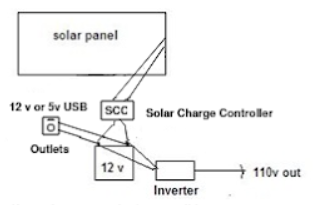
For systems of this size, 110v inverters have limited value. They drain a battery very quickly, and while I have a couple (100 watt & 400 watt), I honestly have a hard time thinking of where I would use them. Charging a laptop, perhaps.
While many of my electrical needs are now met using USB batteries, and small solar panels (see Some Simple Off-The-Shelf Solar Solutions For Power Outages), they won't run my CPAP, larger fans, or a DVD player.

Still, this may be adequate for a lot of people. The advantage is, everything is plug and play, relatively inexpensive, will fit into a duffel bag, and you can start small and add components at your own pace.
As for my new system, it looks like this:

The solar panel is about 18" wide & 39" long. The battery, LiFePo solar charge controller, and output devices all fit into a plastic crate, and weigh about 12 lbs. It provides dual 12V Car Cigarette Lighter Sockets (for CPAP, or Inverter), 2 USB outlets, and the ability to expand.

Major Parts list:
I've also invested $10 into a lead-acid trickle wall charger (110 v) and a $20 3 amp LiFePo wall charger (110 v), so I can keep batteries fully charged when the power is on, without having to deploy the solar panels.
Having this solar gear won't guarantee I'll come away unscathed from the next hurricane, or natural disaster. But, along with having a propane camp stove and heater, a decent first aid kit, 60 gallons of water stored, a well stocked pantry, and a disaster buddy . . . it should certainly improve my odds.
https://afludiary.blogspot.com/2024/05/how-not-to-swelter-in-place.html
#18,066
Two days ago a derecho with straight-line winds of greater than 100 mph struck metro Houston, Texas leaving 7 dead, and a million people without power. Today, > 500,000 are reportedly still without power in Harris County, alone, and some may go weeks before power is restored.
Between tornado outbreaks, derechos, and landfalling hurricanes we see this scenario repeated nearly every year; large regional power outages that can last days, weeks, or sometimes months.
Invariably, we see deaths associated with extreme heat or cold, or fromcarbon monoxide poisoning from using generators, in the days or weeks that follow (see NEJM Mortality in Puerto Rico after Hurricane Maria).
As a Floridian, I've gone through this more than a few times, and even when it isn't life-threatening, going without electricity for days - particularly during the summer - can be miserable.
With Hurricane season starting in a couple of weeks, and the fact that severe weather, earthquakes, and even solar storms can happen at any time, now seems like a good time to review some preparedness options for when the grid goes down.
Generators are an obvious solution, but they are expensive, loud, emit deadly fumes, and consume fuel at a voracious rate. Keeping enough gas on hand to run more than a day or two is impractical for many, and getting more fuel when the power is off can be nearly impossible.
Those with tens of thousands of dollars to spend can have a whole-house Solar system - one capable of running freezers, refrigerators, and air conditioners - when the grid goes down.
But on far less of a budget during my last hurricane outage (2022) I had lights, fans, radios, phone and iPad charging capability, and even a mini-DVD player for my entertainment.
Believe me, under those conditions, having fans was as luxury.
I detailed my previous solar power system upgrade 3 years ago, in My New (And Improved) Solar Battery Project (for CPAP).
It relied upon a pair of 40 watt solar panels I bought in the early 1990s, and a couple of small (35 amp/hr) lead acid batteries. The panels still work, but are approaching the end of their life, and lead-acid batteries - while cheap - are heavy, have a short (2-4 year life), and can only be discharged about 50% without damage.
Since they are still serviceable, I haven't replaced them, but a little over a year ago I augmented them with a third (50 amp/hr) LiFePo battery (light, long lasting, and able to discharge > 80%), and a new 100 watt solar panel.
This new single battery/panel will charge faster, and deliver more power, than the two other batteries combined. And I did it for roughly $300.
I'm not going to give a step-by-step tutorial on how to build a system, since there are scores of videos on YouTube that can do that. Instead, I'm going to give an overview of my system, and why I've made the choices I've made.
If you are at all handy, and comfortable working with 12 volt DC systems, you should be able to cobble together your own system.
Disclaimer: lead acid batteries can offgas Hydrogen, which can be explosive, and should be kept in a ventilated are. A dead short across the terminals of a 12 volt battery can cause a fire or explosion. Reversing the polarity of your connections can fry components. If you are unsure of how to safely deal with batteries or DC voltage, have someone who knows how assist you.
Admittedly, for many people the best solution may be dropping $500-$1000 on a solar generator (really, a battery-inverter), and $150-$400 on a matching solar panel. Its a plug-and-play solution that can be set up by just about anyone, and they certainly are far more aesthetically pleasing than a home brew setup.
But if something breaks, you usually have to send it back to the factory for repairs. That turnaround time might be weeks. No matter how good the warranty, it's of limited comfort when the power is already out.
A home brew system, by its very nature, makes it possible for you to repair it yourself. Except for the cables, a typical system has between 3 and 5 components; Solar panel, Solar Charge Controller, and battery. For more versatility you can add a 12v/5v USB outlet, and (if desired) a 110v inverter.
For systems of this size, 110v inverters have limited value. They drain a battery very quickly, and while I have a couple (100 watt & 400 watt), I honestly have a hard time thinking of where I would use them. Charging a laptop, perhaps.
While many of my electrical needs are now met using USB batteries, and small solar panels (see Some Simple Off-The-Shelf Solar Solutions For Power Outages), they won't run my CPAP, larger fans, or a DVD player.
Still, this may be adequate for a lot of people. The advantage is, everything is plug and play, relatively inexpensive, will fit into a duffel bag, and you can start small and add components at your own pace.
As for my new system, it looks like this:
The solar panel is about 18" wide & 39" long. The battery, LiFePo solar charge controller, and output devices all fit into a plastic crate, and weigh about 12 lbs. It provides dual 12V Car Cigarette Lighter Sockets (for CPAP, or Inverter), 2 USB outlets, and the ability to expand.
Major Parts list:
- ECO-WORTHY 12V 50Ah Trolling Motor LiFePO4 $160
- 100 Watt 12 v Monocrystalline Solar Panel $70
- Solar Charge Controller 10A, Bateria 12V/24V $18
- 12V 3A LiFePO4 Battery Charger $20
- Misc cabling and connectors $20
- With 40-45 amps available from the LiFePo battery I can run my CPAP for 5 (8 hour) nights without recharging. Or, I can watch 35-40 hours of DVDs, or run a large 12 volt fan for 40+ hours. I can also use it to recharge smaller USB battery banks, run 12 volt lights, radios, etc.
- With a 100 watt Solar panel, I can probably average 5+ amps an hour charging, for 4 to 7 hours a day. On on good day, I could probably recharge the battery from being 80% discharged.
I've also invested $10 into a lead-acid trickle wall charger (110 v) and a $20 3 amp LiFePo wall charger (110 v), so I can keep batteries fully charged when the power is on, without having to deploy the solar panels.
Having this solar gear won't guarantee I'll come away unscathed from the next hurricane, or natural disaster. But, along with having a propane camp stove and heater, a decent first aid kit, 60 gallons of water stored, a well stocked pantry, and a disaster buddy . . . it should certainly improve my odds.
https://afludiary.blogspot.com/2024/05/how-not-to-swelter-in-place.html