

Commonground
Senior Moderator
VOLUME 3, NUMBER 43 (PUBLISHED ON Oct 30, 2025)
COVID-19 & Flu Express is a weekly report produced by Surveillance Division of the Communicable Disease Branch of the Centre for Health Protection. It monitors and summarises the latest local and global COVID-19 and influenza activities.
Reporting period: Oct 19, 2025 – Oct 25, 2025 (Week 43)
 The latest surveillance data showed that the overall local activity of COVID-19 has remained at a low level.
The Centre for Health Protection (CHP) has been closely monitoring the local prevalence
of SARS-CoV-2 variants. The latest sewage surveillance data and genetic analysis of
positive respiratory specimens showed that NB.1.8.1 has become the dominating variant
strains in Hong Kong. NB.1.8.1 is one of the descendant lineages of XDV, in turn a
descendent of JN.1. The World Health Organization (WHO) listed NB.1.8.1 as a variant
under monitoring (VUM) on May 23, 2025, and stated that NB.1.8.1 poses a low risk to
global public health based on the available evidence, and that the currently approved
COVID-19 vaccines are expected to be effective against NB.1.8.1, and there is no evidence
to suggest that NB.1.8.1 will cause more serious diseases.
Members of the public are advised to maintain strict personal and environmental hygiene
at all times for personal protection against COVID-19 infection and prevention of the
spread of the disease in the community. High-risk people (e.g. persons with underlying
medical conditions or persons who are immunocompromised) should adopt additional
measures to protect themselves such as wearing mask properly when going to public
places. For other details, please visit the COVID-19 information page
(https://www.chp.gov.hk/en/healthtopics/content/24/102466.html).
Members of the public are advised to take note of the latest recommendations on the use
of COVID-19 vaccines in Hong Kong to protect themselves from serious outcomes of
COVID-19. High-risk priority groups are recommended to receive a dose of COVID-19
vaccine at least six months since the last dose or infection, regardless of the number of
doses received previously. For more details, please visit
(https://www.chp.gov.hk/files/pdf/co...of_covid-19_vaccines_in_hong_kong_oct2025.pdf).
For the latest information on COVID-19 and prevention measures, please visit the
thematic website of COVID-19 (https://www.coronavirus.gov.hk/eng/index.html).
-snip-
Local Situation of Influenza Activity (as of Oct 29, 2025)
Hong Kong is currently in the summer influenza season. The latest surveillance data showed that
local influenza activity remained high.
Influenza can cause serious illnesses in high-risk individuals and even healthy persons. Given that
seasonal influenza vaccines are safe and effective, all persons aged 6 months or above except
those with known contraindications are recommended to receive influenza vaccine to protect
themselves against seasonal influenza and its complications, as well as related hospitalisations
and deaths.
2025/26 Seasonal Influenza Vaccination (SIV) Programmes, including the SIV School Outreach
Programme, the Residential Care Home Vaccination Programme and the Vaccination Subsidy
Scheme, have been commenced on September 25, 2025. Eligible high-risk groups can receive a
free or subsidised SIV through various vaccination programmes. The public may visit the CHP's
Vaccination Schemes page for more details of the vaccination programmes
(https://www.chp.gov.hk/en/features/17980.html).
Apart from getting influenza vaccination, members of the public should always maintain good
personal and environmental hygiene.
For the latest information on seasonal influenza and its prevention, please visit the Centre for
Health Protection's Seasonal Influenza page (http://www.chp.gov.hk/en/view_content/14843.html).
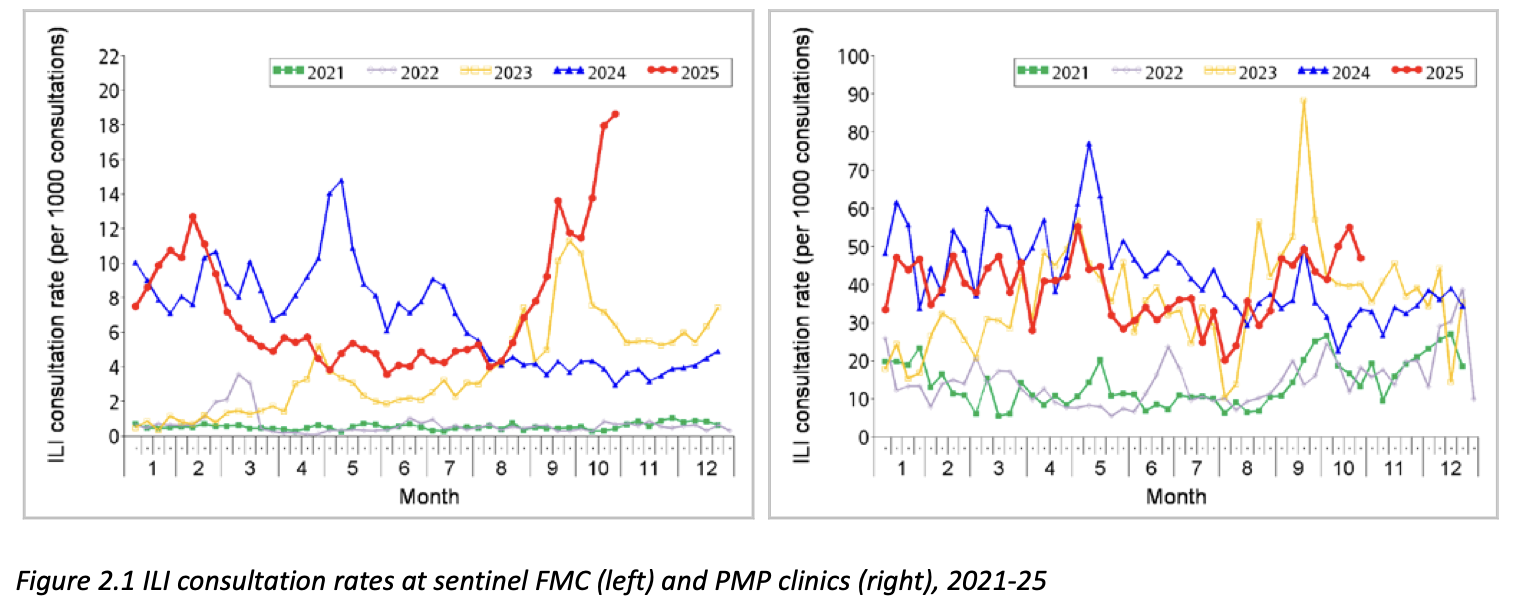
Influenza-like-illness surveillance among sentinel family medicine clinics and sentinel private medical practitioner clinics, 2021-25
In week 43, the average consultation rate for influenza-like illness (ILI) among sentinel family
medicine clinics (FMC) was 18.6 ILI cases per 1,000 consultations, which was higher than 17.9
recorded in the previous week (Figure 2.1, left). The average consultation rate for ILI among sentinel
private medical practitioner (PMP) clinics was 46.9 ILI cases per 1,000 consultations, which was lower
than 55.1 recorded in the previous week (Figure 2.1, right).
Laboratory surveillance, 2021-25
Among the 8,784 respiratory specimens received in week 43, 1,055 (12.01%) were tested positive for
seasonal influenza A or B viruses. Among the subtyped influenza detections, there were 113 (11%)
influenza A(H1), 903 (87%) influenza A(H3) and 26 (2%) influenza B viruses. The positive percentage
(12.01%) was above the baseline threshold of 4.94% but was higher than 11.84% recorded in the
previous week (Figure 2.2).
Figure 2.2 Percentage of respiratory specimens tested positive for influenza viruses, 2021-25 (upper: overall positive percentage, lower: positive percentage by subtypes)
[Chart]
[Notes: The Centre for Health Protection (CHP) of the Department of Health closely monitors the local seasonal influenza activity
through a series of surveillance systems. Among them, the CHP sets threshold levels for two important influenza indicators, including
the positive percentage of influenza detections among respiratory specimens and the admission rate of patients diagnosed with
influenza in public hospitals. These threshold levels are calculated statistically based on data collected for both indicators in the past
years during non-season periods. Using these thresholds, the CHP assesses the current local situation of seasonal influenza with higher
accuracy and determines whether Hong Kong enters influenza season. The CHP annually reviews and analyses the latest surveillance
data, and updates these threshold levels where appropriate. The sensitivity of the surveillance system is enhanced with the updated
thresholds of positive percentage of influenza detection and admission rate of higher coherence.]
Remarks: Some specimens may contain vaccine strains from people with recent history of receiving live-attenuated influenza vaccine
* Including 8,126 specimens received by Public Health Laboratory Services Branch, Centre for Health Protection and 658
specimens received by the Hospital Authority
Surveillance of oseltamivir (Tamiflu) resistant influenza A and B viruses
The Public Health Laboratory Services Branch of the Centre for Health Protection tests virus
isolates of influenza A(H3) and B viruses obtained from cell culture for antiviral susceptibility to
oseltamivir. For influenza A(H1) viruses, genotypic assay for H275Y substitution (which confers
resistance to oseltamivir) is also performed on selected clinical specimens.
In September 2025, there were no new reports of influenza A(H3) and B viruses with reduced
susceptibility to oseltamivir, nor any influenza A(H1) virus with H275Y substitution.
For the results of previous months, please refer to the following webpage:
https://www.chp.gov.hk/en/statistics/data/10/641/695/7088.html
The detection rates of oseltamivir-resistant influenza A and B viruses remain low (less than 5%)
according to latest surveillance data of overseas countries.
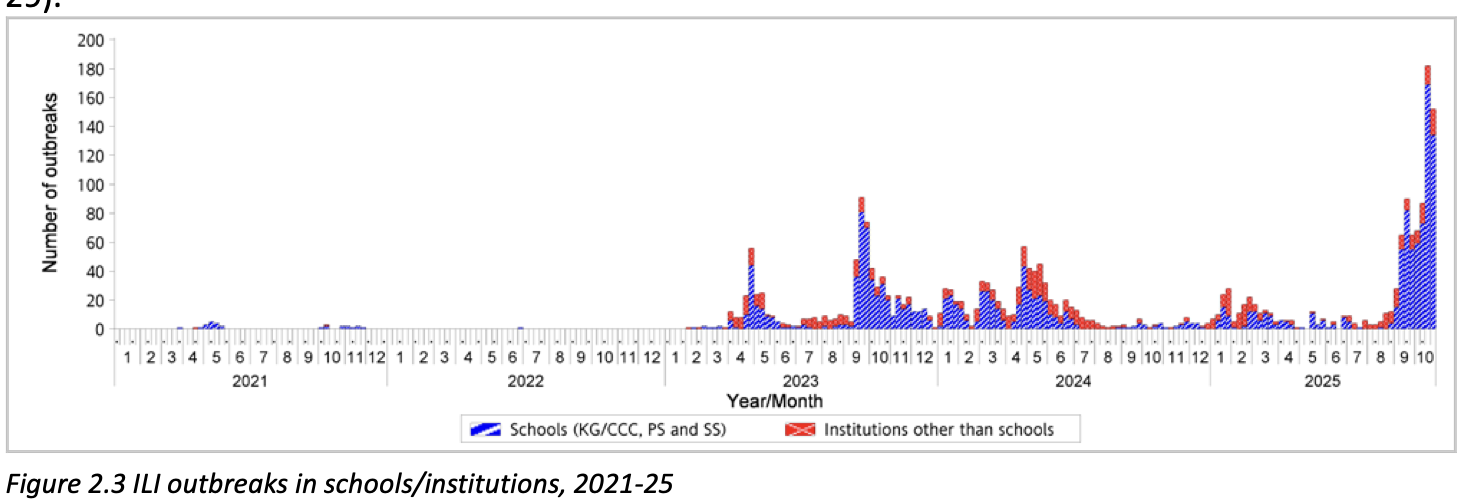
Influenza-like illness outbreak surveillance, 2021-25
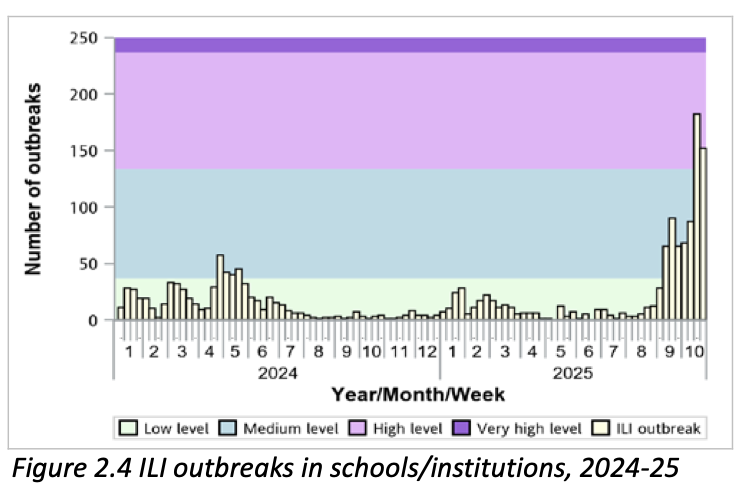
In week 43, 152 ILI outbreaks occurring in schools/institutions were recorded (affecting 1,403
persons), as compared to 182 outbreaks recorded in the previous week (affecting 2,153 persons)
(Figure 2.3). The overall number was at the high intensity level currently (Figure 2.4*). In the first 4
days of week 44 (Oct 26 to 29), 60 ILI outbreaks in schools/institutions were recorded (affecting 342
persons). Since the start of the influenza season in week 36, 797 outbreaks were recorded (as of Oct
29).
[chart]
In comparison, 653, 308, 152 and 134 outbreaks were recorded in the same duration of surveillance
(8 complete weeks) in the 2018/19 winter, 2023 summer, 2023/24 season and 2024/25 winter
seasons respectively, as compared with 737 outbreaks in the current season (Figure 2.5).
Continued: https://www.chp.gov.hk/files/pdf/covid_flux_week43_30_10_2025_eng.pdf
COVID-19 & Flu Express is a weekly report produced by Surveillance Division of the Communicable Disease Branch of the Centre for Health Protection. It monitors and summarises the latest local and global COVID-19 and influenza activities.
Reporting period: Oct 19, 2025 – Oct 25, 2025 (Week 43)
The latest surveillance data showed that the overall local activity of COVID-19 has remained at a low level. The Centre for Health Protection (CHP) has been closely monitoring the local prevalenceof SARS-CoV-2 variants. The latest sewage surveillance data and genetic analysis of
positive respiratory specimens showed that NB.1.8.1 has become the dominating variant
strains in Hong Kong. NB.1.8.1 is one of the descendant lineages of XDV, in turn a
descendent of JN.1. The World Health Organization (WHO) listed NB.1.8.1 as a variant
under monitoring (VUM) on May 23, 2025, and stated that NB.1.8.1 poses a low risk to
global public health based on the available evidence, and that the currently approved
COVID-19 vaccines are expected to be effective against NB.1.8.1, and there is no evidence
to suggest that NB.1.8.1 will cause more serious diseases.
Members of the public are advised to maintain strict personal and environmental hygieneat all times for personal protection against COVID-19 infection and prevention of the
spread of the disease in the community. High-risk people (e.g. persons with underlying
medical conditions or persons who are immunocompromised) should adopt additional
measures to protect themselves such as wearing mask properly when going to public
places. For other details, please visit the COVID-19 information page
(https://www.chp.gov.hk/en/healthtopics/content/24/102466.html).
Members of the public are advised to take note of the latest recommendations on the useof COVID-19 vaccines in Hong Kong to protect themselves from serious outcomes of
COVID-19. High-risk priority groups are recommended to receive a dose of COVID-19
vaccine at least six months since the last dose or infection, regardless of the number of
doses received previously. For more details, please visit
(https://www.chp.gov.hk/files/pdf/co...of_covid-19_vaccines_in_hong_kong_oct2025.pdf).
For the latest information on COVID-19 and prevention measures, please visit thethematic website of COVID-19 (https://www.coronavirus.gov.hk/eng/index.html).
-snip-
Local Situation of Influenza Activity (as of Oct 29, 2025)
Hong Kong is currently in the summer influenza season. The latest surveillance data showed that
local influenza activity remained high.
Influenza can cause serious illnesses in high-risk individuals and even healthy persons. Given that
seasonal influenza vaccines are safe and effective, all persons aged 6 months or above except
those with known contraindications are recommended to receive influenza vaccine to protect
themselves against seasonal influenza and its complications, as well as related hospitalisations
and deaths.
2025/26 Seasonal Influenza Vaccination (SIV) Programmes, including the SIV School Outreach
Programme, the Residential Care Home Vaccination Programme and the Vaccination Subsidy
Scheme, have been commenced on September 25, 2025. Eligible high-risk groups can receive a
free or subsidised SIV through various vaccination programmes. The public may visit the CHP's
Vaccination Schemes page for more details of the vaccination programmes
(https://www.chp.gov.hk/en/features/17980.html).
Apart from getting influenza vaccination, members of the public should always maintain good
personal and environmental hygiene.
For the latest information on seasonal influenza and its prevention, please visit the Centre for
Health Protection's Seasonal Influenza page (http://www.chp.gov.hk/en/view_content/14843.html).
Influenza-like-illness surveillance among sentinel family medicine clinics and sentinel private medical practitioner clinics, 2021-25
In week 43, the average consultation rate for influenza-like illness (ILI) among sentinel family
medicine clinics (FMC) was 18.6 ILI cases per 1,000 consultations, which was higher than 17.9
recorded in the previous week (Figure 2.1, left). The average consultation rate for ILI among sentinel
private medical practitioner (PMP) clinics was 46.9 ILI cases per 1,000 consultations, which was lower
than 55.1 recorded in the previous week (Figure 2.1, right).
Laboratory surveillance, 2021-25
Among the 8,784 respiratory specimens received in week 43, 1,055 (12.01%) were tested positive for
seasonal influenza A or B viruses. Among the subtyped influenza detections, there were 113 (11%)
influenza A(H1), 903 (87%) influenza A(H3) and 26 (2%) influenza B viruses. The positive percentage
(12.01%) was above the baseline threshold of 4.94% but was higher than 11.84% recorded in the
previous week (Figure 2.2).
Figure 2.2 Percentage of respiratory specimens tested positive for influenza viruses, 2021-25 (upper: overall positive percentage, lower: positive percentage by subtypes)
[Chart]
[Notes: The Centre for Health Protection (CHP) of the Department of Health closely monitors the local seasonal influenza activity
through a series of surveillance systems. Among them, the CHP sets threshold levels for two important influenza indicators, including
the positive percentage of influenza detections among respiratory specimens and the admission rate of patients diagnosed with
influenza in public hospitals. These threshold levels are calculated statistically based on data collected for both indicators in the past
years during non-season periods. Using these thresholds, the CHP assesses the current local situation of seasonal influenza with higher
accuracy and determines whether Hong Kong enters influenza season. The CHP annually reviews and analyses the latest surveillance
data, and updates these threshold levels where appropriate. The sensitivity of the surveillance system is enhanced with the updated
thresholds of positive percentage of influenza detection and admission rate of higher coherence.]
Remarks: Some specimens may contain vaccine strains from people with recent history of receiving live-attenuated influenza vaccine
* Including 8,126 specimens received by Public Health Laboratory Services Branch, Centre for Health Protection and 658
specimens received by the Hospital Authority
Surveillance of oseltamivir (Tamiflu) resistant influenza A and B viruses
The Public Health Laboratory Services Branch of the Centre for Health Protection tests virus
isolates of influenza A(H3) and B viruses obtained from cell culture for antiviral susceptibility to
oseltamivir. For influenza A(H1) viruses, genotypic assay for H275Y substitution (which confers
resistance to oseltamivir) is also performed on selected clinical specimens.
In September 2025, there were no new reports of influenza A(H3) and B viruses with reduced
susceptibility to oseltamivir, nor any influenza A(H1) virus with H275Y substitution.
For the results of previous months, please refer to the following webpage:
https://www.chp.gov.hk/en/statistics/data/10/641/695/7088.html
The detection rates of oseltamivir-resistant influenza A and B viruses remain low (less than 5%)
according to latest surveillance data of overseas countries.
Influenza-like illness outbreak surveillance, 2021-25
In week 43, 152 ILI outbreaks occurring in schools/institutions were recorded (affecting 1,403
persons), as compared to 182 outbreaks recorded in the previous week (affecting 2,153 persons)
(Figure 2.3). The overall number was at the high intensity level currently (Figure 2.4*). In the first 4
days of week 44 (Oct 26 to 29), 60 ILI outbreaks in schools/institutions were recorded (affecting 342
persons). Since the start of the influenza season in week 36, 797 outbreaks were recorded (as of Oct
29).
[chart]
In comparison, 653, 308, 152 and 134 outbreaks were recorded in the same duration of surveillance
(8 complete weeks) in the 2018/19 winter, 2023 summer, 2023/24 season and 2024/25 winter
seasons respectively, as compared with 737 outbreaks in the current season (Figure 2.5).
Continued: https://www.chp.gov.hk/files/pdf/covid_flux_week43_30_10_2025_eng.pdf