

Gert van der Hoek
In Memoriam - Editor, Senior Moderator
European Food Safety Authority,
European Centre for Disease Prevention and Control and
European Union Reference Laboratory for Avian Influenza
Abstract
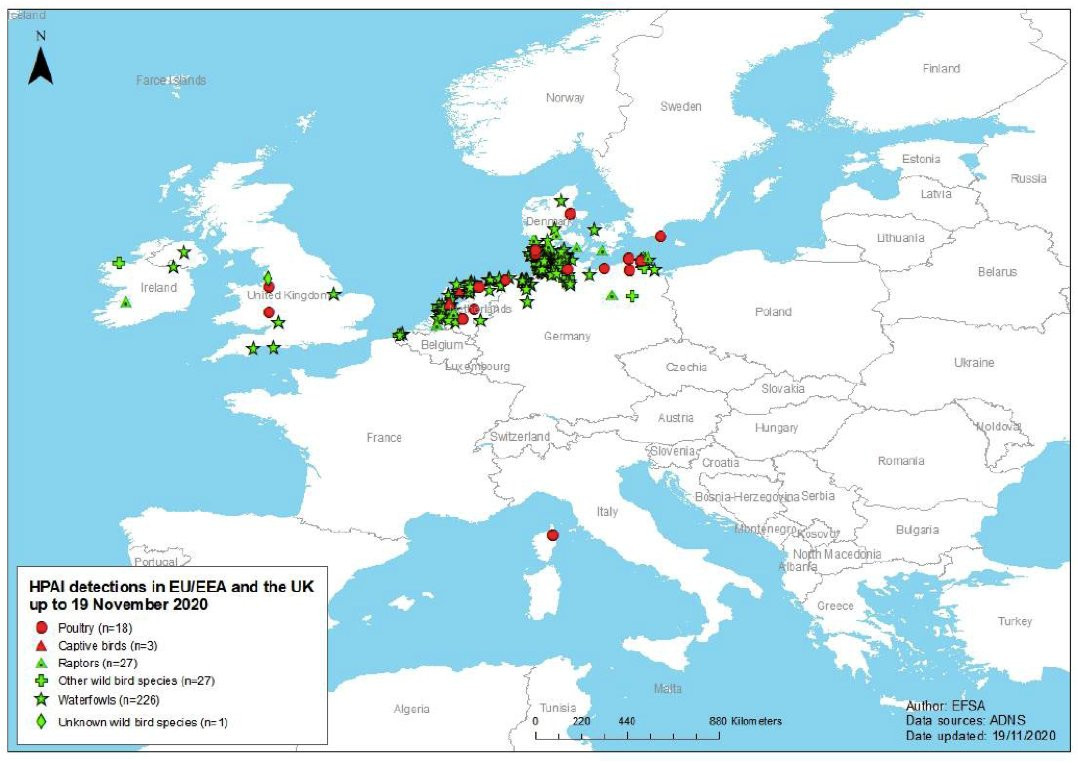
ince 16 October 2020, outbreaks of highly pathogenic avian influenza (HPAI) viruses have been reported in several EU/EEA countries – Belgium, Denmark, France, Germany, Ireland, the Netherlands, and Sweden as well as in the United Kingdom. As of 19 November, 12pm, 302 HPAI A(H5) detections have been reported, with the majority of the detections referring to wild birds (n=281), and a few related to outbreaks in poultry (n=18) and captive birds (n=3).
Most of the detections in wild birds were in wild waterbirds, being barnacle goose the most affected species (n=110), followed by greylag goose (n=47), Eurasian wigeon (n=32), mallard (n=14), and common buzzard (n=13). Three HPAI virus subtypes were identified, A(H5N8), A(H5N5) and A(H5N1), with A(H5N8) being the most reported subtype (n=284). Phylogenetic analysis indicated that the viruses evolved from a single progenitor virus that went through multiple reassortment events. Based on the ongoing autumn migration of wild waterbirds to their wintering areas in Europe, there is a continued risk of further introduction of HPAI A(H5) viruses into Europe.
Furthermore, given the expected movements of both migratory, and resident wild birds in Europe during winter, there is a high risk of further spread of HPAI A(H5) viruses within Europe. No genetic markers indicating adaptation to mammals have been identified in the viruses analysed so far, and no human infection due to avian influenza viruses detected in the recent outbreaks has been reported.
For that reason, the risk to the general population remains very low. However, following the precautionary principle, people should avoid touching sick or dead birds unprotected to minimise any potential risk.
European Centre for Disease Prevention and Control and
European Union Reference Laboratory for Avian Influenza
Abstract
ince 16 October 2020, outbreaks of highly pathogenic avian influenza (HPAI) viruses have been reported in several EU/EEA countries – Belgium, Denmark, France, Germany, Ireland, the Netherlands, and Sweden as well as in the United Kingdom. As of 19 November, 12pm, 302 HPAI A(H5) detections have been reported, with the majority of the detections referring to wild birds (n=281), and a few related to outbreaks in poultry (n=18) and captive birds (n=3).
Most of the detections in wild birds were in wild waterbirds, being barnacle goose the most affected species (n=110), followed by greylag goose (n=47), Eurasian wigeon (n=32), mallard (n=14), and common buzzard (n=13). Three HPAI virus subtypes were identified, A(H5N8), A(H5N5) and A(H5N1), with A(H5N8) being the most reported subtype (n=284). Phylogenetic analysis indicated that the viruses evolved from a single progenitor virus that went through multiple reassortment events. Based on the ongoing autumn migration of wild waterbirds to their wintering areas in Europe, there is a continued risk of further introduction of HPAI A(H5) viruses into Europe.
Furthermore, given the expected movements of both migratory, and resident wild birds in Europe during winter, there is a high risk of further spread of HPAI A(H5) viruses within Europe. No genetic markers indicating adaptation to mammals have been identified in the viruses analysed so far, and no human infection due to avian influenza viruses detected in the recent outbreaks has been reported.
For that reason, the risk to the general population remains very low. However, following the precautionary principle, people should avoid touching sick or dead birds unprotected to minimise any potential risk.