sharon sanders
Editor-in-Chief & President
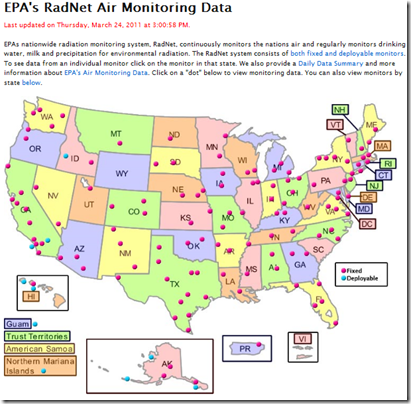
RadNet is a national network of monitoring stations that regularly collect air, precipitation, drinking water, and milk samples for analysis of radioactivity. The RadNet network, which has stations in each State, has been used to track environmental releases of radioactivity from nuclear weapons tests and nuclear accidents. Future uses of this network might include monitoring waste disposal and radioactive cleanup sites. RadNet also documents the status and trends of environmental radioactivity; these data are published by NAREL in a quarterly report entitled Environmental Radiation Data. Previously this was a paper only publication, but it is now being published online as well. <table valign="top" border="0" cellpadding="0" cellspacing="0"> <tbody><tr> <td align="left"> <table valign="top" align="left" border="0" cellpadding="0" cellspacing="0"> <tbody><tr> <td align="left">
 </td> </tr> <tr> <td align="left"> Air | Drinking Water | Milk | Precipitation </td> </tr> <tr> <td> </td> </tr> <tr> <td align="left"> </td> </tr> <tr> <td align="left">
 </td> </tr> <tr> <td> Select one of the areas below to learn about different RadNet sampling programs:
</td></tr> <tr> <td align="center"> <table align="left"> <tbody><tr> <td align="left"> Region 1 - Connecticut, Maine, Massachusetts, New Hampshire, Rhode Island, and Vermont
Region 2 - New Jersey, New York and the territories of Puerto Rico and the U.S. Virgin Islands
Region 3 - Delaware, Maryland, Pennsylvania, Virginia, West Virginia, and the District of Columbia
Region 4 - Alabama, Florida, Georgia, Kentucky, Mississippi, North Carolina, South Carolina, and Tennessee
Region 5 - Illinois, Indiana, Michigan, Minnesota, Ohio, and Wisconsin
Region 6 - Arkansas, Louisiana, New Mexico, Oklahoma, and Texas
Region 7 - Iowa, Kansas, Missouri, and Nebraska
Region 8 - Colorado, Montana, North Dakota, South Dakota, Utah, and Wyoming
Region 9 - Arizona, California, Hawaii, Nevada, and the territories of Guam and American Samoa
Region 10 - Alaska, Idaho, Oregon, and Washington</td> </tr> </tbody></table> </td> </tr> </tbody></table> </td> </tr> <tr> <td class="updateDate" align="center"> Last Updated on June 8, 2009 </td> </tr> </tbody></table> National Air & Radiation Environmental Laboratory
540 South Morris Avenue
Montgomery, AL 36115-2601
(334) 270-3400 Voice, (334) 270-3454 Fax
Please direct your Website questions or comments to contact_NAREL@epa.gov.
http://www.epa.gov/narel/radnet/
</td></tr> <tr> <td align="center"> <table align="left"> <tbody><tr> <td align="left"> Region 1 - Connecticut, Maine, Massachusetts, New Hampshire, Rhode Island, and Vermont
Region 2 - New Jersey, New York and the territories of Puerto Rico and the U.S. Virgin Islands
Region 3 - Delaware, Maryland, Pennsylvania, Virginia, West Virginia, and the District of Columbia
Region 4 - Alabama, Florida, Georgia, Kentucky, Mississippi, North Carolina, South Carolina, and Tennessee
Region 5 - Illinois, Indiana, Michigan, Minnesota, Ohio, and Wisconsin
Region 6 - Arkansas, Louisiana, New Mexico, Oklahoma, and Texas
Region 7 - Iowa, Kansas, Missouri, and Nebraska
Region 8 - Colorado, Montana, North Dakota, South Dakota, Utah, and Wyoming
Region 9 - Arizona, California, Hawaii, Nevada, and the territories of Guam and American Samoa
Region 10 - Alaska, Idaho, Oregon, and Washington</td> </tr> </tbody></table> </td> </tr> </tbody></table> </td> </tr> <tr> <td class="updateDate" align="center"> Last Updated on June 8, 2009 </td> </tr> </tbody></table> National Air & Radiation Environmental Laboratory
540 South Morris Avenue
Montgomery, AL 36115-2601
(334) 270-3400 Voice, (334) 270-3454 Fax
Please direct your Website questions or comments to contact_NAREL@epa.gov.
http://www.epa.gov/narel/radnet/