

Pathfinder
Editor, Senior Moderator
[h=1]Safer Food Saves Lives[/h] Stopping multistate foodborne outbreaks
Language: English
Recommend on FacebookTweet
[h=4]On this Page[/h]
[h=3]Overview[/h] Contaminated food sent to several states can make people sick with the same germ. These multistate outbreaks cause serious illness, and more of these outbreaks are being found. Multistate outbreaks caused 56% of deaths in all reported foodborne outbreaks, although they accounted for just 3% of all such outbreaks from 2010 to 2014. Foods that cause multistate outbreaks are contaminated before they reach a restaurant or home kitchen. Investigating these outbreaks often reveals problems on the farm, in processing or in distribution that resulted in contaminated food. Lessons learned from these outbreaks are helping make food safer. To protect the public?s health, government at all levels and food industries need to work together to stop outbreaks and keep them from happening in the first place.
[h=4]Food industries can:[/h]


Multistate outbreaks cause 56% of deaths in all reported foodborne outbreaks.
An average of 24 multistate outbreaks are reported a year, each involving from 2 to 37 states.
46% of multistate foodborne outbreaks result in product recalls.
[h=3]Problem[/h] [h=4]Multistate foodborne outbreaks are serious and hard to solve.[/h] [h=5]Multistate outbreaks can be hard to detect.[/h]

View large image and text description
[h=3]Infographics[/h]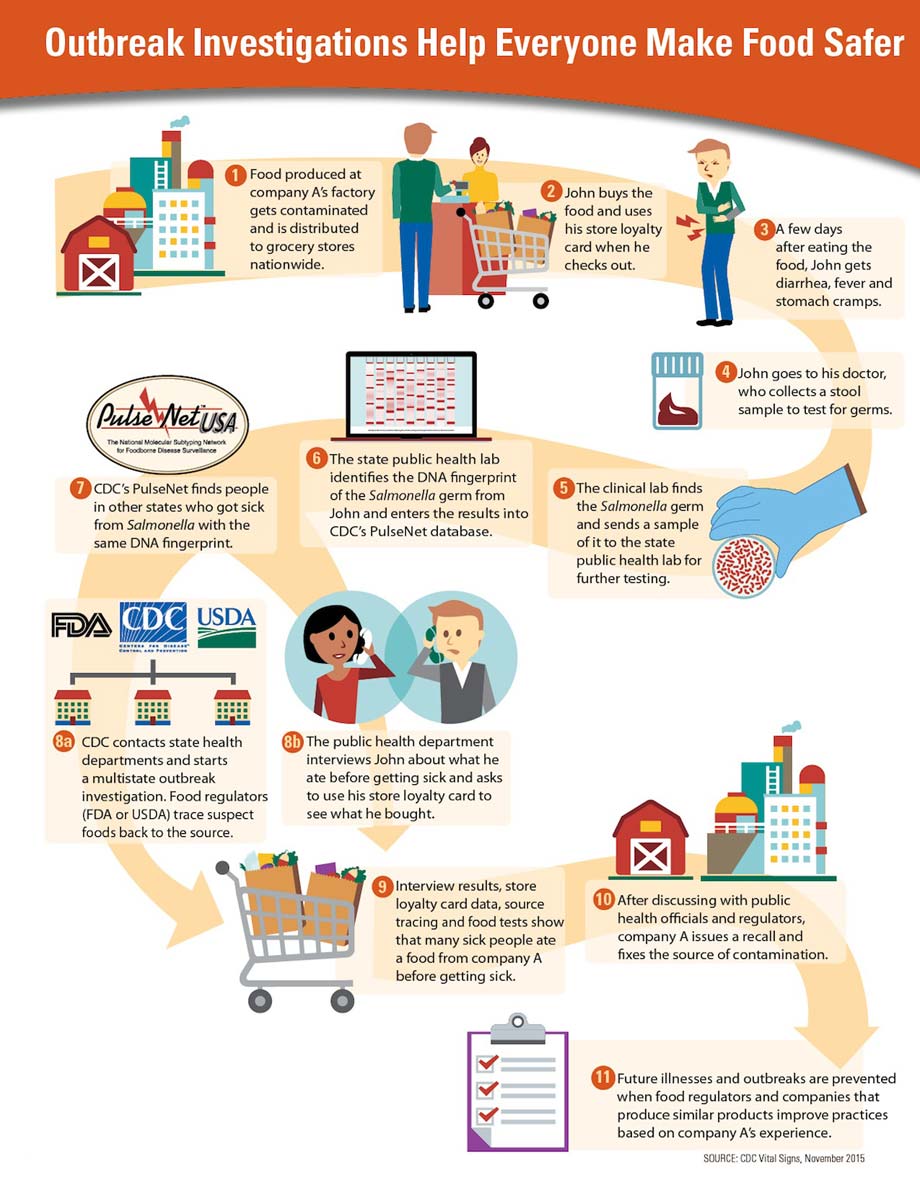
View larger image and text description
[h=3]What Can Be Done[/h] [h=4]The Federal government is[/h]
Language: English
Recommend on FacebookTweet
[h=4]On this Page[/h]
[h=3]Overview[/h] Contaminated food sent to several states can make people sick with the same germ. These multistate outbreaks cause serious illness, and more of these outbreaks are being found. Multistate outbreaks caused 56% of deaths in all reported foodborne outbreaks, although they accounted for just 3% of all such outbreaks from 2010 to 2014. Foods that cause multistate outbreaks are contaminated before they reach a restaurant or home kitchen. Investigating these outbreaks often reveals problems on the farm, in processing or in distribution that resulted in contaminated food. Lessons learned from these outbreaks are helping make food safer. To protect the public?s health, government at all levels and food industries need to work together to stop outbreaks and keep them from happening in the first place.
[h=4]Food industries can:[/h]
- Keep records to trace foods from source to destination.
- Use store loyalty card and distribution records to help investigators identify what made people sick.
- Recall products linked to an outbreak and notify customers.
- Choose only suppliers that use food safety best practices.
- Share proven food safety solutions with others in industry.
- Make food safety a core part of company culture.
- Meet or exceed new food safety laws and regulations.
Multistate outbreaks cause 56% of deaths in all reported foodborne outbreaks.
An average of 24 multistate outbreaks are reported a year, each involving from 2 to 37 states.
46% of multistate foodborne outbreaks result in product recalls.
[h=3]Problem[/h] [h=4]Multistate foodborne outbreaks are serious and hard to solve.[/h] [h=5]Multistate outbreaks can be hard to detect.[/h]
- Contaminated food grown or produced in a single place can wind up in kitchens across America.
- People in many states may get sick from a contaminated food, making it difficult to spot the outbreak.
- Detecting that an outbreak is happening requires specialized testing of germs in laboratories across the country.
- Investigators depend on sick people to remember what they ate several weeks earlier.
- If the problem is a contaminated ingredient, people may unknowingly eat it in many different foods.
- Unexpected foods have been linked to recent multistate outbreaks, such as caramel apples and chia powder.
- Companies may not have complete records of the source or destination of foods.
- Imported food can be even harder to trace to its source, and imports to the US are increasing.
- Many different farms may produce the beef in a single burger or the fresh vegetables sold in a single crate.
- New DNA sequencing technology is improving public health?s ability to link germs found in sick people and in contaminated foods.
- Information technology is helping investigators in many places work together.
- Efforts by food industries are helping trace contaminated foods to their source.
View large image and text description
[h=3]Infographics[/h]
View larger image and text description
[h=3]What Can Be Done[/h] [h=4]The Federal government is[/h]
- Implementing improved food safety laws and regulations.
- Working with state and local health departments to use better methods, including DNA sequencing, to find, investigate and quickly stop multistate foodborne outbreaks.
- Helping state and local health departments improve food safety inspections and guidelines.
- Encourage clinical laboratories to quickly submit germs from sick people to the public health laboratory for advanced testing.
- Test the germs from sick people quickly to find if others got sick from the same germ.
- Interview sick people promptly about what they ate, using standard questions.
- Test suspect foods, if available.
- Participate in national networks to share improved methods for investigating multistate outbreaks.
- Encourage industry actions that focus on preventing foodborne disease.
- Submit germs from sick people quickly to public health laboratories for advanced testing.
- Report suspected outbreaks rapidly to the local or state health department.
- Inform patients or caretakers of those in high-risk groups that they have an increased risk for food poisoning. These include pregnant women, adults over 65 years, children under 5, and people with weakened immune systems. Steps to prevent food poisoning can be found on:www.foodsafety.gov
- Keep records to trace foods from source to destination.
- Use store loyalty card and distribution records to help investigators identify what made people sick.
- Recall products linked to an outbreak and notify customers.
- Choose only suppliers that use food safety best practices.
- Share proven food safety solutions with others in industry.
- Make food safety a core part of company culture.
- Meet or exceed new food safety laws and regulations.
- Check for food recalls and information about how to handle and prepare food safely on: www.foodsafety.gov
- Take action if you think you have a foodborne sickness:
- Talk to your health care provider.
- Write down what you ate in the week before you started to get sick.
- Report your sickness to the health department if you think you are part of an outbreak.
- Assist public health investigators by answering questions about your sickness.
- Consider getting a loyalty card where you shop. If there is a recall, the store can use the card to notify you.