

Pathfinder
Editor, Senior Moderator
About Marburg Virus Disease
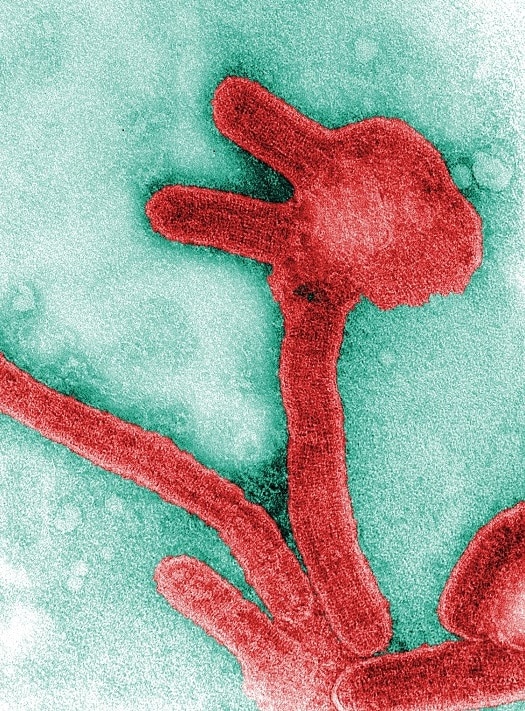
Marburg virus disease (MVD) is a rare but severe hemorrhagic fever that affects people and non-human primates. It is caused by an infection with Marburg virus or Ravn virus, both within genus Marburgvirus. Marburgviruses are zoonotic (or, animal-borne) RNA viruses within the virus family Filoviridae. Ebolaviruses, also filoviruses, are genetically distinct, but closely related to marburgviruses.
Marburg virus was first recognized in 1967, when simultaneous outbreaks of hemorrhagic fever occurred in laboratories in Marburg and Frankfurt, Germany and in Belgrade, Yugoslavia (now Serbia). Thirty-one people became ill, beginning with laboratory workers, followed by several medical personnel and family members who had cared for them. Seven deaths were reported. The first people infected were exposed to Ugandan imported African green monkeys or their tissues while conducting research. One additional case was diagnosed retrospectively.
The Egyptian rousette bat, Rousettus aegyptiacus, is a cave-dwelling bat that is found widely across Africa and the animal reservoir for marburgviruses. Bats infected with marburgviruses do not show obvious signs of illness. Given the bat’s broad geographic spread, more areas are potentially at risk for outbreaks of MVD than previously known. Primates (including people) can become infected with marburgviruses, and may develop serious disease with high mortality. Further study is needed to determine if other species are also susceptible to infection.
MVD appears in sporadic outbreaks throughout sub-Saharan Africa. Many past outbreaks have started with male mine workers in bat-infested mines. The virus then spreads within their families and communities and among healthcare staff. It is possible that isolated cases occur occasionally, as well, but go unrecognized.
Cases of MVD in people have occurred outside Africa but are infrequent. In addition to the 1967 laboratory exposures in Europe that led to the discovery of Marburg virus, a Dutch tourist developed MVD after returning to the Netherlands from Uganda in 2008, and later died. That same year, an American traveler developed MVD after returning to the U.S. from Uganda and recovered. Both travelers had visited a well-known cave inhabited by fruit bats in a national park. See the Marburg Virus Disease Outbreaks for a list of known cases and outbreaks.
.
Last Reviewed: April 19, 2023
Source: Centers for Disease Control and Prevention, National Center for Emerging and Zoonotic Infectious Diseases (NCEZID), Division of High-Consequence Pathogens and Pathology (DHCPP), Viral Special Pathogens Branch (VSPB)
https://www.cdc.gov/vhf/marburg/about.html
Marburg virus disease (MVD) is a rare but severe hemorrhagic fever that affects people and non-human primates. It is caused by an infection with Marburg virus or Ravn virus, both within genus Marburgvirus. Marburgviruses are zoonotic (or, animal-borne) RNA viruses within the virus family Filoviridae. Ebolaviruses, also filoviruses, are genetically distinct, but closely related to marburgviruses.
Marburg virus was first recognized in 1967, when simultaneous outbreaks of hemorrhagic fever occurred in laboratories in Marburg and Frankfurt, Germany and in Belgrade, Yugoslavia (now Serbia). Thirty-one people became ill, beginning with laboratory workers, followed by several medical personnel and family members who had cared for them. Seven deaths were reported. The first people infected were exposed to Ugandan imported African green monkeys or their tissues while conducting research. One additional case was diagnosed retrospectively.
The Egyptian rousette bat, Rousettus aegyptiacus, is a cave-dwelling bat that is found widely across Africa and the animal reservoir for marburgviruses. Bats infected with marburgviruses do not show obvious signs of illness. Given the bat’s broad geographic spread, more areas are potentially at risk for outbreaks of MVD than previously known. Primates (including people) can become infected with marburgviruses, and may develop serious disease with high mortality. Further study is needed to determine if other species are also susceptible to infection.
MVD appears in sporadic outbreaks throughout sub-Saharan Africa. Many past outbreaks have started with male mine workers in bat-infested mines. The virus then spreads within their families and communities and among healthcare staff. It is possible that isolated cases occur occasionally, as well, but go unrecognized.
Cases of MVD in people have occurred outside Africa but are infrequent. In addition to the 1967 laboratory exposures in Europe that led to the discovery of Marburg virus, a Dutch tourist developed MVD after returning to the Netherlands from Uganda in 2008, and later died. That same year, an American traveler developed MVD after returning to the U.S. from Uganda and recovered. Both travelers had visited a well-known cave inhabited by fruit bats in a national park. See the Marburg Virus Disease Outbreaks for a list of known cases and outbreaks.
.
Last Reviewed: April 19, 2023
Source: Centers for Disease Control and Prevention, National Center for Emerging and Zoonotic Infectious Diseases (NCEZID), Division of High-Consequence Pathogens and Pathology (DHCPP), Viral Special Pathogens Branch (VSPB)
https://www.cdc.gov/vhf/marburg/about.html