• FluTrackers.com Inc. does not provide medical advice. Information on this web site is collected from various internet resources, and the FluTrackers board of directors makes no warranty to the safety, efficacy, correctness or completeness of the information posted on this site by any author or poster. The information collated here is for instructional and/or discussion purposes only and is NOT intended to diagnose or treat any disease, illness, or other medical condition. Every individual reader or poster should seek advice from their personal physician/healthcare practitioner before considering or using any interventions that are discussed on this website. By continuing to access this website you agree to consult your personal physican before using any interventions posted on this website, and you agree to hold harmless FluTrackers.com Inc., the board of directors, the members, and all authors and posters for any effects from use of any medication, supplement, vitamin or other substance, device, intervention, etc. mentioned in posts on this website, or other internet venues referenced in posts on this website.
  • We are not asking for any donations. Do not donate to any entity who says they are raising funds for us.

Canada - Northwest Territories: anthrax outbreak confirmed in the Slave River Lowlands bison population

Pathfinder

Editor, Senior Moderator
Suspected Outbreak of Anthrax Underway in Slave River Lowlands Bison Population; Response Plan Activated

Public Service Announcement

Yellowknife — July 4, 2023

A suspected anthrax outbreak is underway in the Slave River Lowlands bison population.

15 bison carcasses were found in the Slave River Lowlands between Fort Smith and Fort Resolution over the weekend of June 30 – July 3, 2023.

Test results are currently pending. However, this is being treated as an active outbreak because of preliminary evidence observed and collected in the field.

Accordingly, the Anthrax Emergency Response Plan has been activated.

Background on the response plan

When anthrax is suspected or detected, an Incident Management Team is mobilized to manage it.

Primary objectives include rapid detection and disposal of dead, infected bison and keeping people away from the area.

This minimizes the release of anthrax spores into the soil, protects bison populations, and protects public health and safety.

The following actions will be taken:

Aerial and ground surveillance for bison carcasses
Rapid response to carcass sites to sample affected animals
Incineration or chemical treatment of bison and surrounding grass areas to prevent the spread of spores
Management of wildfire risks due to burning required during response
Public information will be provided to mitigate risks for people
Updates, reporting, precautions, and what to expect

Updates will be provided Mondays and Fridays until further notice.

Get the latest updates, information about how to report sick or dead bison, precautions you should take, how we respond to anthrax outbreaks, and what you can expect during response on our page tracking the outbreak.

...

https://www.gov.nt.ca/en/newsroom/s...river-lowlands-bison-population-response-plan
 
bison_anthrax.jpg

Service_Banner_Top_Slice_GNWT.png


Get the Latest on Anthrax Outbreaks in Bison
Current status

Updated July 10, 7:00pm


An Anthrax outbreak in the Slave River Lowlands Bison Population has been confirmed via laboratory testing. All bison carcasses will be treated as confirmed Anthrax cases now that the disease has been confirmed in the Slave River Lowlands population.

To-date, carcasses have not been found in public access areas.

Updates will be provided on Mondays and Fridays until further notice. Additional updates may be issued as-needed.

Outbreak statistics [TABLE="align: left, border: 0, cellpadding: 0, cellspacing: 0"]
[TR]
[TD="colspan: 2"]Confirmed cases[/TD]
[TD]Carcasses treated[/TD]
[/TR]
[TR]
[TD]28[/TD]
[TD="colspan: 2"]0[/TD]
[/TR]
[/TABLE]


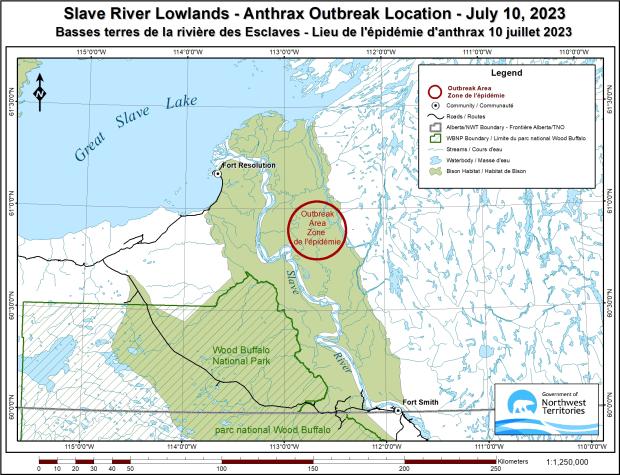
Map of affected area

south_slave_bison_anthrax_outbreak_location_july10_2023.jpg

Key activities
  • Identified one new carcass within the same known outbreak area during surveillance
  • Prepared two sites for treatment of carcasses and surrounding land.
  • Mobilizing and onboarding disposal crews to be ready to safely treat carcasses and land.
  • Mobilizing and onboarding disposal crews to be ready to safely dispose of carcasses.
  • Close coordination and information-sharing with communities and across government to build situational awareness and assess potential impacts due to response.
Management actions which could affect you


None at this time.

Health precautions


Though extremely rare, anthrax can be transmitted to humans through direct contact with infected animals, carcasses, or animal parts (e.g. meat, hide, hair). The illness does not seem to spread from person to person. Take these precautions to stay safe:
  • Do not approach, hunt, or eat Bison in the Slave River Lowlands (see map above) until otherwise indicated by ECC
  • If you see a dead bison, do not go near it, do not touch it, and do not allow domestic animals to do so either. Report dead bison observations immediately to 1-867-872-6438
  • Do not turn up soil nearby where bison were
  • Anyone who has been exposed to anthrax spores but is not yet sick should be treated with antibiotics and a few doses of the vaccine to prevent infection. If for any reason you believe you may have interacted with a sick bison or soil surrounding them,, call your local health centre immediately.
  • If you’re on-the-land in the area, stay aware of your surroundings, follow any signage or instructions, and stay out of areas which are closed due to anthrax response.
Report sick or dead bison (or other large mammals):
  • Call the Bison Control number at 1-867-872-6438 to report any dead bison you find to Environment and Climate Change immediately. Do not approach carcasses.
  • Call 1-867-872-6438 as soon as you can if you observe bison who appear sick. For example:
    • Having difficulty walking
    • With foamy or bloody looking discharge coming from their nostrils or anus
    • With significant swelling or distension of abdomen
What you can expect during response
  • Area or highway closures – stay up-to-date by using the NWT Highway Conditions Map, following social media, and staying up to date with local news.
  • Individuals in hazardous materials suits
  • Smoke or fire if a carcass site is near your community or along your travel route.
Background


Anthrax outbreaks can occur in bison populations (Mackenzie, Slave River Lowlands, and Nahanni herds) during the summer months.

Anthrax is a bacterial disease caused by inhaling or ingesting anthrax spores, which can be found in soil which has been contaminated by the spores. Bison can inhale the spores when wallowing in dust baths or ingest them while grazing and become infected.

The disease is fatal for bison. Though rare, it can also occur in other mammals, including humans.

While there have been no recent cases of human exposure or illness documented in the NWT, anthrax can cause an infection should a person come into direct contact with infected bison or bison parts. It is important to take appropriate precautions to prevent exposure.

Signs and Symptoms of Anthrax in Bison


Bison with anthrax may exhibit any of the following signs:
  • Found dead – often animals appear bloated and may be lying on their side in a sawhorse stance
  • White or bloody foam discharge from nostrils
  • Appearing depressed or unresponsive to stimuli
  • Stopping eating, or overfeeding and stop ruminating
  • Appearing lame or having a stiff-legged gait.
  • Swelling below the skin
  • Refusing to get up when people, aircraft, or vehicles approach
Signs and Symptoms of Anthrax in Humans


Anthrax occurrence in humans is extremely rare. You can only get anthrax by inhaling the spores, eating contaminated meat, or having the spores come in contact with your skin, particularly an open wound or mucosa. People with anthrax are not capable of infecting others.

Anyone who has been exposed to anthrax spores but is not yet sick should be treated with antibiotics and a few doses of the vaccine to prevent infection; please contact your local health centre

Signs and symptoms of anthrax can include the following;
  • Cutaneous (skin) anthrax which begins as a raised bump on the skin that becomes a blister, and then a painless ulcer with a black area in the center. Lymph nodes near the wound may become swollen. Skin anthrax is easily treated with antibiotics.
  • Intestinal anthrax is very rare. It begins with nausea, loss of appetite, vomiting, and fever. Those symptoms are followed by abdominal pain, vomiting of blood, and severe diarrhea. Early antibiotic treatment is important if you have intestinal anthrax.
  • Inhalation anthrax begins with flu-like symptoms (cough, fever, muscle aches). These symptoms may last two to three days, and then appear to go away for one or two days. Then the illness can come back, resulting in severe lung problems, difficulty breathing, and shock. Unless it’s treated, inhalation anthrax can be very dangerous – it’s fatal in up to 90 percent of cases.
Response plan


When Anthrax is suspected or detected in Bison, an Incident Management Team is mobilized to respond.

Rapid detection and disposal of dead infected bison and keeping people away from affected bison are the objectives.

This minimizes the release of anthrax spores into the soil, protects bison populations, and protects public health and safety.

The following actions will be taken:
  • Aerial and ground surveillance for bison carcasses
  • Rapid response to carcass sites to sample affected animals
  • Incineration or chemical treatment of bison and surrounding grass areas to prevent the spread of spores
  • Management of wildfire risks due to burning required during response
  • Public information will be provided to mitigate risks for people
https://www.gov.nt.ca/ecc/en/services/get-latest-anthrax-outbreaks-bison
 
Back
Top Bottom