• FluTrackers.com Inc. does not provide medical advice. Information on this web site is collected from various internet resources, and the FluTrackers board of directors makes no warranty to the safety, efficacy, correctness or completeness of the information posted on this site by any author or poster. The information collated here is for instructional and/or discussion purposes only and is NOT intended to diagnose or treat any disease, illness, or other medical condition. Every individual reader or poster should seek advice from their personal physician/healthcare practitioner before considering or using any interventions that are discussed on this website. By continuing to access this website you agree to consult your personal physican before using any interventions posted on this website, and you agree to hold harmless FluTrackers.com Inc., the board of directors, the members, and all authors and posters for any effects from use of any medication, supplement, vitamin or other substance, device, intervention, etc. mentioned in posts on this website, or other internet venues referenced in posts on this website.
  • We are not asking for any donations. Do not donate to any entity who says they are raising funds for us.

Brazil records outbreaks of avian flu in mammals; disease affected sea lions in RS

tetano

Editor, Senior Moderator
The Ministry of Agriculture and Livestock identified the first outbreak of avian influenza in southern sea lions on Cassino beach, in Rio Grande do Sul. The information was released this Wednesday (4).

This is the first record of the disease in marine mammals in Brazil. Cases in animals of the species have also been reported in Peru, Chile, Argentina and Uruguay.​

The investigation and sample collection were conducted in conjunction with the Rio Grande Marine Animal Recovery Center.

The samples were processed by the Federal Agricultural Defense Laboratory in Campinas (LFDA-SP), a reference in South America for the diagnosis of the virus, which confirmed that it was H5N1, a highly pathogenic avian influenza virus already detected in several species of wild birds in the country.

Although human infections with avian influenza viruses are rare, the Ministry asks the population to avoid approaching the place where outbreaks were recorded and not to touch sick or dead animals to prevent contagion and spread of the disease.

There are no changes in Brazil's status as free from avian influenza before the World Organization for Animal Health (WHO), as there is no record of the disease in commercial production.​

https://g1.globo.com/economia/agron...e-gripe-aviaria-em-leoes-marinhos-no-rs.ghtml
 
Translation Google

AVIAN INFLUENZA


Map confirms case of avian influenza in sea lions in RS

It is the first outbreak of the disease in marine mammals in Brazil. The country remains disease-free because no commercial production was affected

Published on 10/04/2023 1:06 pm Updated on 10/04/2023 2:01 pm
b05aebb3-acc3-4b39-a701-50eff49161d0.png


Map confirms case of avian influenza in sea lions in RS


The Ministry of Agriculture and Livestock (Mapa) confirms this Wednesday (4) the detection of the highly pathogenic avian influenza virus (IAAP) in a Patagonian sea lion (Otaria flavescens), also called sea lion -do-sul, found on Cassino beach, in the municipality of Rio Grande, on the coast of Rio Grande do Sul.

This is the first outbreak of the disease recorded in marine mammals in Brazil. Cases in mammals have also been reported in this same species in Peru, Chile, Argentina and Uruguay.

The investigation and sample collection were conducted in conjunction with the Rio Grande Marine Animal Recovery Center. The samples were processed by the Federal Agricultural Defense Laboratory in Campinas (LFDA-SP), a reference in South America for the diagnosis of the virus, which confirmed that it was H5N1, a highly pathogenic avian influenza virus already detected in several species of wild birds in the country.

Although human infections with avian influenza viruses are rare, Mapa asks the population to avoid approaching the place where outbreaks were recorded and not to touch sick or dead animals to prevent contagion and spread of the disease.

>>> The Map reinforces to the entire population that there is no risk in consuming poultry meat or inspected eggs, that is, they have the inspection seals: SIF, SIE, SIM or SISBI.

There are no changes in Brazil's avian influenza-free status before the World Organization for Animal Health (WHO), as there is no record of the disease in commercial production.

Press Information
Patrícia Távora
press@agro.gov.br


https://www.gov.br/agricultura/pt-b...-de-influenza-aviaria-em-leoes-marinhos-no-rs

 
Brazil - Influenza A viruses of high pathogenicity (Inf. with) (non-poultry including wild birds) (2017-) - Immediate notification


GENERAL INFORMATION

COUNTRY/TERRITORY OR ZONE
COUNTRY/TERRITORY

ANIMAL TYPE
TERRESTRIAL

DISEASE CATEGORY
Listed disease

EVENT ID
5259

DISEASE
Influenza A viruses of high pathogenicity (Inf. with) (non-poultry including wild birds) (2017-)

CAUSAL AGENT
Highly pathogenic avian influenza virus

GENOTYPE / SEROTYPE / SUBTYPE
H5N1

START DATE
2023/10/01

REASON FOR NOTIFICATION
Unusual host species

DATE OF LAST OCCURRENCE - CONFIRMATION DATE
2023/10/03

EVENT STATUS
On-going

END DATE - SELF-DECLARATION
NO REPORT INFORMATION

REPORT NUMBER
Immediate notification

REPORT ID
IN_163115

REPORT REFERENCE - REPORT DATE
2023/10/05

REPORT STATUS
Validated

NO EVOLUTION REPORT


EPIDEMIOLOGY

SOURCE OF EVENT OR ORIGIN OF INFECTION
  • Unknown or inconclusive
EPIDEMIOLOGICAL COMMENTS
No epidemiological comment

QUANTITATIVE DATA SUMMARY

MEASURING UNIT
Animal

SpeciesSusceptibleCasesDeathsKilled and Disposed ofSlaughtered/ Killed for commercial useVaccinated South-American sea lion (WILD)NEW-84200TOTAL-84200

DIAGNOSTIC DETAILS

CLINICAL SIGNS
YES

METHOD OF DIAGNOSTIC
Clinical, Diagnostic test
Real-time polymerase chain reaction (real-time PCR)Laboratório Federal de Defesa Agropecuária em Sao Paulo (LFDA)South-American sea lion12023/10/032023/10/03Positive

https://wahis.woah.org/#/in-review/5259
 
Source: https://g1.globo.com/economia/agron...-de-gripe-aviaria-em-mamiferos-marinhos.ghtml

Brazil records 2nd outbreak of bird flu in marine mammals
Records of influenza affected the Patagonian sea lion and South American fur seal species on the southern coast of Rio Grande do Sul.
By g1
10/07/2023 2:38 pm Updated 4 hours ago

Brazil identified the second outbreak of avian influenza in marine mammals. The case was recorded on Hermenegildo beach, in the municipality of Santa Vitória do Palmar, on the south coast of Rio Grande do Sul, and affected the Patagonian sea lion and South American sea lion species, according to data available this Saturday (7) at information system of the Ministry of Agriculture and Livestock.

According to the Secretariat of Agriculture, Livestock, Sustainable Production and Irrigation (Seapi) in Rio Grande do Sul, the positive diagnosis in the animals was received on Friday night (6).

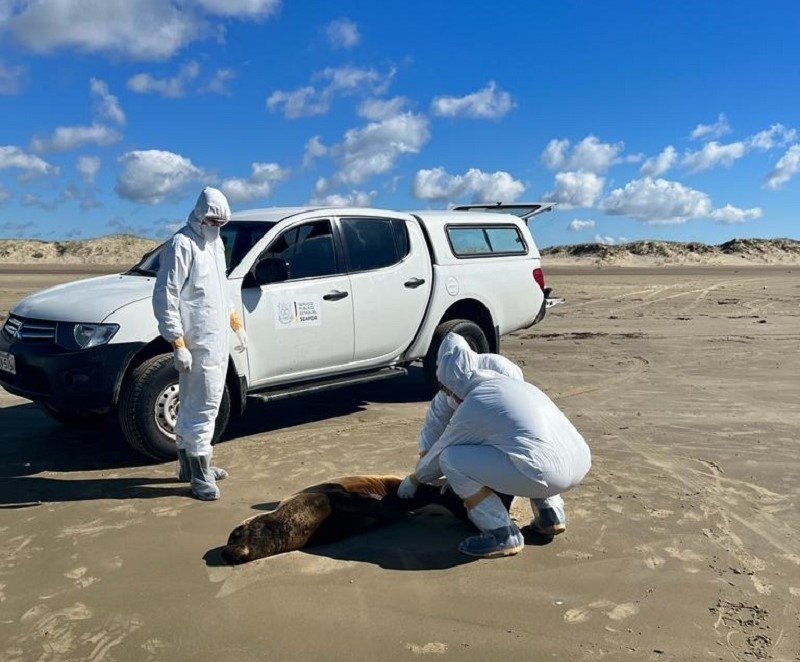
Notification of the animals' appearance was registered on Wednesday (4) and the assistance was carried out by agricultural inspectors, in partnership with specialists from the Marine Animal Recovery Center (Cram) in Rio Grande.

The samples were processed by the Federal Agricultural Defense Laboratory in Campinas (LFDA-SP), a reference in South America for the diagnosis of the virus, which confirmed that it was H5N1, a highly pathogenic avian influenza virus already detected in several species of wild birds in the country.

The first record of the disease involving marine mammals in the country also occurred on Wednesday. The focus on southern sea lions was on Cassino beach, in Rio Grande (RS). Cases in animals of the species have also been reported in Peru, Chile, Argentina and Uruguay.


These notifications do not change the state and country's health status as free from avian influenza before the World Organization for Animal Health (WHO), as there is no record of the disease in commercial production.

Although human infections with avian influenza viruses are rare, the Ministry asks the population to avoid approaching the place where outbreaks were recorded and not to touch sick or dead animals to prevent contagion and spread of the disease.

Cases in Brazil

To date, Brazil has a total of 120 outbreaks of bird flu, only three of which are in subsistence birds, that is, those used for domestic consumption.

For now, the country has not confirmed cases of the disease on farms engaged in large-scale trade. Therefore, the Government states that there is no risk to the consumption of meat and eggs. Furthermore, there has never been transmission to humans in Brazil.​
 
image.png - Click image for larger version  Name:	image.png Views:	2 Size:	49.8 KB ID:	980426

Torres, Rio Grande do Sul
/https://en.wikipedia.org/wiki/Torres,_Rio_Grande_do_Sul

-----------------------------------------------


Translation Google'

Sea lion found in Torres tests positive for influenza virus

This is the third focus on an aquatic mammal and from now on there will be no more collections of the same species

Publication: 10/11/2023 at 7:18 pm


Card on a gray background, with Agriculture written in the center, just below an icon representing a plantation with a tractor on it on the right side and an icon of a flowering plant on the left side.  In the bottom right corner is the logo used by the 2023-2026 administration of the Rio Grande do Sul government.


The Secretariat of Agriculture, Livestock, Sustainable Production and Irrigation (Seapi) was informed, this Wednesday (11/10), about the positive result of the test for the Highly Pathogenic Avian Influenza virus (H5N1) carried out on the sea lion found at Praia Real, in Torres. Confirmation given by the Federal Agricultural Defense Laboratory of Campinas (LFDA-SP), a reference unit of the World Organization for Animal Health (WHO).

This is considered the third outbreak of aquatic mammals in the State. To date, 146 dead or sick animals have been found in São José do Norte, Rio Grande, Santa Vitória do Palmar, Palmares do Sul, Pinhal, Torres, Tavares, Mostardas, Imbé and Pelotas.

From now on, as per guidance from the Ministry of Agriculture and Livestock (Mapa), there will be no more sampling of lions and sea lions, only if a new species of animal shows symptoms of Influenza. Even with confirmation, the health condition of the State and the country does not change, and there is no risk to food consumption.

The deputy director of the Department of Animal Health Surveillance and Defense (DDA), Francisco Lopes, reinforces that the Official Veterinary Service (SVO-RS) is responding to all notifications that are received, providing the necessary personal protective equipment (PPE) to city ​​halls, as well as products for disinfecting vehicles and machines.

Lopes warns people, especially those who live on the coast or who will visit during the holiday. “It is essential that people do not approach, feed or touch animals found on the beach. Furthermore, it is advisable to avoid taking domestic animals or not letting them get close to suspected mammals or birds, in order to avoid contagion by the virus”, he reinforces.

All suspicions, which include respiratory, neurological signs or high and sudden mortality, must be reported immediately to Seapi through the nearest
Agricultural Defense Inspectorate or via Whatsapp number: (51) 98445-2033.

Text: Ascom Seapi
Edition: Secom


https://www.estado.rs.gov.br/leao-m...em-resultado-positivo-para-virus-da-influenza
 
Translation Google

RS has 375 animals killed in regions with a focus on bird flu this year

In total, 375 marine mammals were found dead or sick along the coast of Rio Grande do Sul

G1
Agrimidia
10/20/2023 09:14

After the confirmation of four outbreaks of bird flu in the state of Rio Grande do Sul, monitoring of beaches mobilized city hall teams. In total, 375 marine mammals were found dead or sick along the coast of Rio Grande do Sul.

In Santa Vitória do Palmar, on the South Coast, specifically at Praia do Hermenegildo, 21 marine animals were found dead in a single day, totaling more than 140 over the course of a week. Furthermore, outbreaks of the disease were confirmed in aquatic mammals in the cities of Rio Grande and Torres, and in a wild bird in São José do Norte. It is important to highlight that bird flu has not been recorded in humans, however, health authorities warn about the importance of avoiding contact with animals at risk.

The dead animals are being buried on the beaches, in ditches about 2 meters deep, an action carried out hastily to avoid contaminating other animals, such as birds and dogs. The Department of Animal Health Surveillance and Defense (DDA) appeals to residents and visitors to beaches to avoid approaching or feeding animals found on the coast.


https://www.agrimidia.com.br/sanida...-regioes-com-foco-da-gripe-aviaria-neste-ano/
 
Source: https://www.pagina12.com.ar/600530-gripe-aviar-al-menos-164-mamiferos-marinos-muertos-en-playas

In Santa Vitória do Palmar
Bird flu: at least 164 marine mammals dead on beaches in southern Brazil
They were found 45 kilometers off the coast of the state of Río Grande do Sul, on the border with Uruguay, where the death of about 400 sea lions and sea lions was reported, also due to avian flu.
October 21, 2023 - 07:37

At least 164 sea lions and sea lions were found dead on the beaches of a municipality in southern Brazil due to avian influenza that affects these animals, local authorities reported this Saturday.

From the mayor's office of Santa Vitória do Palmar, in the state of Rio Grande do Sul, it was indicated that the dead animals were found in recent days, along 45 kilometers of the coast, and are being buried to avoid new infections.

The place is located near the border with Uruguay, where the death of about 400 wolves and sea lions was reported, also attributed to bird flu.

At the beginning of October, the Brazilian Ministry of Agriculture and Livestock had reported the first outbreak of the disease in marine mammals in the country, in Cassino, another beach in Rio Grande do Sul.

Even so, Brazil continues with the status of a country "free of the disease" because "no commercial production was affected" so far, as confirmed by the government.

Concern about the number of animals affected

In Argentina, the infection of more than a hundred sea lions with avian flu from contact with infected migratory birds generated alerts among authorities and specialists. These are the first cases recorded in Argentina in which avian flu is transferred from birds to mammals, in particular to fur seals (Otaria flavescens).

Since mid-August, more than a hundred specimens were found dead in Tierra del Fuego, Santa Cruz, Chubut (Península Valdés), Río Negro and in the Buenos Aires towns of Mar del Plata, Necochea, Monte Hermoso, Villa Gesell, Coronel Rosales and more cases are being investigated in Villarino.

"We are facing a very aggressive strain, the animals quickly infect each other and immediately begin to show the first symptoms, which are mostly tremors that can lead to convulsions," said the president of the Argentine Fauna Foundation, Juan Lorenzani.
When did the infections begin?

In Peru, Chile and Argentina, deaths were recorded in their marine fauna due to the virus, which causes serious muscular, neurological and respiratory problems. It is transmitted orally and respiratoryly and spread through secretions and excretions.

Although contagion in humans is unusual, authorities recommend that people do not approach dead or sick animals, and that they keep their pets away from the sources.

The presence of avian flu in sea lions began last February in Peru and Chile, where they had to issue "a health alert" due to the large number of infected animals.

In this species of mammals, which "lacks sufficient defenses for this type of disease", the virus generates serious muscular, neurological and respiratory effects, which are seen in "the convulsive and disoriented movements that are recorded in infected specimens", Lorenzani detailed.

Virus A in its H5N1 variant present in sea lions is a highly pathogenic subtype of avian influenza, which recorded its first records in South America in wild birds at the end of 2022 in Peru.

In Argentina, the first cases in birds were in February 2023 in the Lagunas de Pozuelos natural area, in the province of Jujuy.

"Due to its great versatility and adaptive capacity, influenza developed many subtypes. The H5N1 variant was detected in birds in 1996 for the first time and had the peculiarity of being sustained over time and beginning to incorporate genetic changes and spread around the world from of large waves," said Ariel Vagnozzi, a veterinarian specializing in avian viruses.​
 
Brazil - Influenza A viruses of high pathogenicity (Inf. with) (non-poultry including wild birds) (2017-) - Follow up report 2


GENERAL INFORMATION

COUNTRY/TERRITORY OR ZONE
COUNTRY/TERRITORY

ANIMAL TYPE
TERRESTRIAL

DISEASE CATEGORY
Listed disease

EVENT ID
5259

DISEASE
Influenza A viruses of high pathogenicity (Inf. with) (non-poultry including wild birds) (2017-)

CAUSAL AGENT
Highly pathogenic avian influenza virus

GENOTYPE / SEROTYPE / SUBTYPE
H5N1

START DATE
2023/10/01

REASON FOR NOTIFICATION
Unusual host species

DATE OF LAST OCCURRENCE - CONFIRMATION DATE
2023/10/03

EVENT STATUS
On-going

END DATE - SELF-DECLARATION

NO REPORT INFORMATION

REPORT NUMBER
Follow-up report 2

REPORT ID
FUR_163467

REPORT REFERENCE - REPORT DATE
2023/10/20

REPORT STATUS
Validated

NO EVOLUTION REPORT


EPIDEMIOLOGY SOURCE OF EVENT OR ORIGIN OF INFECTION
  • Unknown or inconclusive
EPIDEMIOLOGICAL COMMENTS


No epidemiological comment

QUANTITATIVE DATA SUMMARY

MEASURING UNIT
Animal

SpeciesSusceptibleCasesDeathsKilled and Disposed ofSlaughtered/ Killed for commercial useVaccinated South American fur seal (WILD)NEW------TOTAL-2523100 South-American sea lion (WILD)NEW-10100TOTAL-3931500 All speciesNEW-10100TOTAL-6454600

DIAGNOSTIC DETAILS

CLINICAL SIGNS
YES

METHOD OF DIAGNOSTIC
Clinical, Diagnostic test
Real-time polymerase chain reaction (real-time PCR)Laboratório Federal de Defesa Agropecuária em Sao Paulo (LFDA)South-American sea lion,South American fur seal42023/10/032023/10/18Positive
Gene sequencingLaboratório Federal de Defesa Agropecuária em Sao Paulo (LFDA)South-American sea lion12023/10/052023/10/05Positive

https://wahis.woah.org/#/in-review/5259
 
Source: https://phys.org/news/2023-10-bird-flu-marine-mammals-brazil.html

October 25, 2023
Bird flu kills more than 500 marine mammals in Brazil

At least 522 seals and sea lions have been found dead along the coast of southern Brazil, authorities said Wednesday, blaming the die-off on avian flu.

Brazil declared an animal health emergency over avian flu in May after confirming multiple cases in wild birds, and reported its first outbreak of the disease among marine mammals last month in the state of Rio Grande do Sul.

The country, the world's biggest chicken exporter, has not reported any cases in domesticated birds or commercial poultry operations.

The Rio Grande do Sul agriculture department said the dead seals and sea lions had been found at various points along its coast.

Several of the animals were found near Brazil's border with Uruguay, which also recently reported hundreds of seals and sea lions killed by avian flu...
 
Translation Google
Bird flu requires care for those on the coast

Attention must be doubled during the holidays, when thousands of people head to the beaches of RS

Publication: 10/31/2023 at 12:28 pm

bird flu state surveillance oout23
Open outbreaks of influenza include aquatic mammals in the municipalities of Rio Grande, Santa Vitória do Palmar and Torres - Photo: Divulgação Seapi

Rio Grande do Sul recorded outbreaks of bird flu and a large mortality of aquatic mammals in the last month. At the moment, the virus is circulating in the State, and some wild animals, such as birds, lions and sea lions, may appear sick or dead on Rio Grande do Sul's beaches.

Avian influenza mainly affects birds, but, in addition to aquatic mammals, it can occasionally affect dogs, cats and humans who have direct contact with infected animals.

Therefore, anyone who is on the coast of the State or will be heading to the beaches during the long weekend of November 2nd should take some precautions.

Recommendations

  • do not approach or try to help injured or sick animals;
  • do not approach dead animals;
  • avoid walking with dogs, cats or other domestic animals on the beach.
If you find dead or sick animals on the beaches, notify state agencies via WhatsApp or local authorities:
  • Agriculture - (51) 98445-2033
  • Environment - (51) 98593-1288
The agencies also warn that there is no risk in consuming cooked or processed foods, such as eggs and poultry. Furthermore, there is no record of avian influenza on poultry farms or subsistence poultry farms in the State.

Bird flu in RS

The State currently has four open outbreaks of influenza, registered in the municipalities of Rio Grande, Santa Vitória do Palmar and Torres (in aquatic mammals) and in São José do Norte (in wild birds). Another outbreak was detected in May in the Taim Reserve, also in wild birds – however, it was closed after epidemiological evidence and negative harvests carried out by the Secretariat of Agriculture, Livestock, Sustainable Production and Irrigation (Seapi).

The protocol adopted by the Ministry of Agriculture and Livestock (Mapa) is that, at the moment a species presents a positive report for avian influenza, animals of the same species found sick or dead must be treated as positive cases of the disease, without the need for sample collection and diagnostic examination.

To date, the following species have had a positive report for avian influenza in Rio Grande do Sul: black-necked swan, king tern, fur seal and sea lion. 608 aquatic mammals (sea lion and fur seal) died due to influenza in the State.

“The secretariat has already published a technical note with guidelines, but it is our duty to further disseminate the information and precautions that the population needs to take when seeing wild animals on the beaches. We are carrying out active surveillance, with visits and health education, to prevent spread on farms”, says the deputy director of Seapi's Animal Health Surveillance and Defense Department, Francisco Lopes.

Multidisciplinary actions

An effort of multidisciplinary actions has been carried out by Seapi with the state secretariats of Health, Environment and Infrastructure and Public Security, in addition to the Civil House, to organize bird flu surveillance strategies on the coast of the State, where the cases have concentrated, and prevent the spread of the virus.

[SUB]Text: Ascom Seapi[/SUB]
[SUB]Edition: Secom[/SUB]


https://www.estado.rs.gov.br/gripe-aviaria-demanda-cuidados-para-quem-esta-no-litoral

 
Back
Top