

Gert van der Hoek
In Memoriam - Editor, Senior Moderator
Full article: Scientific American
New Type of More Problematic Mosquito-Borne Illness Detected in Brazil
A second form of the painful chikungunya virus has appeared in Brazil—one that could more easily spread, including to the U.S.
November 4, 2014
 CDC
CDC
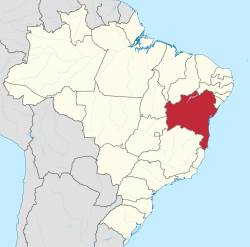
Bahia State
wikipedia
Full article: Scientific American
.
New Type of More Problematic Mosquito-Borne Illness Detected in Brazil
A second form of the painful chikungunya virus has appeared in Brazil—one that could more easily spread, including to the U.S.
November 4, 2014
When a mosquito-borne disease first arrived in the Western Hemisphere last year, humans were relatively lucky. The disease, which causes crippling joint pain persisting for weeks or even months and for which there is no known therapy or vaccine, hopscotched from the Caribbean islands to eventually land in the U.S. and the rest of the Americas. But the type of chikungunya creeping across the region then was one that could only readily spread via Aedes aegypti, a mosquito that is uncommon in the U.S.
Americans were particularly fortunate that the other predominate strain of chikungunya—one that derives from Africa and has fueled significant outbreaks in Asian countries for the past decade—was not seen in this hemisphere. The African strain has been accumulating mutations that allow it to be spread more easily by Aedes albopictus. That bug is common in the eastern U.S. and can survive colder temperatures. It also lays it eggs in a wider variety of settings, making it more difficult to exterminate.
Yet new findings from Brazil suggest that risk to the Americas could be on the rise. Pedro Vasconcelos, director of the Evandro Chagas Institute, Brazil’s confirmatory laboratory, warns that in one of the country’s 26 states it has detected the more problematic African strain of chikungunya. That form of chikungunya is the second to arrive in Brazil, joining the Asian-derived strain carried by A. Aegypti that is already circulating throughout the Western Hemisphere, he told Scientific American.
The majority of Brazil’s cases, Vasconcelos says, are in Bahia state along the eastern coast, the same place where the African strain is appearing, so officials think that form of chikungunya is the most common in Brazil.
Bahia State
wikipedia
Full article: Scientific American
.