

Michael Coston
Editor, Senior Moderator
Australia: Victoria Reports A New Outbreak of HPAI (H7N8)

Outbreaks of H7 avian flu in 2024
#18,608
While Australia/NZ/Oceania remain free from the HPAI H5N1 virus, last year Australia's poultry industry was rocked by repeated outbreaks from 3 different subtypes of H7 avian flu (see map above). Just over 2 months ago, New Zealand reported their first outbreak (of H7N6).
LPAI (low path) viruses circulate worldwide. Most are considered innocuous to poultry and to humans, but when an H5 or H7 LPAI virus spills over from wild birds into poultry they can sometimes spontaneously mutate into an HPAI strain.

After a long struggle, 5 days ago Australia's poultry industry declared themselves free of the H7 virus (see statement below):
Current situation
On 3 February 2025, Australia self-declared freedom from high pathogenicity avian influenza (HPAI) H7 to the World Organisation for Animal Health, effective 23 January 2025.
HPAI H7 has been eradicated from Victoria, NSW and the ACT and there have been no new detections of HPAI H7 in Australia since 12 July 2024.
In 2024, a response to three strains of HPAI H7 took place. There were 16 infected premises including 8 in Victoria, 6 in NSW and 2 in the ACT.
But, as we've seen so many times in the past, such declarations are often fleeting. LPAI and HPAI viruses abound in nature, and new subtypes (and genotypes within subtypes) are emerging all of the time.
Today Victoria is reporting a fresh outbreak - this time of HPAI H7N8 - which is different from the two strains they reported in 2024. First their statement, after which I'll have more on H7 viruses.
Current situation
Last updated 8 February 2025
Agriculture Victoria has confirmed the presence of avian influenza at a poultry property in northern Victoria, which has now been placed into quarantine.
Diagnostic testing performed by Australian Centre for Disease Preparedness at Geelong confirmed high pathogenicity H7N8, which is different to the strain that impacted Victorian poultry farms during 2024. Although the 2024 New South Wales/Australian Capital Territory outbreak was also an H7N8 virus, the current laboratory has advised that the current Victorian outbreak is a different virus.
The property has been placed under quarantine and a declared area is in place in the eastern two-thirds of the Strathbogie Shire to prevent movements that could spread the virus. Any suspicion of an emergency animal disease (EAD) should be immediately reported to the 24-hour EAD Hotline on 1800 675 888 or to your local vet.
Consumers should not be concerned about eggs and poultry products from the supermarkets, they do not pose a risk and are safe to consume.
While cases among humans in direct contact with animals infected with high pathogenicity avian influenza viruses are possible, the current risk to the public remains low. Find out more about avian influenza in humans from the BetterHealth Channel.
In 2024 Victoria experienced Australia’s largest avian influenza outbreak on record.
Between 22 May and 24 June, 8 properties tested positive for high-pathogenicity H7N3 and H7N9 avian influenza in south-west Victoria.
HPAI H7 viruses remain primarily a concern for poultry producers, with human infections up until 2013 being both rare and generally mild. But in 2013 an LPAI H7N9 virus emerged in China in 2013 which showed us that - with the right set of mutations - an H7 virus can become a formidable public health threat.
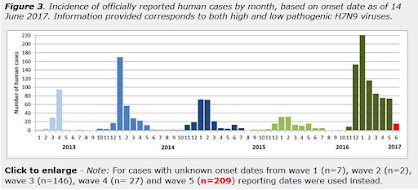
H7N9 Epidemic Waves - June 14th 2017 - Credit FAO
Luckily, that deadly strain has gone to ground since China's introductions of an H5+H7 vaccine in 2017 - and while versions of it still circulate in birds - it appears to have lost much of its affinity for mammals (see EID Journal: Evolution and Antigenic Drift of Influenza A (H7N9) Viruses, China, 2017–2019).
For now, the H7 viruses popping up in Australia show no signs of posing any kind of serious public health threat.
But, as with all influenza viruses with zoonotic potential, things can change over time. Which is why these outbreaks must be quickly contained, before something worse can happen.
https://afludiary.blogspot.com/2025/02/australia-victoria-reports-new-outbreak.html
Outbreaks of H7 avian flu in 2024
#18,608
While Australia/NZ/Oceania remain free from the HPAI H5N1 virus, last year Australia's poultry industry was rocked by repeated outbreaks from 3 different subtypes of H7 avian flu (see map above). Just over 2 months ago, New Zealand reported their first outbreak (of H7N6).
LPAI (low path) viruses circulate worldwide. Most are considered innocuous to poultry and to humans, but when an H5 or H7 LPAI virus spills over from wild birds into poultry they can sometimes spontaneously mutate into an HPAI strain.
After a long struggle, 5 days ago Australia's poultry industry declared themselves free of the H7 virus (see statement below):
Current situation
On 3 February 2025, Australia self-declared freedom from high pathogenicity avian influenza (HPAI) H7 to the World Organisation for Animal Health, effective 23 January 2025.
HPAI H7 has been eradicated from Victoria, NSW and the ACT and there have been no new detections of HPAI H7 in Australia since 12 July 2024.
In 2024, a response to three strains of HPAI H7 took place. There were 16 infected premises including 8 in Victoria, 6 in NSW and 2 in the ACT.
But, as we've seen so many times in the past, such declarations are often fleeting. LPAI and HPAI viruses abound in nature, and new subtypes (and genotypes within subtypes) are emerging all of the time.
Today Victoria is reporting a fresh outbreak - this time of HPAI H7N8 - which is different from the two strains they reported in 2024. First their statement, after which I'll have more on H7 viruses.
Current situation
Last updated 8 February 2025
Agriculture Victoria has confirmed the presence of avian influenza at a poultry property in northern Victoria, which has now been placed into quarantine.
Diagnostic testing performed by Australian Centre for Disease Preparedness at Geelong confirmed high pathogenicity H7N8, which is different to the strain that impacted Victorian poultry farms during 2024. Although the 2024 New South Wales/Australian Capital Territory outbreak was also an H7N8 virus, the current laboratory has advised that the current Victorian outbreak is a different virus.
The property has been placed under quarantine and a declared area is in place in the eastern two-thirds of the Strathbogie Shire to prevent movements that could spread the virus. Any suspicion of an emergency animal disease (EAD) should be immediately reported to the 24-hour EAD Hotline on 1800 675 888 or to your local vet.
Consumers should not be concerned about eggs and poultry products from the supermarkets, they do not pose a risk and are safe to consume.
While cases among humans in direct contact with animals infected with high pathogenicity avian influenza viruses are possible, the current risk to the public remains low. Find out more about avian influenza in humans from the BetterHealth Channel.
In 2024 Victoria experienced Australia’s largest avian influenza outbreak on record.
Between 22 May and 24 June, 8 properties tested positive for high-pathogenicity H7N3 and H7N9 avian influenza in south-west Victoria.
HPAI H7 viruses remain primarily a concern for poultry producers, with human infections up until 2013 being both rare and generally mild. But in 2013 an LPAI H7N9 virus emerged in China in 2013 which showed us that - with the right set of mutations - an H7 virus can become a formidable public health threat.
H7N9 Epidemic Waves - June 14th 2017 - Credit FAO
Luckily, that deadly strain has gone to ground since China's introductions of an H5+H7 vaccine in 2017 - and while versions of it still circulate in birds - it appears to have lost much of its affinity for mammals (see EID Journal: Evolution and Antigenic Drift of Influenza A (H7N9) Viruses, China, 2017–2019).
For now, the H7 viruses popping up in Australia show no signs of posing any kind of serious public health threat.
But, as with all influenza viruses with zoonotic potential, things can change over time. Which is why these outbreaks must be quickly contained, before something worse can happen.
https://afludiary.blogspot.com/2025/02/australia-victoria-reports-new-outbreak.html
Last edited:

