
• FluTrackers.com Inc. does not provide medical advice. Information on this web site is collected from various internet resources, and the FluTrackers board of directors makes no warranty to the safety, efficacy, correctness or completeness of the information posted on this site by any author or poster. The information collated here is for instructional and/or discussion purposes only and is NOT intended to diagnose or treat any disease, illness, or other medical condition. Every individual reader or poster should seek advice from their personal physician/healthcare practitioner before considering or using any interventions that are discussed on this website. By continuing to access this website you agree to consult your personal physican before using any interventions posted on this website, and you agree to hold harmless FluTrackers.com Inc., the board of directors, the members, and all authors and posters for any effects from use of any medication, supplement, vitamin or other substance, device, intervention, etc. mentioned in posts on this website, or other internet venues referenced in posts on this website.
  • We are not asking for any donations. Do not donate to any entity who says they are raising funds for us.

Ash Dieback taking on political implications in Britain

jflorida

Well-known member
(didnt see a thread for this and was following it)

Ash Dieback in Britain has moved to the forefront of environmental discussion there. The fungus Chalara fraxinea is the cause and it started showing up in Europe in the mid 90s after being initially observed in a mass die-back in Poland around '92. The going theory is that it originated in Asia as trees there are immune to the disease. This year it made a huge initial appearance in Britain showing up on nursery stock and then also being found established in forests in the East Anglia region.

It has the potential to become a environmental nightmare for English Forests as the disease has a history of losses between 60 and 90 per cent as seen in ash trees in Denmark.
 
Re: Ash Dieback taking on political implications in Britain

Ash dieback on 80 sites an ?epidemic? as nurseries threaten to sue for ?10m [ http://www.telegraph.co.uk/earth/ea...mic-as-nurseries-threaten-to-sue-for-10m.html ]


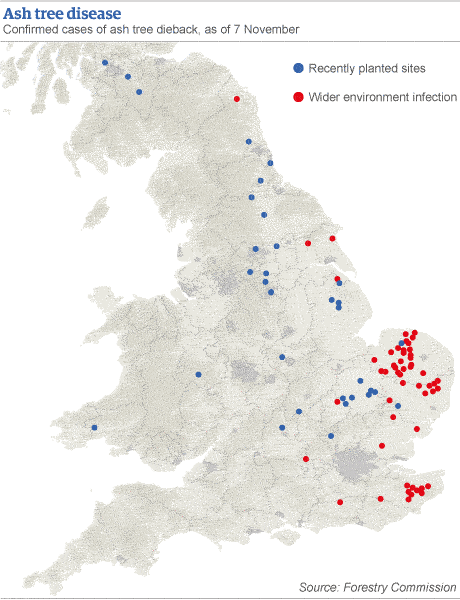
The Department for the Environment Food and Rural Affairs (Defra) confirmed the disease is now in 14 nurseries and 36 sites where saplings were recently planted, meaning hundreds of thousands of trees will have to be destroyed.

Most seriously, the disease has been found in 32 woodland sites in Suffolk, Norfolk, Essex and Kent. On some sites thousands of trees were found with signs of infections, such as black spots on leaves and cankers on stems.

This figure is up from just 12 confirmed sites on Friday and is likely to rise over the next few days, as hundreds of inspectors check trees around the country.
 
Re: Ash Dieback taking on political implications in Britain


Ash dieback: number of affected counties doubles [ http://www.guardian.co.uk/environment/2012/nov/07/ash-dieback-counties-doubles ]

"The discovery of the disease in these counties does not mean the disease is spreading rapidly. It is likely that the disease has been present in these areas for a number of years, originally caused by spores blown in from mainland Europe.

Ward added: "If we had carried out the kind of research we would like to have done when the disease turned up in Europe it's possible we could've come up with a solution. But that's easy to say in hindsight."

The disease is also known to have come in via imports, with the first cases in the UK found in February at a Buckinghamshire nursery which had imported 2,000 ash trees from the Netherlands. An import ban was imposed on 29 October.
 
Re: Ash Dieback taking on political implications in Britain

UK Forestry Commission [ http://www.forestry.gov.uk/chalara ]:

The disease has now been confirmed in 115 sites: in 15 nurseries, 39 planting sites and 61 locations in the wider environment (forests and woodlands).

surveyed over 92 percent of England and all of Scotland and Wales so far ?a tremendous achievement, especially in such a short time, which shows our combined determination to deal with Chalara.?

A map showing all locations with confirmed cases of Chalara is available at www.forestry.gov.uk/chalara.
 
Back
Top