

sharon sanders
Editor-in-Chief & President
hat tip Michael Coston
CDC West Nile Update
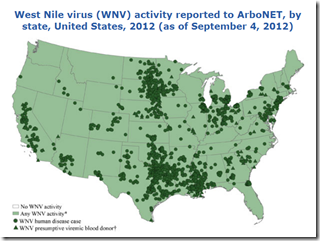
Credit DVBID
# 6539
I was away from my desk yesterday for the CDC’s teleconference update on West Nile activity across the nation, but Lisa Schnirring for CIDRAP News has an excellent overview.
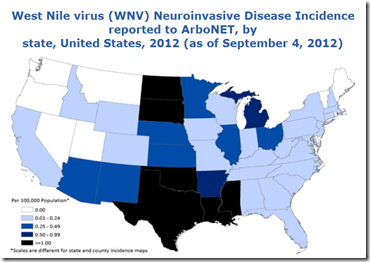
Texas, which has been particularly hard hit this year, has now reported 40 deaths, and a record 495 neuroinvasive cases this year.
Neuroinvasive cases (which present with meningitis, encephalitis, or flaccid Paralysis) are severe enough that they result in hospitalization and diagnosis, and so they are considered a better indicator of the scope of each year’s epidemic.
Credit DVBID
Vector-borne illnesses like West Nile Virus, EEE (Eastern Equine Encephalitis), Dengue, Lyme Disease, Babesia, Powassan Virus, and even the newly reported Heartland Virus (see also Maryn McKenna’s report) are becoming increasingly common across the United States.
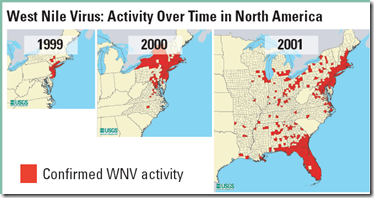
From the USGS Factsheet on West Nile Virus
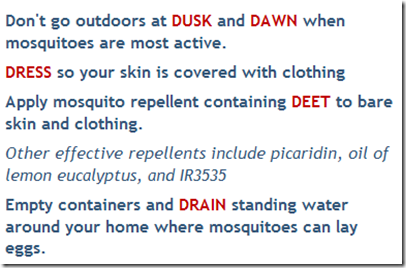
Prevention is the key.
West Nile Virus is now endemic across most of the United States and the prudent move is to take the recommended precautions against mosquito bites.
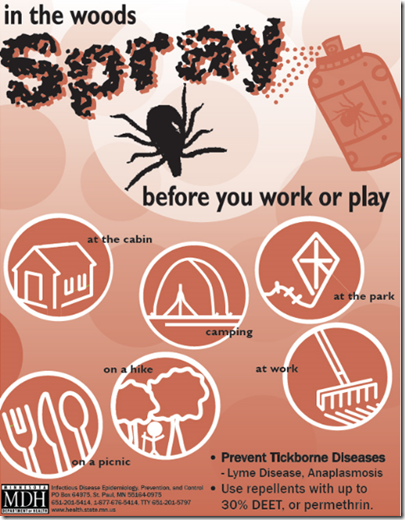
And ticks, which can also easily transmit diseases, require preventative measures as well.
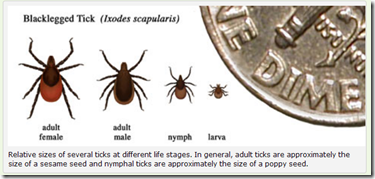
(Credit CDC)
Posted by Michael Coston at 2012-09-06
CDC West Nile Update
Credit DVBID
# 6539
I was away from my desk yesterday for the CDC’s teleconference update on West Nile activity across the nation, but Lisa Schnirring for CIDRAP News has an excellent overview.
West Nile virus cases continue record pace
Lisa Schnirring
 Staff Writer
Sep 5, 2012 (CIDRAP News) – The number of West Nile virus cases in the United States this year has jumped by about 25% in the past week, and though new reports are still coming in at a record pace, Texas—the hardest hit state—is seeing some promising signs that interventions such as aerial spraying are working.
(Continue . . .)
The transcript of this teleconference and an audio file is now available on the CDC Newsroom webpage.Lisa Schnirring
Sep 5, 2012 (CIDRAP News) – The number of West Nile virus cases in the United States this year has jumped by about 25% in the past week, and though new reports are still coming in at a record pace, Texas—the hardest hit state—is seeing some promising signs that interventions such as aerial spraying are working.
(Continue . . .)
Texas, which has been particularly hard hit this year, has now reported 40 deaths, and a record 495 neuroinvasive cases this year.
Neuroinvasive cases (which present with meningitis, encephalitis, or flaccid Paralysis) are severe enough that they result in hospitalization and diagnosis, and so they are considered a better indicator of the scope of each year’s epidemic.
Mild cases – called West Nile Fever – often go undiagnosed, with probably only 2%-3% being identified.
As you can see from the chart below, while 44 states have reported human infections with the West Nile Virus this year, it is the middle of the country that is being hardest hit by neuroinvasive WNV.
Credit DVBID
Vector-borne illnesses like West Nile Virus, EEE (Eastern Equine Encephalitis), Dengue, Lyme Disease, Babesia, Powassan Virus, and even the newly reported Heartland Virus (see also Maryn McKenna’s report) are becoming increasingly common across the United States.
Many scientists believe that as climate change occurs, we will see more of these mosquito, flea, tick, and biting fly transmitted diseases here, and in the European Union.
To give you an idea how quickly a new, vector-borne disease like West Nile can spread, the WNV only arrived in the United States twelve years ago and in a few short few years had invaded all 48 contiguous states.
From the USGS Factsheet on West Nile Virus
Prevention is the key.
West Nile Virus is now endemic across most of the United States and the prudent move is to take the recommended precautions against mosquito bites.
And ticks, which can also easily transmit diseases, require preventative measures as well.
(Credit CDC)
Posted by Michael Coston at 2012-09-06