

sharon sanders
Editor-in-Chief & President
NEJM: Pediatric H1N1 Hospitalizations & Deaths In Argentina
# 4191
The next time someone tries to tell you how mild, how insignificant, and how overhyped by health officials the pandemic of 2009 has been ? refer them to this study which appears in the NEJM (New England Journal of Medicine) which analyses the rate of hospitalization and death among pediatric H1N1 patients in Argentina over their recent flu season.
While novel H1N1 has not proven to be a huge killer of elderly adults, its impact on younger age groups has been substantially greater than normally seen with seasonal influenza.
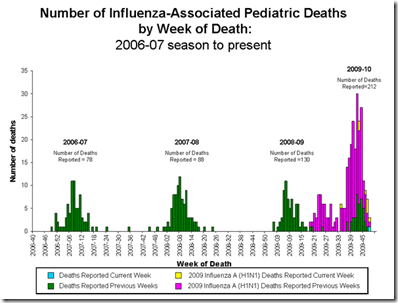
The CDC?s tracking of pediatric deaths in the US for the year 2009 shows a huge increase in pediatric mortality. The actual number of pediatric deaths has been estimated to exceed 1,000 this year.

These numbers are estimated as of mid-November, and are no doubt quite a bit higher today.
So it is of little surprise that an analysis of pediatric cases from Argentina would show double the normal (seasonal flu-related) pediatric hospitalizations and a 10 fold increase in pediatric deaths.
# 4191
The next time someone tries to tell you how mild, how insignificant, and how overhyped by health officials the pandemic of 2009 has been ? refer them to this study which appears in the NEJM (New England Journal of Medicine) which analyses the rate of hospitalization and death among pediatric H1N1 patients in Argentina over their recent flu season.
While novel H1N1 has not proven to be a huge killer of elderly adults, its impact on younger age groups has been substantially greater than normally seen with seasonal influenza.

The CDC?s tracking of pediatric deaths in the US for the year 2009 shows a huge increase in pediatric mortality. The actual number of pediatric deaths has been estimated to exceed 1,000 this year.
These numbers are estimated as of mid-November, and are no doubt quite a bit higher today.
So it is of little surprise that an analysis of pediatric cases from Argentina would show double the normal (seasonal flu-related) pediatric hospitalizations and a 10 fold increase in pediatric deaths.
Pediatric Hospitalizations Associated with 2009 Pandemic Influenza A (H1N1) in Argentina
Romina Libster, M.D., et al.
ABSTRACT
Background While the Northern Hemisphere experiences the effects of the 2009 pandemic influenza A (H1N1) virus, data from the recent influenza season in the Southern Hemisphere can provide important information on the burden of disease in children.
Methods We conducted a retrospective case series involving children with acute infection of the lower respiratory tract or fever in whom 2009 H1N1 influenza was diagnosed on reverse-transcriptase polymerase-chain-reaction assay and who were admitted to one of six pediatric hospitals serving a catchment area of 1.2 million children. We compared rates of admission and death with those among age-matched children who had been infected with seasonal influenza strains in previous years.
Results Between May and July 2009, a total of 251 children were hospitalized with 2009 H1N1 influenza. Rates of hospitalization were double those for seasonal influenza in 2008. Of the children who were hospitalized, 47 (19%) were admitted to an intensive care unit, 42 (17%) required mechanical ventilation, and 13 (5%) died. The overall rate of death was 1.1 per 100,000 children, as compared with 0.1 per 100,000 children for seasonal influenza in 2007. (No pediatric deaths associated with seasonal influenza were reported in 2008.) Most deaths were caused by refractory hypoxemia in infants under 1 year of age (death rate, 7.6 per 100,000).
Conclusions Pandemic 2009 H1N1 influenza was associated with pediatric death rates that were 10 times the rates for seasonal influenza in previous years.
Romina Libster, M.D., et al.
ABSTRACT
Background While the Northern Hemisphere experiences the effects of the 2009 pandemic influenza A (H1N1) virus, data from the recent influenza season in the Southern Hemisphere can provide important information on the burden of disease in children.
Methods We conducted a retrospective case series involving children with acute infection of the lower respiratory tract or fever in whom 2009 H1N1 influenza was diagnosed on reverse-transcriptase polymerase-chain-reaction assay and who were admitted to one of six pediatric hospitals serving a catchment area of 1.2 million children. We compared rates of admission and death with those among age-matched children who had been infected with seasonal influenza strains in previous years.
Results Between May and July 2009, a total of 251 children were hospitalized with 2009 H1N1 influenza. Rates of hospitalization were double those for seasonal influenza in 2008. Of the children who were hospitalized, 47 (19%) were admitted to an intensive care unit, 42 (17%) required mechanical ventilation, and 13 (5%) died. The overall rate of death was 1.1 per 100,000 children, as compared with 0.1 per 100,000 children for seasonal influenza in 2007. (No pediatric deaths associated with seasonal influenza were reported in 2008.) Most deaths were caused by refractory hypoxemia in infants under 1 year of age (death rate, 7.6 per 100,000).
Conclusions Pandemic 2009 H1N1 influenza was associated with pediatric death rates that were 10 times the rates for seasonal influenza in previous years.