

sharon sanders
Editor-in-Chief & President
Lancet: Pediatric Mortality Related To Pandemic H1N1
# 5014
Although its impact has almost been universally under-appreciated by the media and general public ? we continue to see compelling evidence that the pandemic of 2009 was unusual in presentation, stressed many health care systems, and caused significant mortality and morbidity around the world.
It is true that in terms of absolute mortality -the pandemic of 2009 was less severe than many other flu outbreaks. But the World Health Organization is also quick to admit that the `official numbers? of deaths around the world were badly undercounted.
We will probably never know (with any confidence) the full impact of the pandemic.
Of course, much depends upon how you choose to measure a pandemic?s severity.
For example.
With seasonal influenza, it is the elderly and frail that make up 90% of the deaths each year. The average age of death from seasonal flu in the US has been estimated to be 76.
Compare that to the mean age of death from the novel H1N1 virus, which has been calculated to be half that of seasonal flu, or 37.4 years (see Study: Years Of Life Lost Due To 2009 Pandemic)
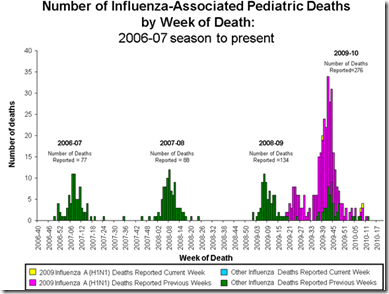
Another indicator of how the pandemic of 2009 differed from seasonal flu comes from this stark graphic showing a four-fold increase in pediatric deaths from influenza associated illness during the pandemic.
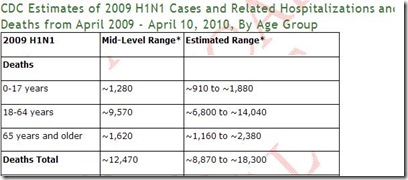
As bad as these numbers are, the CDC actually estimatesthat only about 25% of pediatric influenza deaths were identified ? and put the `real? number at closer to 1300.
All of which brings us to a new study which appears in the The Lancet, that finds a significant increase in pediatric mortality from influenza-related causes in the UK during the pandemic of 2009.
First a link to this news report from the The Telegraph, then some excerpts from the Lancet Abstract.
Here are some excerpts from the Abstract.
While the novel H1N1 virus of 2009 produced essentially a low-mortality-high morbidity event for most of the population, studies continue to show that this flu pandemic differed from an ordinary flu season in a variety of ways.
For more on how this flu was different from seasonal flu, you might wish to revisit There?s No Flu Like A New Flu.
# 5014
Although its impact has almost been universally under-appreciated by the media and general public ? we continue to see compelling evidence that the pandemic of 2009 was unusual in presentation, stressed many health care systems, and caused significant mortality and morbidity around the world.
It is true that in terms of absolute mortality -the pandemic of 2009 was less severe than many other flu outbreaks. But the World Health Organization is also quick to admit that the `official numbers? of deaths around the world were badly undercounted.
We will probably never know (with any confidence) the full impact of the pandemic.
For example.
With seasonal influenza, it is the elderly and frail that make up 90% of the deaths each year. The average age of death from seasonal flu in the US has been estimated to be 76.
Compare that to the mean age of death from the novel H1N1 virus, which has been calculated to be half that of seasonal flu, or 37.4 years (see Study: Years Of Life Lost Due To 2009 Pandemic)
So in terms of years of life lost (YLL), the average 2009 pandemic flu death had a many-fold greater impact than the average seasonal flu fatality.
Another indicator of how the pandemic of 2009 differed from seasonal flu comes from this stark graphic showing a four-fold increase in pediatric deaths from influenza associated illness during the pandemic.
As bad as these numbers are, the CDC actually estimatesthat only about 25% of pediatric influenza deaths were identified ? and put the `real? number at closer to 1300.
All of which brings us to a new study which appears in the The Lancet, that finds a significant increase in pediatric mortality from influenza-related causes in the UK during the pandemic of 2009.
First a link to this news report from the The Telegraph, then some excerpts from the Lancet Abstract.
Swine flu killed three times more children than ordinary influenza: research
Three times as many children died from swine flu than from seasonal flu with the younger ones hit the hardest, research has shown.
Three times as many children died from swine flu than from seasonal flu with the younger ones hit the hardest, research has shown.
Here are some excerpts from the Abstract.
The Lancet, Early Online Publication, 27 October 2010
doi:10.1016/S0140-6736(10)61195-6
Paediatric mortality related to pandemic influenza A H1N1 infection in England: an observational population-based study
Nabihah Sachedina MBBS , Prof Liam J Donaldson MD
Summary
Background
Young people (aged 0?18 years) have been disproportionately affected by pandemic influenza A H1N1 infection. We aimed to analyse paediatric mortality to inform clinical and public health policies for future influenza seasons and pandemics.
<SNIP>
Findings
70 paediatric deaths related to pandemic influenza A H1N1 were reported. Childhood mortality rate was 6 per million population.
The rate was highest for children aged less than 1 year. Mortality rates were higher for Bangladeshi children (47 deaths per million population [95% CI 17?103]) and Pakistani children (36 deaths per million population [18?64]) than for white British children (4 deaths per million [3?6]). 15 (21%) children who died were previously healthy; 45 (64%) had severe pre-existing disorders.
The highest age-standardised mortality rate for a pre-existing disorder was for chronic neurological disease (1536 per million population). 19 (27%) deaths occurred before inpatient admission. Children in this subgroup were significantly more likely to have been healthy or had only mild pre-existing disorders than those who died after admission (p=0?0109). Overall, 45 (64%) children had received oseltamivir: seven within 48 h of symptom onset.
doi:10.1016/S0140-6736(10)61195-6
Paediatric mortality related to pandemic influenza A H1N1 infection in England: an observational population-based study
Nabihah Sachedina MBBS , Prof Liam J Donaldson MD
Summary
Background
Young people (aged 0?18 years) have been disproportionately affected by pandemic influenza A H1N1 infection. We aimed to analyse paediatric mortality to inform clinical and public health policies for future influenza seasons and pandemics.
<SNIP>
Findings
70 paediatric deaths related to pandemic influenza A H1N1 were reported. Childhood mortality rate was 6 per million population.
The rate was highest for children aged less than 1 year. Mortality rates were higher for Bangladeshi children (47 deaths per million population [95% CI 17?103]) and Pakistani children (36 deaths per million population [18?64]) than for white British children (4 deaths per million [3?6]). 15 (21%) children who died were previously healthy; 45 (64%) had severe pre-existing disorders.
The highest age-standardised mortality rate for a pre-existing disorder was for chronic neurological disease (1536 per million population). 19 (27%) deaths occurred before inpatient admission. Children in this subgroup were significantly more likely to have been healthy or had only mild pre-existing disorders than those who died after admission (p=0?0109). Overall, 45 (64%) children had received oseltamivir: seven within 48 h of symptom onset.
While the novel H1N1 virus of 2009 produced essentially a low-mortality-high morbidity event for most of the population, studies continue to show that this flu pandemic differed from an ordinary flu season in a variety of ways.
Considering the years of life lost (YLL), the impact on health care, and increased pediatric mortality - while never reaching the disaster status that some in the media originally hyped - I find it difficult to go along with the popular notion that the pandemic of 2009 was a non-event.
For more on how this flu was different from seasonal flu, you might wish to revisit There?s No Flu Like A New Flu.