

sharon sanders
Editor-in-Chief & President
CDC Updates Their H1N1 Fatality Estimates
# 4146
Attempts to count individual deaths from the H1N1 virus in the US ceased during the summer when it was determined that it was not longer possible to keep any kind of accurate tally.
In November the CDC released their estimates of the pandemic?s impact here in the US up until mid-October. At that time, they estimated 22,000,000 people had been infected and roughly 4,000 had died.
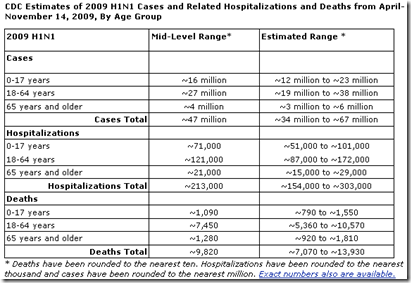
Today, the CDC has updated those numbers through November 14th, and they show a significant increase over the previous numbers. A mid-range estimate of 47 million infections and nearly 10,000 deaths.
You can find previous discussions on the reasons why the official counts under represent the true number of cases, hospitalizations, and deaths in the following blog entries:
Medical Examiner: H1N1 Deaths Understated
When No Number Is Right
Dead Reckoning
Numbers Don?t Tell The Whole Story
A Decided Lack Of Data
Measuring The Severity Of A Pandemic
# 4146
Attempts to count individual deaths from the H1N1 virus in the US ceased during the summer when it was determined that it was not longer possible to keep any kind of accurate tally.
That was expected since, even during a regular flu season, we don?t count individual flu deaths. The oft repeated number of 36,000 flu-related deaths annually is an estimate.
In November the CDC released their estimates of the pandemic?s impact here in the US up until mid-October. At that time, they estimated 22,000,000 people had been infected and roughly 4,000 had died.
Today, the CDC has updated those numbers through November 14th, and they show a significant increase over the previous numbers. A mid-range estimate of 47 million infections and nearly 10,000 deaths.
The Numbers
On November 12, 2009 CDC provided the first set of estimates on the numbers of 2009 H1N1 cases and related hospitalizations and deaths in the United States between April and October 17, 2009.
Estimates from April ? October 17, 2009:
Using the same methodology CDC has updated the estimates to include the time period from April through November 14, 2009.
You can read more about the methods used to come up with these numbers on the CDC?s website HERE. On November 12, 2009 CDC provided the first set of estimates on the numbers of 2009 H1N1 cases and related hospitalizations and deaths in the United States between April and October 17, 2009.
Estimates from April ? October 17, 2009:
- CDC estimated that between 14 million and 34 million cases of 2009 H1N1 occurred between April and October 17, 2009. The mid-level in this range was about 22 million people infected with 2009 H1N1.
- CDC estimated that between about 63,000 and 153,000 2009 H1N1-related hospitalizations occurred between April and October 17, 2009. The mid-level in this range was about 98,000 H1N1-related hospitalizations.
- CDC estimated that between about 2,500 and 6,000 2009 H1N1-related deaths occurred between April and October 17, 2009. The mid-level in this range was about 3,900 2009 H1N1-related deaths.
Using the same methodology CDC has updated the estimates to include the time period from April through November 14, 2009.
- CDC estimates that between 34 million and 67 million cases of 2009 H1N1 occurred between April and November 14, 2009. The mid-level in this range is about 47 million people infected with 2009 H1N1.
- CDC estimates that between about 154,000 and 303,000 2009 H1N1-related hospitalizations occurred between April and November 14, 2009. The mid-level in this range is about 213,000 H1N1-related hospitalizations.
- CDC estimates that between about 7,070 and 13,930 2009 H1N1-related deaths occurred between April and November 14, 2009. The mid-level in this range is about 9,820 2009 H1N1-related deaths.
You can find previous discussions on the reasons why the official counts under represent the true number of cases, hospitalizations, and deaths in the following blog entries:
Medical Examiner: H1N1 Deaths Understated
When No Number Is Right
Dead Reckoning
Numbers Don?t Tell The Whole Story
A Decided Lack Of Data
Measuring The Severity Of A Pandemic